
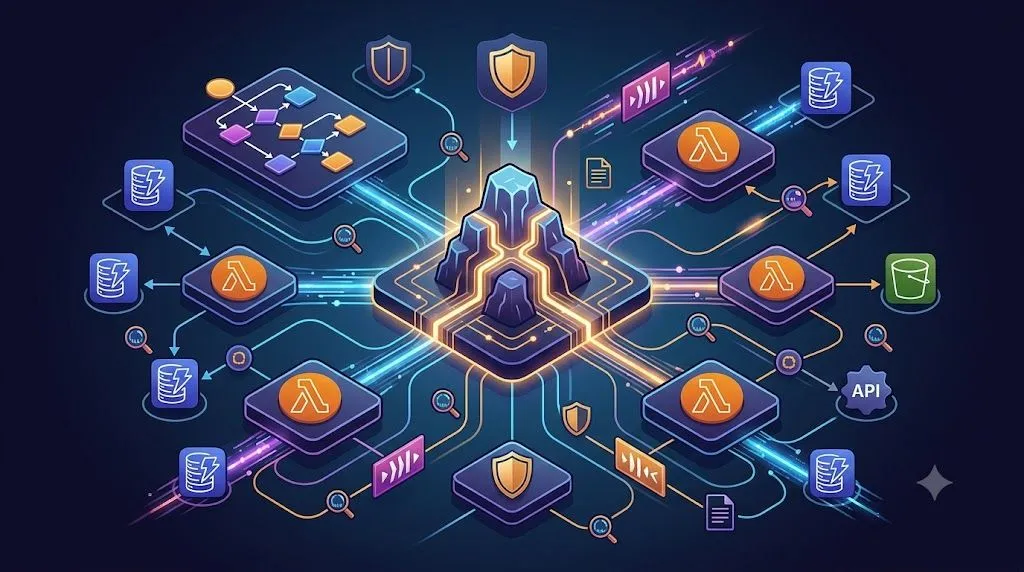
Building Production-Grade Agentic Systems with Amazon Bedrock and Event-Driven Serverless
Explore how to transition AI applications from basic prompt-response models to autonomous, production-ready agentic architectures using Amazon Bedrock, stateful runtimes, and event-driven AWS serverless patterns.

The landscape of generative AI on AWS has shifted dramatically from simple chat interfaces to autonomous, multi-step agentic workflows. Modern enterprise applications demand systems that can evaluate goals, choose the right tools, execute complex tasks asynchronously, and handle errors gracefully—all within strict security boundaries.
Combining Amazon Bedrock Managed Agents with a serverless event fabric provides a repeatable framework for building production-ready AI agents.
1. The Shift to Bounded Autonomy
Traditional LLM integrations rely on immediate, synchronous request-response loops. In contrast, agentic workflows execute multi-step plans that require asynchronous orchestration, retries, and state retention.
When designing autonomous agents on AWS, apply these core guardrails:
- Least-Privilege Identities: Scope tool execution permissions strictly using IAM roles per task.
- Stateful Runtimes: Maintain conversational and transactional context without exposing sensitive data across system boundaries.
- Bounded Limits: Define explicit stop conditions, such as maximum step counts, execution timeout thresholds, and request rate caps.
2. Architecture: Combining Bedrock Agents with Event Bridge & SQS
For production workloads, treat agent executions like asynchronous jobs rather than immediate API calls.
1
2
3
4
5
6
7
8
9
10
11
12
13
[ User Request ]
       │
       ▼
[ Amazon API Gateway ]
       │
       ▼
[ AWS Lambda / Step Functions ] ──► (Triggers Agent Job)
       │
       ▼
[ Amazon Bedrock Managed Agent ]
  ├── Tool Call 1 ──► [ AWS Lambda ] ──► [ Amazon DynamoDB ]
  ├── Tool Call 2 ──► [ Amazon Aurora / S3 ]
  └── Response Stream ──► [ Amazon SQS / WebSocket API ]
Core Components
- Orchestration Layer: Use AWS Step Functions or Amazon SQS to manage the lifecycle of an agent execution (kickoff, state tracking, retries, and dead-letter queues).
- Tool Execution: Connect Bedrock Agents directly to serverless Lambda functions to query databases (such as Amazon Aurora or DynamoDB) or call external APIs securely.
- Stream-First Delivery: Stream partial step results back to users via WebSockets or HTTP streaming to optimize time-to-first-byte (TTFB) and improve user experience during multi-step reasoning.
3. Best Practices for Production Deployment
To keep agentic architectures cost-effective and resilient:
- Apply Bedrock Guardrails Early: Implement PII masking and denied-topic filtering at the API layer before context reaches the execution environment.
- Leverage Prompt Caching: Enable Bedrock prompt caching for repeated context and systemic system prompts to significantly reduce token costs and inference latency.
- Audit Every Tool Call: Log every action, input parameter, and output event through AWS CloudTrail and Amazon CloudWatch to ensure complete traceability.
By pairing Amazon Bedrock's agent capabilities with AWS's serverless foundation, teams can move past pilot projects and deliver secure, scalable, and autonomous AI workloads in production.
Enjoyed reading this content? Let the author know!
Your likes, comments, shares, and saves help creators reach more builders.

Loading recommendations
Loading article