
Weekend Agent Challenge: oops
oops is a tiny CLI tool that pipes your error into Amazon Bedrock Nova Micro and returns a plain-English explanation, the likely cause, and a copy-paste fix — with a warm, blame-free tone.

Weekend Agent Challenge: oops — because error messages shouldn't need a translator
What it does and who it's for
Let me be honest about how oops was born. It was late, I was staring at a sqlite traceback for the twentieth time that week, and I caught myself thinking: why do I have to mentally parse this wall of red text every single time? I know what "no such table" means. But after six hours of debugging, my brain just... doesn't.
So oops is dead simple. You pipe your error into it, and it gives you three things:
What went wrong — in plain English, one sentence, zero jargon
Why it probably happened — the likely cause, no blame attached
The fix — actual code or a command you can copy-paste
Why it probably happened — the likely cause, no blame attached
The fix — actual code or a command you can copy-paste
That's the whole product. No config files, no dashboard, no setup wizard.
npm run build 2>&1 | oops
oops "TypeError: Cannot read properties of undefined (reading 'map')"
cat traceback.txt | oops
oops "TypeError: Cannot read properties of undefined (reading 'map')"
cat traceback.txt | oops
It's for developers like me — people who'd rather spend their energy fixing the bug than decoding the error message first.
How I built it
The whole thing is one Python file, about 120 lines, with a single dependency: boto3. I kept the architecture boring on purpose. I had hours, not days.
Here's how it works, step by step:
Input — argparse grabs your error from stdin, a CLI argument, or a --file flag
Trim — the error is truncated to 6,000 characters so a giant stack trace doesn't blow up the context window
Think — it's sent to Amazon Bedrock (Nova Micro, us-east-1) through the converse API. Bedrock is the entire brain — no local models, no regex heuristics, no keyword matching
Answer — the response lands in under three seconds, shaped by a strict system-prompt contract
Everything interesting lives in that system prompt. It enforces:
"In plain English" — one sentence, zero jargon
"Likely cause" — a sentence or two, no condescension
"The fix" — concrete and copy-pasteable, never vague advice
Under 200 words total, warm tone throughout
"Likely cause" — a sentence or two, no condescension
"The fix" — concrete and copy-pasteable, never vague advice
Under 200 words total, warm tone throughout
Why Nova Micro? Two reasons, both practical:
Cost — it's one of Bedrock's cheapest models, so each explanation costs a fraction of a cent
Speed — the full round-trip lands under three seconds. That mattered to me because if this took ten seconds I'd never build the habit. It had to feel like a reflex: see red, pipe to oops, keep moving
Speed — the full round-trip lands under three seconds. That mattered to me because if this took ten seconds I'd never build the habit. It had to feel like a reflex: see red, pipe to oops, keep moving
Auth is just standard AWS environment variables. If you've already got AWS credentials configured, oops just works — nothing else to set up.
The repo is public at https://github.com/pintu544/oops — MIT licensed, pip install -r requirements.txt and you're running.
The delightful detail
Here's the part I care about most: oops never makes you feel stupid for the error.
I've tried other error explainers. They're correct, but they're cold — they read like documentation that happens to be about your mistake. And when you're frustrated, when you've been stuck for an hour, the last thing you need is a tool that talks down to you.
So the system prompt carries what I think of as a tone contract:
It leads with reassurance disguised as clarity
It doesn't say "you forgot to create the table" — it says "the table doesn't exist yet"
Same information, completely different feeling. One scolds you, the other helps you
It doesn't say "you forgot to create the table" — it says "the table doesn't exist yet"
Same information, completely different feeling. One scolds you, the other helps you
How do I know it worked? I ran it against two real errors:
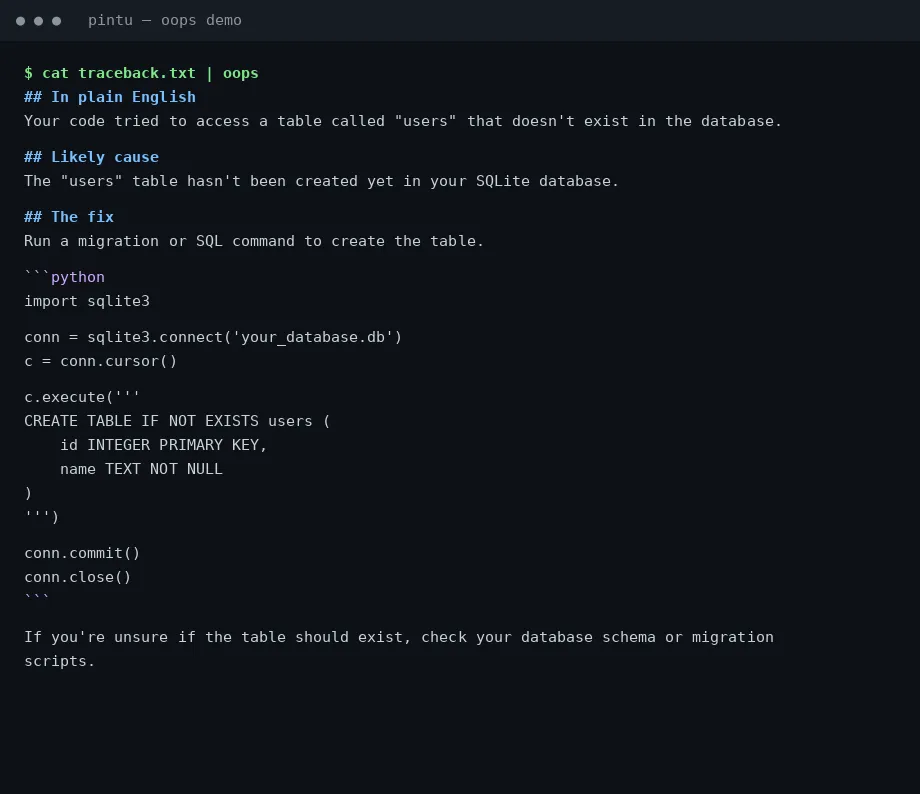
A Python sqlite3.OperationalError — nailed the cause and gave the exact CREATE TABLE fix
A Node EADDRINUSE crash — laid out both options (kill the process, or switch ports) instead of arrogantly choosing for me
A Node EADDRINUSE crash — laid out both options (kill the process, or switch ports) instead of arrogantly choosing for me
Both times it honored the contract: plain-English sentence first, then the cause, then a specific fix with real code.
The moment I knew the tone was right: reading the sqlite output back. "Your code tried to access a table called 'users' that doesn't exist in the database." No blame. No lecture. Just a friend telling you what's up. Honestly, that's the whole product.
Proof it works
Repo: https://github.com/pintu544/oops
And here's a real run — actual sqlite traceback in, friendly explanation out, in seconds:
Clone it, set your AWS credentials, throw any error at it. If it ever talks down to you, open an issue — I'll fix the prompt. That's a promise.
Built for the AWS Builder Center Weekend Challenge (Oct 9–12, 2026). Total build time: about an hour. Cost per explanation: basically nothing.
Enjoyed reading this content? Let the author know!
Your likes, comments, shares, and saves help creators reach more builders.

Loading recommendations
Loading article