
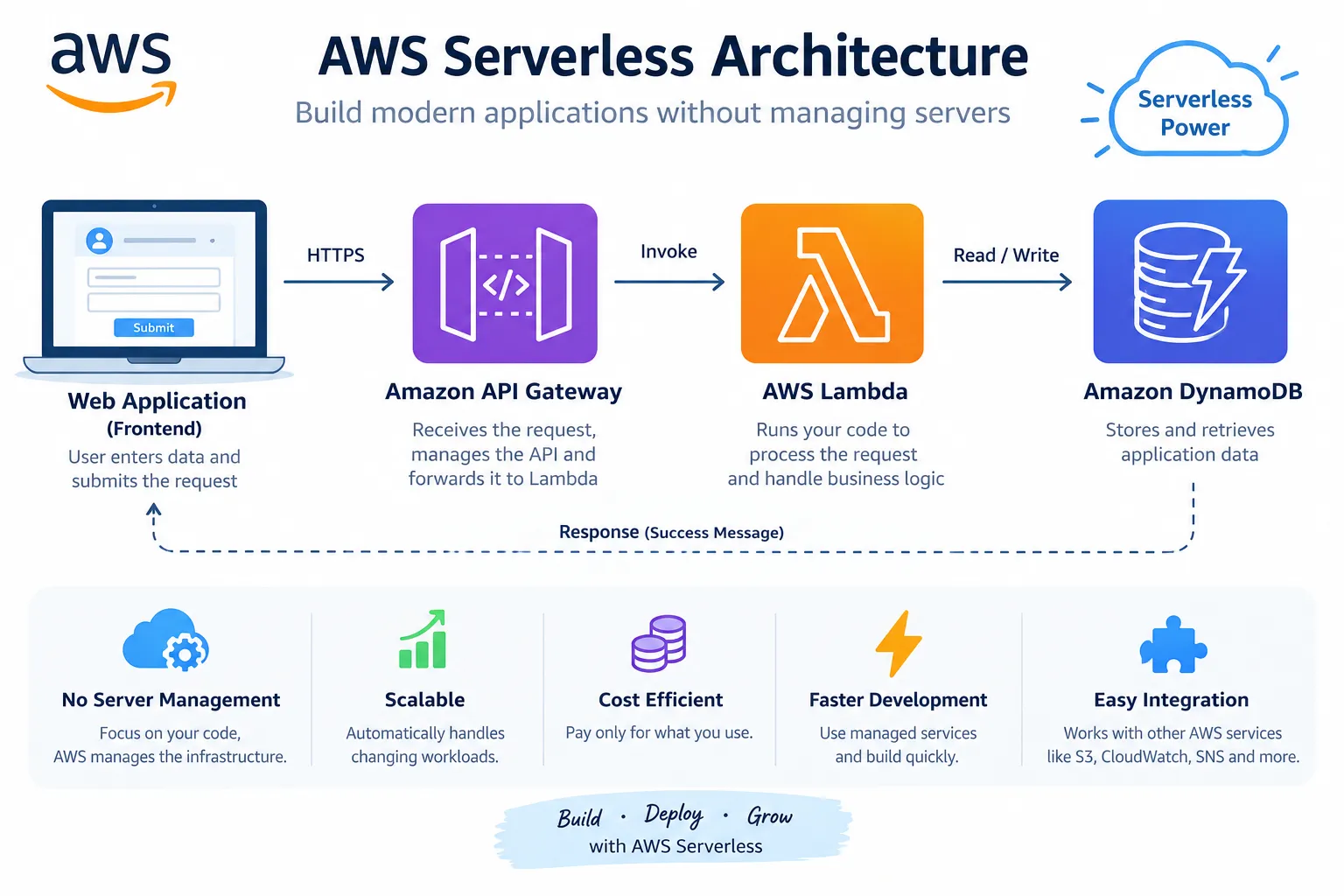
Building Smarter Applications with AWS Serverless Services
Discover how AWS serverless services help developers build scalable, cost-effective, and reliable applications without managing servers. Learn how AWS Lambda, Amazon API Gateway, and Amazon DynamoDB work together to create modern cloud applications with a practical example.

Building Smarter Applications with AWS Serverless Services
Introduction
In today's digital world, developers need to build applications that are fast, scalable, reliable, and cost-effective. Traditional application development often requires managing servers, configuring infrastructure, and handling maintenance.
AWS serverless computing provides another approach. It allows developers to build and run applications without directly managing the underlying servers.
With AWS serverless services, developers can focus more on writing code and solving real-world problems instead of spending time managing infrastructure.
What Is Serverless Computing?
Serverless computing is a cloud computing approach in which the cloud provider manages the underlying infrastructure. Developers can run their code without provisioning or maintaining servers.
Although it is called serverless, servers still exist behind the scenes. AWS manages much of the infrastructure, allowing developers to focus on application development.
Some popular AWS serverless services include:
- AWS Lambda: Runs code in response to events without requiring you to manage servers.
- Amazon API Gateway: Creates and manages APIs that allow applications to communicate with backend services.
- Amazon DynamoDB: Provides a managed NoSQL database for storing and retrieving application data.
- Amazon S3: Stores files, images, documents, and other objects.
- Amazon API Gateway: Creates and manages APIs that allow applications to communicate with backend services.
- Amazon DynamoDB: Provides a managed NoSQL database for storing and retrieving application data.
- Amazon S3: Stores files, images, documents, and other objects.
How Do These Services Work Together?
Let's understand how these services can work together to build a simple application.
Imagine you want to create an online student registration system.
The application needs to collect student details, process registration requests, and store information securely.
Here is a simple workflow:
Step 1: User Interface
A student opens the registration website and enters their name, email address, and course details.
The website can be hosted using Amazon S3 or another suitable hosting service.
Step 2: API Request
When the student submits the form, Amazon API Gateway receives the request and forwards it to the appropriate backend function.
Step 3: Process the Request
AWS Lambda executes code to validate the submitted information and process the registration.
Step 4: Store the Data
Amazon DynamoDB stores the student registration details.
Step 5: Return the Response
The application returns a success message to the student after the registration has been processed.
This architecture can reduce the need to manage servers manually while providing a flexible foundation for the application.
Benefits of AWS Serverless Computing
1. Less Infrastructure Management
AWS manages much of the underlying infrastructure, so developers can spend more time building application features.
2. Scalability
Serverless services can scale to accommodate changing workloads, although developers must still consider service quotas and application design.
3. Cost Efficiency
With services such as AWS Lambda, charges are generally based on requests and execution duration. Other services have their own pricing models, so the total cost depends on the architecture and usage.
4. Faster Development
Developers can combine managed services instead of building and maintaining every infrastructure component themselves.
5. Integration with Other AWS Services
Serverless applications can integrate with databases, storage services, messaging systems, monitoring tools, and other AWS services.
Challenges to Consider
Serverless computing also has some challenges.
- Cold starts: Some functions may experience additional startup latency after periods of inactivity.
- Service limits: Applications must be designed around applicable service quotas and execution limits.
- Monitoring and debugging: Developers need appropriate logging, tracing, and monitoring to troubleshoot distributed applications.
- Vendor dependency: Using provider-specific services can make migration to another cloud platform more complicated.
Understanding these challenges helps developers choose the right architecture for their applications.
Getting Started
If you are new to AWS, you can start with a small project rather than building a complex application immediately.
Follow these steps:
1. Learn the basics of AWS and cloud computing.
2. Explore AWS Lambda and create a simple function.
3. Learn how Amazon API Gateway connects an API to a Lambda function.
4. Store sample application data in Amazon DynamoDB.
5. Add error handling, logging, and security controls.
6. Test the application and review the costs before expanding it.
2. Explore AWS Lambda and create a simple function.
3. Learn how Amazon API Gateway connects an API to a Lambda function.
4. Store sample application data in Amazon DynamoDB.
5. Add error handling, logging, and security controls.
6. Test the application and review the costs before expanding it.
You can explore the official documentation for each service to understand its features and configuration options.
Conclusion
AWS serverless computing offers developers a practical way to build modern applications without managing all the underlying infrastructure.
By combining AWS Lambda, Amazon API Gateway, and Amazon DynamoDB, developers can create applications that process requests, execute business logic, and store data using managed cloud services.
For students and beginners, building a small serverless project is an excellent way to gain hands-on cloud computing experience.
Start small, experiment with AWS services, and gradually build applications that solve real-world problems.
Enjoyed reading this content? Let the author know!
Your likes, comments, shares, and saves help creators reach more builders.

Loading recommendations
Loading article