
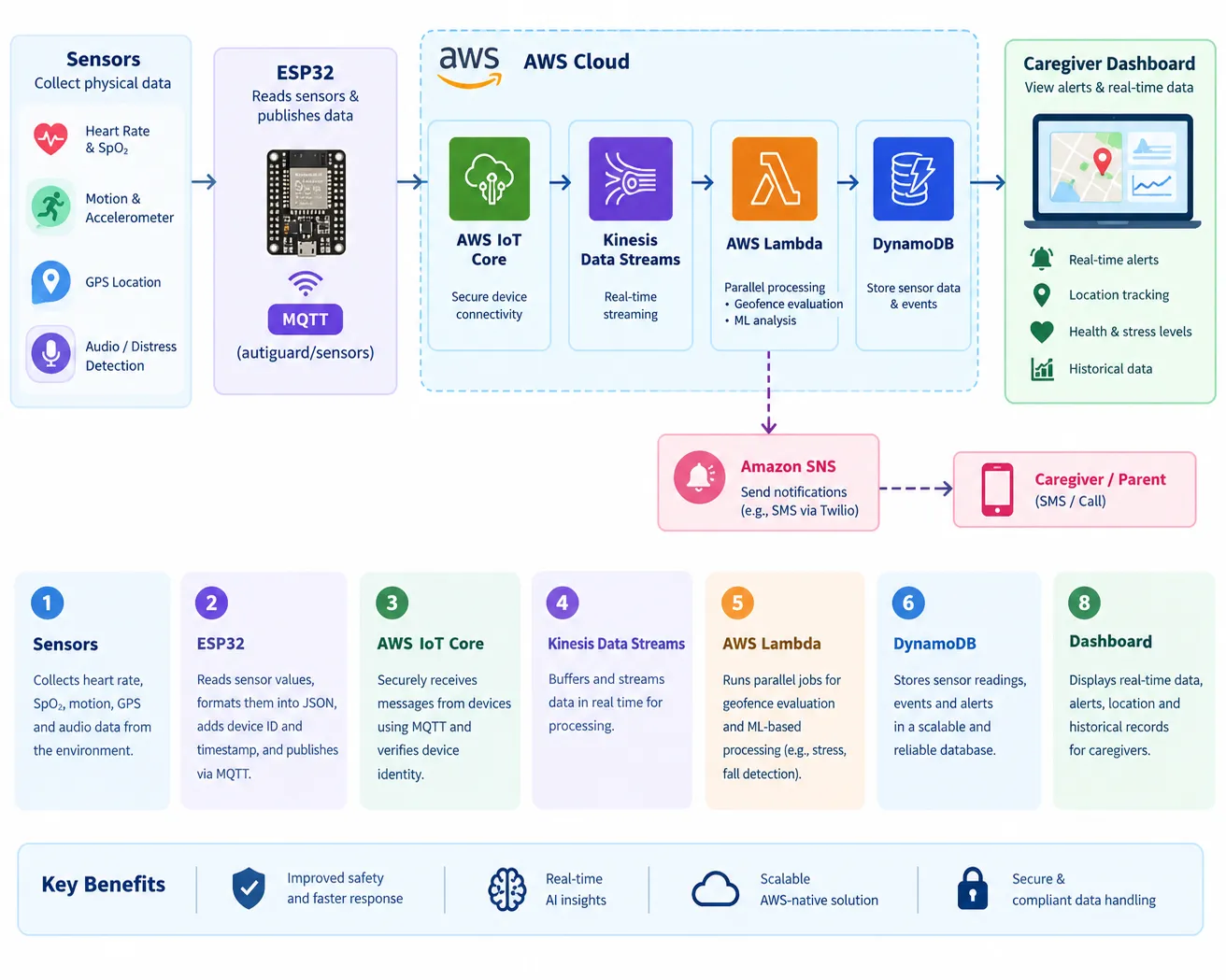
From Sensors to Alerts: Building an IoT Safety Pipeline with AWS
Explore how I designed an IoT data pipeline for AutiGuard using ESP32, MQTT, AWS IoT Core, AWS Lambda, and Amazon DynamoDB, with a focus on security, event processing, and caregiver alerts.

From Sensors to Alerts: Building an IoT Safety Pipeline with AWS
1. Introduction
The Internet of Things (IoT) is transforming the way physical devices collect, communicate, and process information. From smart homes to healthcare assistance systems, connected devices can collect useful data and make it available to applications that help people make informed decisions.
However, collecting sensor data is only the first step. A complete IoT solution must also securely transmit information, process incoming messages, store important records, identify significant events, and deliver relevant notifications.
This challenge inspired me while developing AutiGuard, an IoT-based safety and assistance project designed to support autistic individuals and their caregivers.
The project explores how wearable sensors and cloud computing can work together to support safety monitoring. My goal was to understand how data collected by an embedded device could travel through an AWS cloud pipeline and become meaningful information for an application.
As a student exploring cloud computing and AWS technologies, this project gave me an opportunity to connect hardware, messaging protocols, backend processing, databases, and application development in a single architecture.
In this article, I explain the architecture of the AutiGuard IoT pipeline, the responsibilities of its AWS services, the data flow, security considerations, implementation challenges, and the lessons I learned during development.
2. Understanding the Problem
A sensor-based application can generate information continuously. For example, a wearable device may collect movement readings, physiological measurements, or signals associated with a possible safety event.
Without a suitable processing system, this information remains a collection of raw values. The application needs a reliable way to receive these values, organize them, evaluate relevant conditions, and make the resulting information accessible to authorized caregivers.
Several challenges must be addressed:
- Reliable communication: Sensor readings must reach the cloud despite changes in network connectivity.
- Device authentication: Only authorized devices should be permitted to publish data.
- Data validation: Invalid, incomplete, or unexpected messages must not be treated as trustworthy events.
- Scalable processing: The system should be able to process incoming messages without requiring every operation to run on the device.
- Data storage: Sensor readings and important events need an organized storage strategy.
- Timely notifications: Relevant events should reach the appropriate application or notification component.
- Privacy: Sensitive information must be collected, transmitted, and stored responsibly.
These requirements shaped the architecture I explored for AutiGuard.
3. Overview of the Proposed Architecture
The pipeline connects the physical device to cloud services and then to the application layer.
The overall data flow is:
Sensors → ESP32 → AWS IoT Core → AWS IoT Rule → AWS Lambda → Amazon DynamoDB → Caregiver Dashboard
A separate notification path can connect the processing component to Amazon SNS or another notification service.
Each component performs a specific task, making the architecture modular and easier to maintain.
3.1 Sensors: Collecting Physical Data
The sensor layer represents the physical interface between the environment and the application.
Depending on the hardware configuration, the system may collect movement data, physiological measurements, and other signals relevant to its intended safety functions.
Sensors do not independently establish that an emergency has occurred. Their readings can be affected by movement, placement, environmental conditions, and measurement errors.
Therefore, sensor readings should be treated as inputs for further evaluation rather than definitive conclusions.
3.2 ESP32: Connecting Hardware to the Cloud
The ESP32 acts as the embedded processing and communication unit.
Its responsibilities include:
- Reading available sensor measurements.
- Preparing the collected values in a structured format.
- Associating messages with a device identifier.
- Publishing messages through an appropriate communication protocol.
- Handling connection failures and reconnection attempts.
- Providing basic local behavior when cloud connectivity is unavailable.
For example, the device could prepare a JSON message containing a device identifier, timestamp, heart-rate reading, movement information, and an event indicator.
The exact fields depend on the sensors available and the application's requirements.
Separating hardware collection from cloud processing allows the embedded device to focus on acquiring data while AWS services handle subsequent operations.
4. Why MQTT Is Suitable for IoT
Message Queuing Telemetry Transport (MQTT) is a lightweight messaging protocol commonly used for connected devices.
Many embedded devices have limited computing resources and operate over networks where bandwidth or connectivity may be constrained. MQTT's publish-and-subscribe model provides a practical way to exchange messages without requiring each device to communicate directly with every application component.
In a publish-and-subscribe architecture, a device publishes a message to a topic. A messaging broker receives that message and makes it available to authorized subscribers or other configured integrations.
For AutiGuard, a topic could be:
autiguard/sensorsA device might publish a message such as:
1
2
3
4
5
6
7
{
  "device_id": "autiguard001",
  "timestamp": "2026-10-12T10:00:00Z",
  "heart_rate": 82,
  "stress_score": 35,
  "fall_detected": false
}
This is an illustrative payload, not a claim about a particular production record. The timestamp, units, and fields should be defined consistently by the actual application.
MQTT can also support different quality-of-service levels, depending on delivery requirements. However, delivery guarantees at the messaging layer do not automatically guarantee that a database write or notification has completed successfully.
This distinction is important when designing a reliable pipeline.
5. Receiving Device Messages with AWS IoT Core
AWS IoT Core provides managed infrastructure for connecting devices to AWS and exchanging messages.
In the proposed architecture, the ESP32 publishes telemetry through MQTT to AWS IoT Core. The cloud service provides the messaging entry point between the physical device and downstream processing components.
Important responsibilities
Device identity: Each device should have an appropriate identity and authentication mechanism.
Secure communication: Devices should use TLS and correctly configured credentials when connecting to the service.
Topic permissions: AWS IoT policies should restrict which topics a device can publish to or subscribe to.
Message routing: AWS IoT rules can inspect incoming messages and route matching data to supported AWS services.
For example, an IoT policy can permit an authorized device to publish to its designated telemetry topic without granting unnecessary access to other devices or application resources.
This follows the principle of least privilege: every device and service should receive only the permissions necessary for its role.
AWS IoT Core therefore serves as more than a communication endpoint. It is an important part of the identity, authorization, and message-routing architecture.
6. Routing Messages with AWS IoT Rules
Once AWS IoT Core receives a message, the system needs a way to send relevant information to the next processing stage.
AWS IoT rules can evaluate incoming MQTT messages using configured SQL-like expressions and direct matching messages to supported destinations.
For AutiGuard, a rule can select messages from the sensor telemetry topic and route them to an AWS Lambda function.
The logical flow is:
- The ESP32 publishes a telemetry message.
- AWS IoT Core receives the message.
- An IoT rule evaluates the configured topic and selection conditions.
- The rule forwards the matching message to the selected destination.
- The downstream processing component handles the event.
This approach avoids placing every cloud-side operation inside the embedded device.
It also provides flexibility. As the system grows, different rules can route different categories of data to separate processing or storage components.
For example, ordinary telemetry and potentially important safety events may require different processing paths.
7. Processing Telemetry with AWS Lambda
AWS Lambda is a serverless compute service that runs application code in response to supported triggers.
In an IoT architecture, an AWS IoT rule can invoke a Lambda function to process matching messages.
This makes Lambda suitable for lightweight backend operations without requiring a continuously running server for each processing task.
7.1 Message validation
The first step is to validate the incoming data.
The function should verify that required fields exist, values have the expected types, timestamps are valid, and numeric measurements fall within reasonable application-defined ranges.
For example, a message with a missing device identifier or an invalid heart-rate value should not automatically become a trusted safety event.
Validation reduces the risk of corrupted data entering the system.
7.2 Event evaluation
After validation, the function can evaluate the incoming readings against configured application rules.
A movement pattern may indicate a possible fall, while several signals together may justify further investigation. The system should not assume that one threshold always indicates a genuine emergency.
Where machine-learning models are used, their outputs should be evaluated separately for accuracy, false positives, false negatives, and performance under realistic conditions.
7.3 Recording events
Once a message has passed validation, the function can prepare a structured record for storage.
The record may contain a device identifier, timestamp, relevant measurements, event classification, and processing status.
The design should distinguish raw telemetry from derived events so that later analysis can identify what the device measured and what the application inferred.
7.4 Error handling
Cloud processing must account for invalid input, temporary service failures, duplicate delivery, and unsuccessful database operations.
Depending on the trigger configuration, retry behavior and failure destinations may need to be configured explicitly. Processing should also be designed to avoid creating duplicate safety events when a message is retried.
These practices help turn a basic message handler into a more dependable backend component.
8. Storing Telemetry with Amazon DynamoDB
Amazon DynamoDB is a managed NoSQL database that supports key-value and document data models.
For an IoT application, DynamoDB can store telemetry records, event histories, and device-related information.
The most suitable table design depends on the application's expected access patterns rather than simply the number of fields in each message.
8.1 Sensor telemetry
Telemetry records may include the device identifier, event timestamp, and relevant sensor readings.
A partition key based on device identity and a sort key based on time can support retrieving recent readings for an individual device.
The exact key structure should account for write volume, query patterns, and the risk of concentrating too much traffic on a single partition.
8.2 Safety-event records
Potential safety events can be represented separately from ordinary telemetry.
An event record may include:
- A unique event identifier.
- The device identifier.
- The event timestamp.
- The event category.
- The event evaluation status.
- The notification status, where applicable.
Separating events from raw readings can make it easier for a dashboard to retrieve important records without processing the entire telemetry history.
8.3 Designing for future growth
A small prototype and a production deployment have different requirements.
As the number of devices grows, the data model should be reviewed for write capacity, query efficiency, data retention, storage cost, and monitoring requirements.
Time-to-live (TTL) can be considered for records that should expire after a defined retention period. However, TTL deletion is asynchronous, so it should not be treated as an exact-time deletion mechanism.
Appropriate access controls and encryption should also be configured for the database.
9. From Processed Data to Caregiver Alerts
The goal of a safety-oriented pipeline is not simply to collect and store readings. It is to make important information available to the appropriate person.
After a potential event is evaluated and recorded, the system can pass a notification request to a dedicated notification component.
One possible design uses Amazon Simple Notification Service (Amazon SNS) to distribute notifications to supported subscribers or downstream systems.
The flow may be:
- A sensor message arrives in AWS IoT Core.
- The IoT rule routes it to Lambda.
- Lambda validates and evaluates the message.
- The relevant event is stored in DynamoDB.
- The processing component initiates the configured notification workflow.
- The caregiver application displays the event or receives a notification through its supported delivery mechanism.
The exact implementation depends on the application. Amazon SNS does not automatically create a complete caregiver application, and mobile push notifications may require additional services and configuration.
The notification design should also define what happens when delivery fails.
For example, a system may track whether a notification was requested, accepted by the delivery service, and acknowledged by the intended application. These are different states and should not be treated as equivalent.
For a safety-related application, the interface should communicate uncertainty clearly and avoid presenting an unverified sensor classification as a confirmed emergency.
10. Security and Privacy Considerations
Security is especially important when an IoT system handles physiological measurements, location data, or information associated with vulnerable users.
A secure architecture must protect the device, the network connection, the cloud resources, and the application.
10.1 Device authentication
Each device should have a suitable identity and credentials. Where X.509 certificates are used, provisioning, storage, rotation, and revocation must be considered.
Credentials should never be embedded in public source repositories or exposed in screenshots and logs.
10.2 Least-privilege authorization
AWS IoT policies, Lambda execution roles, and database permissions should be restricted to the resources required by each component.
For example, a processing function that writes telemetry records should not automatically receive unrestricted access to unrelated databases.
10.3 Encryption
Communication between devices and cloud services should use secure transport. Sensitive stored information should also be protected using appropriate encryption and access-control configurations.
10.4 Data minimization
The system should collect only information required for its intended functionality.
Location and physiological information should be protected through restricted access, appropriate retention rules, and clear consent and data-handling practices.
If audio-based features are explored, the design should carefully consider whether audio collection is necessary and avoid retaining raw audio unnecessarily.
10.5 Monitoring and auditing
AWS monitoring and audit services can help identify processing failures, unusual activity, and configuration problems.
CloudWatch can be used to monitor relevant application logs and metrics. AWS CloudTrail can help audit supported AWS API activity.
Sensitive information should not be written indiscriminately into logs. Monitoring must provide operational visibility without creating another source of unnecessary personal data.
11. Reliability and Scalability
A cloud pipeline can appear successful during a small demonstration while still having weaknesses that become visible under real-world conditions.
AutiGuard's architecture needs to account for both technical failures and the limitations of physical sensor readings.
Network interruptions
A device may temporarily lose internet connectivity. Depending on available memory and the requirements, it may need a bounded local queue, reconnection logic, and a strategy for resending buffered messages.
Duplicate messages
Retries can result in repeated delivery. Unique event identifiers and idempotent processing can help prevent duplicate database records or repeated notifications.
Invalid sensor readings
Unexpected readings should be validated before they influence important decisions. Sensor calibration and realistic testing are essential.
Cloud-service failures
Database writes or notification operations may fail. The application should define how failures are logged, retried, and escalated.
Monitoring
Metrics such as message-processing failures, Lambda errors, processing duration, and notification failures can help reveal operational problems.
These measures do not guarantee perfect reliability, but they provide a foundation for testing and improving the system systematically.
12. Testing the End-to-End Pipeline
Testing each service independently is useful, but an IoT system also needs end-to-end verification.
A practical testing strategy can be divided into several stages.
Stage 1: Device testing
Verify that the ESP32 reads the available sensors and produces correctly formatted messages.
Stage 2: Messaging testing
Confirm that an authenticated device can publish to the intended AWS IoT Core topic and that unauthorized access is rejected.
Stage 3: Routing testing
Publish test messages and verify that the configured IoT rule routes matching messages to the correct destination.
Stage 4: Processing testing
Send valid, incomplete, malformed, and duplicate messages to check how the Lambda function handles each case.
Stage 5: Database testing
Confirm that valid records are written correctly and that the application's expected queries return the right information.
Stage 6: Notification testing
Verify that the configured notification path works, that failures are recorded, and that duplicate processing does not produce inappropriate repeated alerts.
Stage 7: Integration testing
Test the entire pipeline under realistic network conditions and with representative sensor inputs.
A prototype should use controlled test data and clearly identify simulated events. Real-world reliability, safety effectiveness, and model accuracy must be established through appropriate testing rather than assumed from successful cloud connectivity.
13. Challenges and Lessons Learned
Developing an IoT cloud architecture involves several interconnected decisions.
One important lesson is that hardware connectivity is only the beginning. A successful connection does not prove that data is valid, securely authorized, stored correctly, or delivered to the application.
Another lesson is that AWS services should have clearly defined responsibilities. AWS IoT Core handles device messaging, IoT rules route selected messages, Lambda executes application logic, and DynamoDB stores application records. This separation makes the design easier to reason about and test.
I also learned that reliability must be considered across the entire pipeline. MQTT delivery, Lambda execution, database writes, and notification delivery are separate operations, each with its own failure modes.
Finally, building for a social-impact use case requires more than technical functionality. Privacy, accessibility, false alarms, caregiver usability, and responsible interpretation of sensor data must be considered throughout development.
These lessons helped me understand cloud architecture as a system-design discipline rather than simply a collection of AWS services.
14. Future Improvements
There are several directions in which the AutiGuard pipeline can evolve.
Improved event detection
Additional validation and carefully evaluated machine-learning models could help distinguish ordinary activity from patterns that require attention.
Better caregiver dashboards
A dashboard could present recent events, device connectivity, relevant telemetry, and notification status in an accessible format.
Offline resilience
Local buffering and controlled resynchronization could help preserve relevant readings during temporary connectivity failures.
Operational monitoring
CloudWatch dashboards, alarms, and structured logs could help developers detect processing errors and investigate failures.
Infrastructure as code
AWS CDK or AWS CloudFormation can make infrastructure deployments more repeatable and reduce configuration differences between environments.
Cost optimization
The architecture can be evaluated for message volume, Lambda execution, DynamoDB capacity, logging, notification usage, and data retention.
Responsible deployment
Before the system is used in real-world safety scenarios, it needs careful validation, privacy review, appropriate user and caregiver involvement, and testing under realistic conditions.
These improvements represent development opportunities, not claims that every feature is already complete.
15. Conclusion
Building AutiGuard has helped me understand how embedded devices and cloud services can work together to transform sensor readings into useful application events.
By exploring ESP32, MQTT, AWS IoT Core, AWS IoT rules, AWS Lambda, and Amazon DynamoDB, I developed a clearer understanding of device communication, event processing, data storage, and cloud architecture.
The most valuable lesson is that a reliable IoT solution must be designed as an end-to-end system. Connectivity, validation, security, storage, notification handling, and testing all contribute to the final result.
As a student continuing my journey in AWS and cloud computing, I see AutiGuard as an opportunity to learn by building, testing, and improving a project with a meaningful purpose.
I look forward to continuing this journey, strengthening the implementation, and sharing more lessons from my hands-on experience with AWS.
Building with purpose. Learning through implementation. Growing one cloud service at a time.
#AWS #AWSIoT #CloudComputing #InternetOfThings #AWSLambda #AmazonDynamoDB #MQTT #Serverless #StudentBuilder
Enjoyed reading this content? Let the author know!
Your likes, comments, shares, and saves help creators reach more builders.

Loading recommendations
Loading article