
Textract Couldn't Read My Bilingual Warranty Cards. Geometry and Claude Haiku Fixed It
Textract's AnalyzeExpense mangled two-column warranty cards. I rebuilt the columns from bounding boxes with code, used Claude Haiku only for the leftovers, and measured about 1.4 cents per receipt.

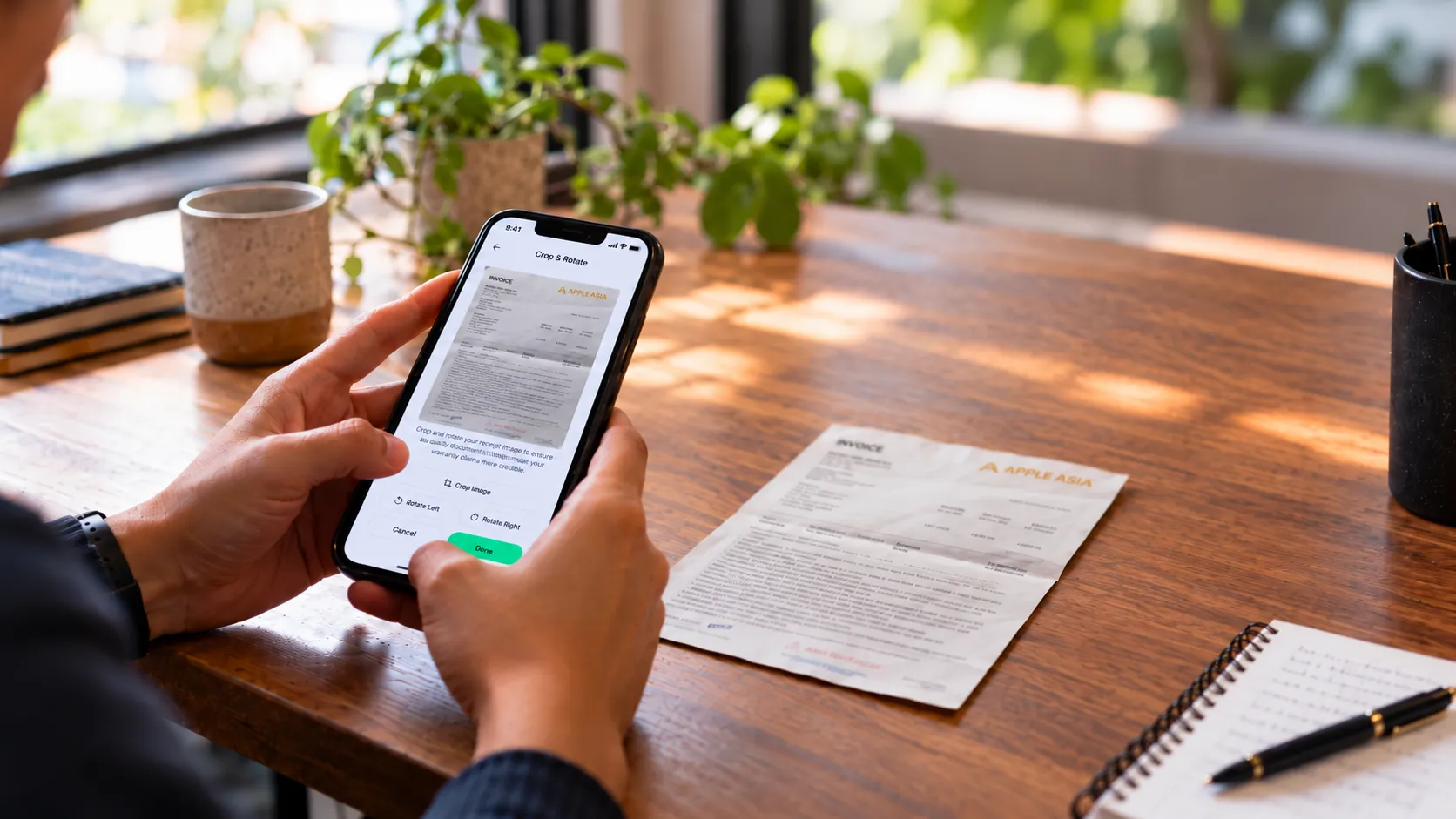
I'm building Reclaima , an Android app that scans a receipt, tracks every item's warranty and return deadline, and generates a claim PDF when something breaks. The whole app depends on one step: reading the receipt correctly.
Amazon Textract's
AnalyzeExpense API does most of that well. It returns the vendor, total, dates and line items as structured fields. Then I scanned a real bilingual warranty card, and the result looked like this:1
Warranty Warranty does does not not cover cover for for physical damages
Here is why that happened, and the two-step fix that made it readable.
Why the text came out doubled
Many warranty cards are printed in two side-by-side columns: English on one side, another language on the other, saying the same thing. OCR reads a page line by line, left to right, across the whole width. So it reads a bit of the left column, then a bit of the right, then the next line of the left, and so on. The two columns get interleaved.
You get two symptoms:
- Duplicated words, where the same phrase appears in both columns.
- Orphan fragments: lonely lines like "the", "only" or "above" left over from a column break.
The obvious fix, and why I didn't start with it
The tempting answer in 2026 is "just send the whole image to an LLM." I didn't, for two reasons:
AnalyzeExpensealready gives me structured, typed fields (total, date, line items) with confidence scores. Rebuilding that with prompts would be slower and harder to trust.- Most of the problem isn't language. It's geometry. The model shouldn't have to guess at a layout problem I can solve exactly.
So the fix has two steps: rebuild the layout with code first, then use an LLM only for what's left.
Step 1: Rebuild the columns from bounding boxes (free and deterministic)
Textract returns a
BoundingBox for every LINE block. If a region has two columns, the left edges of its lines cluster into two groups with a clear gap between them. Find the largest gap, and if it's wide enough, split at it:1
2
3
4
5
6
7
8
9
10
11
left_vals = sorted({round(ln["left"], 3) for ln in lines})
gaps = [(left_vals[i + 1] - left_vals[i], (left_vals[i] + left_vals[i + 1]) / 2)
for i in range(len(left_vals) - 1)]
max_gap, split_x = max(gaps, key=lambda g: g[0])
if max_gap >= 0.15: # 15% of page width -> two columns
left_col = sorted([l for l in lines if l["left"] < split_x], key=lambda l: l["top"])
right_col = sorted([l for l in lines if l["left"] >= split_x], key=lambda l: l["top"])
ordered = left_col + right_col # read each column top to bottom
else:
ordered = sorted(lines, key=lambda l: l["top"])
That one change turns "interleaved soup" into "left column, then right column." It costs nothing, needs no API call, and gives the same answer every time.
Step 2: Let Claude Haiku clean up the leftovers
Geometry can't fix everything. Some lines are still duplicated, fragments remain, and the non-English half still needs to be removed. For that I call Claude Haiku 4.5 on Amazon Bedrock with a narrow prompt:
1
2
3
4
5
6
SYMPTOM 1 - Word duplication: "Warranty Warranty does does not not cover cover"
must become: "Warranty does not cover"
SYMPTOM 2 - Orphan fragments: absorb into the neighbouring sentence or drop.
- Preserve ALL factual warranty details exactly: time periods, day counts,
  coverage conditions, exclusions.
- Return ONLY the cleaned text. No explanation.
Three settings matter more than the prompt wording:
temperature: 0.1. This is a repair job, not creative writing.- A tight
max_tokens. 512 for warranty notes, 50 for a store name. That caps cost and stops the model from rambling. - Fail open. If Bedrock throws an error, the code logs it and returns the original OCR text. A slow or failed LLM call never blocks a user from saving a receipt.
What the cleanup should produce, taken from the example in my prompt:
1
Warranty does not cover for physical damages
What one receipt costs
I took the unit prices from the AWS Price List API (
aws pricing get-products, us-east-1) and the token counts from CloudWatch's AWS/Bedrock metrics for my real calls.Unit prices (us-east-1, on-demand):
- Textract
AnalyzeExpense: $0.01 per page (first 1M pages a month) - Claude Haiku 4.5, via the
us.cross-region profile: $1.10 per 1M input tokens, $5.50 per 1M output tokens
Tokens per call (14 real calls): an average of 365 input and 25 output. The output is tiny because most calls return one short field, like a store name or a phone number. Most of the input is my prompt's instructions, not the receipt text.
So one Claude call costs about:
1
365 × $1.10/1M + 25 × $5.50/1M ≈ $0.00054
The number of calls depends on the receipt, because the app only cleans fields that actually exist. A fully loaded receipt with a store name, phone, email, address, warranty notes and 3 products needs 8 calls:
| Step | Cost |
|---|---|
| Textract AnalyzeExpense (1 page) | $0.0100 |
| Claude Haiku 4.5 (8 calls × $0.00054) | $0.0043 |
| Total per receipt | ≈ $0.014 |
Even in that worst case, about 70% of the cost is Textract, not the LLM. It would take roughly 18 Claude calls to cost as much as one Textract page. In a pipeline like this, the "AI" step is the cheap part.
What I'd change
I review my own code honestly, so here is what I'm fixing next:
- One call per field is wasteful. Store name, phone, email, address, notes and every product name each get their own call, and each one repeats a few hundred tokens of instructions. One call that returns all fields as JSON would send the instructions once and cut latency.
- The
global.inference profile is about 9% cheaper. It costs $1.00 / $5.00 per 1M tokens instead of $1.10 / $5.50, and switching is just a different model ID. - Some of these calls don't need an LLM at all. Phone numbers and emails have strict formats. A regex is cheaper, instant, and can't hallucinate.
- My prompts assume the US. The phone prompt defaults to
+1and the address prompt uses US formats, which breaks for receipts from anywhere else. My email example also teaches the model to merge parts of a domain (best . buy . com→bestbuy.com), which is risky for multi-part domains like.co.uk.
The lesson
Fix structure with code, and fix meaning with a model. Bounding boxes solved most of my problem for free. The LLM handles the small, messy remainder, under tight limits and with a fallback.
Your turn
Have you hit OCR problems with multi-column or multi-language documents? How did you handle them: geometry, a bigger model, or something else? Tell me in the comments.
Reclaima: https://reclaima.sujaya.dev/ · Code: https://github.com/sujayamindev/reclaima
Enjoyed reading this content? Let the author know!
Your likes, comments, shares, and saves help creators reach more builders.

Loading recommendations
Loading article