

How we ran the Kiro University Challenge as a community build-along: 141 builders at AWS User Group Madurai
A community case study and playbook from AWS User Group Madurai. We - Vivek, Logesh and Poobalan turned Kiro's seven-lesson University Challenge into a build-along with four evening Circle sessions, a one-command setup that created a compliant repo and progress tracking, a leaderboard ranked by active days, and community rewards earned by rank. 141 members joined, 77 linked a repo, 38 demonstrated all seven lessons. Includes the numbers, what went wrong, and how to run it without a custom platform.

Kiro is AWS's AI-assisted development environment. In September 2026 the Kiro team ran the Kiro University Challenge: seven short lessons (spec-driven development, steering documents, hooks, property-based testing, powers, MCP and custom agents), then one final project, with up to 5,250 Kiro credits per person for builders who demonstrate the lessons.
I lead AWS User Group Madurai in Tamil Nadu, India. Most of the group's members had never opened Kiro, and most of them are students. A self-paced challenge with eligibility rules, a public repo requirement and a hard deadline is easy to start and easy to drop, so I ran it as a build-along with my co-organizers Poobalan P and Logesh S .
This article covers what I set up, the numbers the platform tracked, what did not go to plan, and a playbook another user group can copy.
Results

Alt text: Infographic: 141 builders joined, 77 linked a GitHub repo, 60 demonstrated at least one lesson, 38 completed all seven, 1,720 commits, 354 lesson completions, 51 community prizes
- 141 members joined the build-along on awsugmdu.in, and 150+ people attended the user group's events.
- 103 of the 141 were students and 23 were working professionals (15 had no profile).
- 77 linked a GitHub repo, which is what the platform needs to track progress.
- 38 of those 77 demonstrated all seven lessons, and 60 demonstrated at least one.
- 46 also completed a bonus lesson, and 22 completed both bonus lessons.
- Builders made 1,720 commits inside the challenge window and recorded 354 lesson completions between them.
- 51 builders are in line for community prizes across five tiers.
Source: the awsugmdu.in campaign leaderboard on 12 Oct 2026. Kiro reviews entries and awards its own credits; these are the user group's numbers.
The number I watch most is 38 of 77: almost half of the builders who linked a repo demonstrated every lesson.
The people who ran it

Alt text: The team behind the build-along: Vivek Raja P S (lead), Poobalan P and Logesh S (co-organizers), and Circle leads Yogesh S, Dineshraj Dhanapathy, Omshree Butani and Madhumithaa
Poobalan P and Logesh S co-organized the build-along with me.
Four Circle leads ran the evening sessions and taught the lessons live: Yogesh S, Dineshraj Dhanapathy, Omshree Butani and Madhumithaa.
The playbook in six steps
- Run the lessons live in short evening sessions, two lessons per evening.
- Give members one setup command that creates a challenge-compliant repo and turns on progress tracking.
- Rank builders by the number of days they commit, and require at least one lesson for the top places.
- Show each builder a personal checklist of lessons and submission rules.
- Offer rewards as a ladder by rank, plus points and a badge for every valid entry.
- Partner with student group leads, and set college targets on submissions as well as attendance.
The sections below explain each step and what it took.
Timeline
Alt text: Timeline from 21 Sep to 10 Oct: four Circle sessions on 23 to 26 Sep, build weeks, entries close 6 Oct 12:29 PM IST, standings on 10 Oct
| Date | What happened |
|---|---|
| 21 Sep | Kiro opens the challenge |
| 23 Sep | Circle 1: lessons 1 and 2 |
| 24 Sep | Circle 2: lessons 3 and 4 |
| 25 Sep | Circle 3: lessons 5 and 6 |
| 26 Sep | Circle 4: lesson 7 and both bonus lessons |
| 27 Sep to 5 Oct | Build weeks: open build room, office hours, submission checks |
| 6 Oct, 12:29 PM IST | Entries close |
| 10 Oct | Community standings frozen for prizes |
Step 1: Circles, two lessons per evening
Circles are the user group's small, recurring study groups. Each one is a one-hour live session where people work through something together, with shared resources and peer support afterwards. The user group runs a Women in Tech Circle and a Builder Circle.
I mapped the seven lessons onto four online Circle evenings at 7:30 PM IST:
- 23 Sep, Women in Tech Circle: spec-driven development (plan a feature as requirements, design and tasks before code) and steering documents (project rules Kiro reads every time).
- 24 Sep, Builder Circle: hooks (actions Kiro runs automatically on events) and property-based testing (checks that run across hundreds of generated inputs).
- 25 Sep, Women in Tech Circle: powers (installable bundles of tools and know-how) and the Model Context Protocol (connecting Kiro to outside tools and data).
- 26 Sep, Builder Circle: custom agents, plus both bonus lessons (Kiro Web and cloud sessions, and packaging your own power), with a live demo of agents building a full-stack app.
The four sessions drew 114 RSVPs on Meetup: 37, 36, 18 and 23.
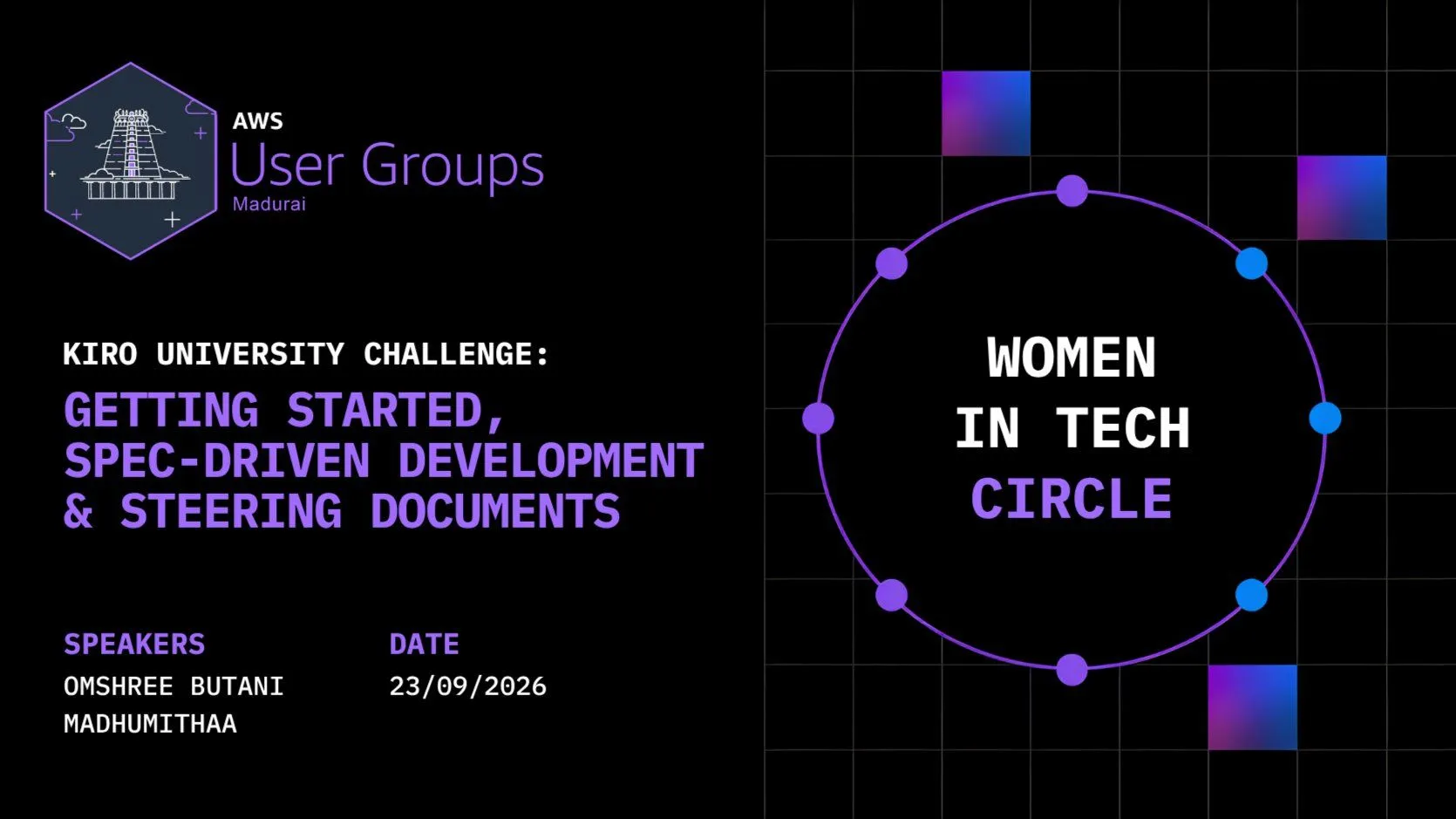
Alt text: Poster for the 23 Sep Women in Tech Circle on Kiro University lessons 1 and 2

Alt text: Poster for the 26 Sep Builder Circle on lesson 7 and the bonus lessons
Each announcement named two lessons, one line on why they mattered, and an open invitation. From the 23 Sep announcement: "Bring your laptop, bring your questions, bring your energy and the room is open for all of it." From the 24 Sep one: "Yesterday we specced it. Today we automate it and try to break it."
After the four Circles, the format moved to building: a build sprint, an open build room, office hours and a submission check before the deadline.
Step 2: one setup command
The hard part for a first-time builder was the setup around Kiro: creating a clean repo, committing the .kiro folder, staying inside the rule that a repo must have no commits before the challenge started, and knowing whether they were on track.
I put all of that behind one command on awsugmdu.in/kiro. A member signs in with their awsugmdu.in account and copies the command. It runs in about two minutes and does four things.

Alt text: Diagram: one setup command creates a fresh repo, installs Kiro hooks, installs the reporter outside the repo, and links the repo to the member's profile; the platform then checks GitHub every 6 hours and ranks builders
- It creates a fresh project repo with the .kiro scaffolding in place. Because the repo is new, it has no commits from before the challenge, so it passes Kiro's no-prior-commits rule automatically.
- It installs three Kiro hooks that count activity: one counts tool calls, one counts prompts and marks the session start, and one reports the session when it ends.
- It installs a small reporter script in the member's home folder, outside the project, and reads the member's token from a separate file there, so the token never goes into the public repo.
- It links the GitHub repo to the member's awsugmdu.in profile.
This is the hooks file every builder received, shortened:
1
2
3
4
{ "version": "v1", "hooks": [
  { "name": "Kironomics Tool Counter",     "trigger": "PostToolUse" },
  { "name": "Kironomics Prompt Counter",   "trigger": "UserPromptSubmit" },
  { "name": "Kironomics Session Reporter", "trigger": "Stop" } ] }
It also meant every builder had a working example of Kiro hooks, lesson 3, before that lesson's Circle.
The reporter sends counts, session durations and Kiro credit totals. It never sends prompt text, source code, file names or paths.
Poobalan explained the setup to new members like this: "You can join with a single command, and your GitHub repo will be linked for tracking. Your commits and progress are tracked as you build, so you can focus on actually building your project."
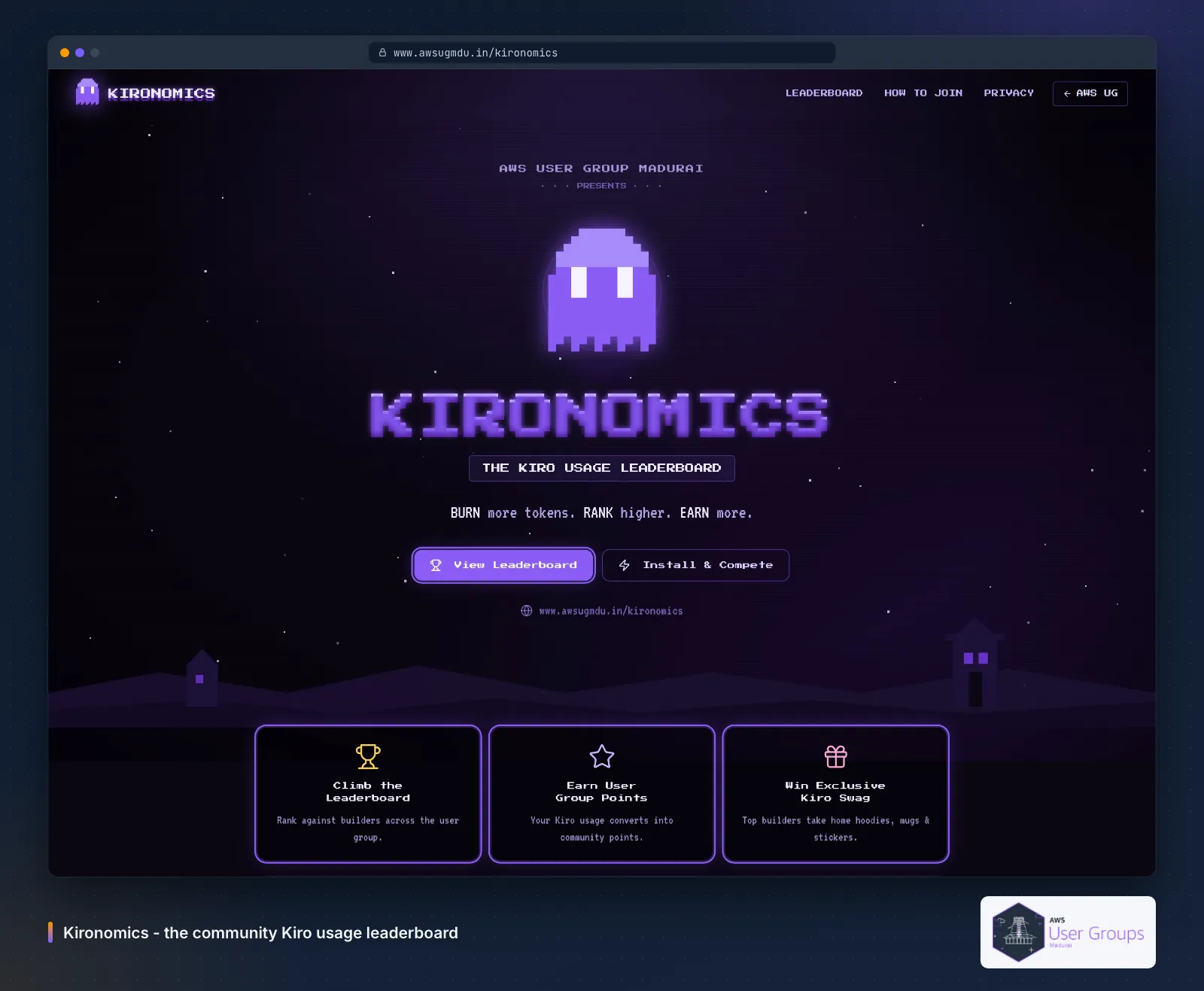
Alt text: The awsugmdu.in/kiro page with the challenge details and the three steps to join
Step 3: a leaderboard ranked by active days
Every six hours the platform checks each linked repo on GitHub for commits inside the challenge window and for the lessons that show up in the repo, such as specs in .kiro/specs, steering files, hooks, MCP servers, custom agents and a packaged power.
The leaderboard ranks builders by active days, meaning days with at least one commit, counted in IST. Commits break ties, then lessons. As the page puts it: "Days, not commit count, so a hundred pushes in one afternoon still counts as one day."
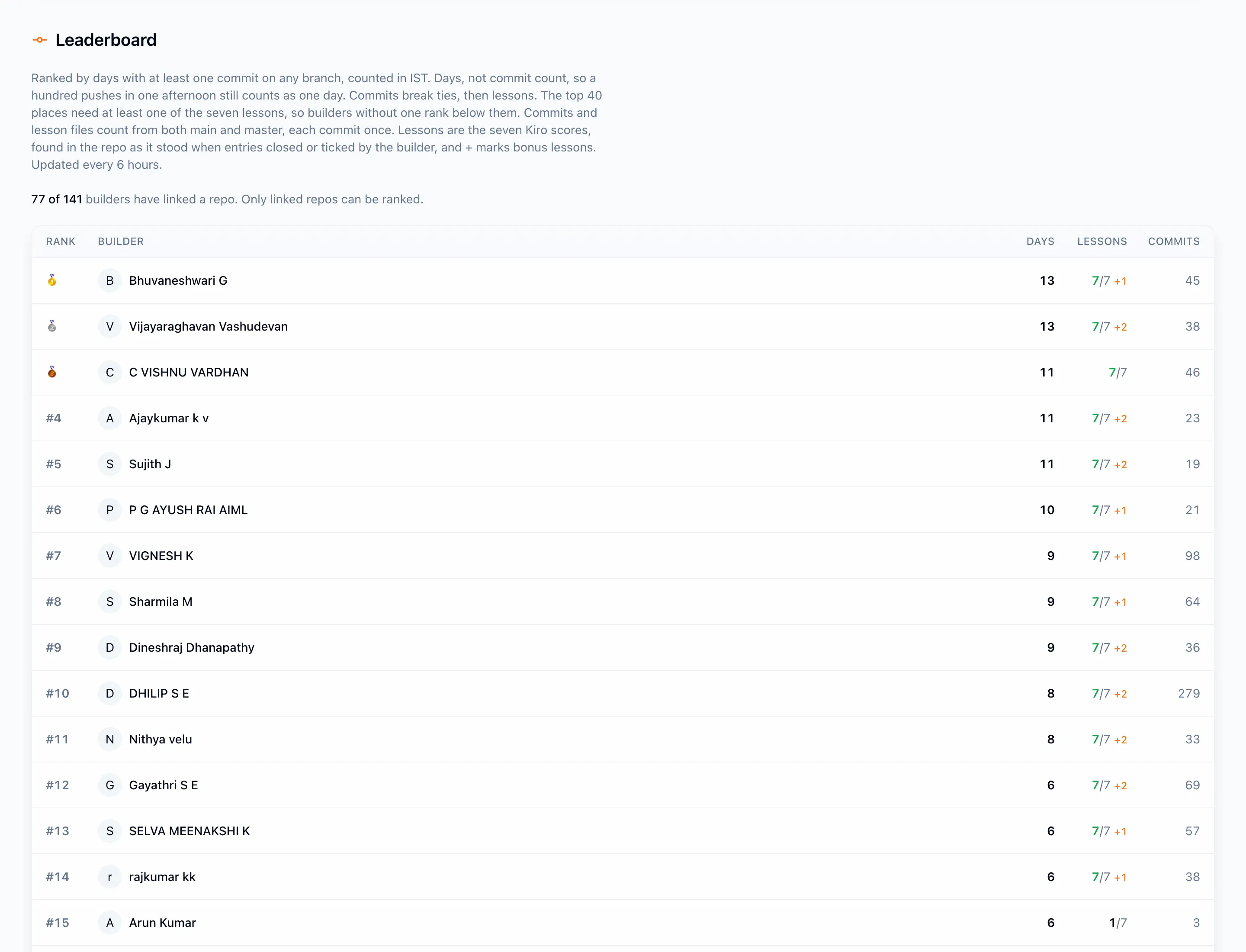
I chose active days because learning a new tool needs regular practice, and a commit count rewards bursts. The top three builders committed on 13, 13 and 11 separate days.
I added one rule to keep the board about Kiro: the top 40 places require at least one of the seven lessons.

Alt text: The build-along leaderboard on awsugmdu.in/kiro, ranked by active days, then commits, then lessons
Step 4: a checklist each builder can see
Each builder's page shows two lists. The first is the seven lessons and two bonus lessons, ticked automatically from the repo where possible. The second is the submission checklist: a public repo they own, no commits before 21 Sep, the .kiro folder committed, a 30-second to 3-minute demo video, a public post, one line per lesson, the entry form submitted on kiro.dev, and no commits after submitting.
This let builders check whether they were done without messaging an organizer.
Step 5: rewards as a ladder
Kiro awards its own credits. On top of those, the user group put up its own rewards and ranked them by the leaderboard.

Alt text: Rewards ladder: ranks 1 to 3 jacket, 4 to 6 power bank, 7 to 11 water bottle, 12 to 31 T-shirt, 32 to 51 sticker sheet
| Final rank | Reward | Coupon worth |
|---|---|---|
| 1 to 3 | Jacket | 2,500 points |
| 4 to 6 | Power bank | 2,000 points |
| 7 to 11 | Water bottle | 1,500 points |
| 12 to 31 | T-shirt | 1,000 points |
| 32 to 51 | Sticker sheet | 150 points |
Everyone with a valid entry also earns community points, a digital badge and a place in the showcase. Winners get a coupon by email and in their profile, claim the item in the community store, and the coupon's points are added to their total.
The store also sells a one-month Kiro subscription for 500 points, so points earned by learning Kiro can buy more Kiro.

Alt text: The awsugmdu.in community store, where members redeem points
Step 6: Student Builder Groups and college targets
I could not run sessions on every campus, so I partnered with Student Builder Groups (SBG) and their leads. Students joined the user group's Circles to learn, and their leads helped them finish on campus.
Each college had a target that counted two numbers together: about 80 students attending and their submissions. From the announcement: "Filling seats alone doesn't count, we're measuring what your students finish." The top two colleges got special Kiro swag for their captain and a social media shout-out from the user group, and colleges that hit the target were offered a re:Invent watch party.
Who can take part
Kiro's credits have their own eligibility rules, including a minimum age of 18 and a GitHub account at least three months old. Every builder submits their own entry on kiro.dev, and Kiro decides credits.
The user group's Circles, leaderboard and swag are separate from Kiro's credits. Students who could not claim Kiro's credits could still attend the Circles, learn Kiro and count towards their college's target, and the announcements said so plainly.
Kironomics, the usage leaderboard
Alongside the build-along, the user group runs Kironomics, a leaderboard for Kiro usage. The same hooks from the setup command feed it. It ranks members on sessions, tool and MCP calls, hook triggers and credits used, gives titles from Kiro Novice to Session Immortal, and converts usage into user group points.
Since it started, Kironomics has recorded 170 builders, 2,596 Kiro sessions, 39,653 MCP calls and 3,085 hook triggers. These are all-time totals, not only the challenge window.

Alt text: The Kironomics leaderboard on awsugmdu.in, top five builders
What builders said
"Behind this achievement are countless hours of learning, experimenting, and refining prompts in the Kiro environment, even late nights when my eyes were burning, but I kept going because I believed in my work."
Selva Meenakshi, Student
"Thank you for this wonderful opportunity! Grateful to be part of the Kiro University Challenge and the amazing AWS UG Madurai community. This journey has been a great learning experience, and I'm excited to keep building and growing!"
Bhuvaneshwari G, B.Sc. Computer Science student, first on the build-along leaderboard
The top three on the build-along leaderboard:
- Bhuvaneshwari G: 13 active days, 45 commits, all seven lessons and one bonus lesson.
- Vijayaraghavan Vashudevan: 13 active days, 38 commits, all seven lessons and both bonus lessons.
- C Vishnu Vardhan: 11 active days, 46 commits, all seven lessons.
What did not go to plan
- 64 of the 141 members who joined never linked a repo, so the platform could not track them or rank them. Linking the repo should be part of the first session, done live.
- Circle RSVPs dropped mid-week. They went from 37 and 36 for the first two sessions to 18 for the third, then 23 for the fourth.
- An early version of the reporter script held the API key as a literal value. Members who followed both the build-along setup and Kiro's instruction to commit the .kiro folder publicly published that key on GitHub. The current version keeps the reporter and the token outside the project.
- An earlier version of the hooks used shell commands and a hard-coded /tmp path, which failed silently on Windows. Those members appeared to install correctly but never showed up on the leaderboard. The current reporter is a Python script that works the same on macOS, Linux and Windows.
Running this without a custom platform
The awsugmdu.in platform automated most of this, but a user group without one can still copy the steps:
- Circles: schedule four evening sessions on Meetup, two lessons each.
- Setup: publish a template repo with the .kiro folder and a short README, and ask members to create their repo from it after the challenge opens.
- Tracking: collect GitHub repo URLs in a form, and run a daily script against the GitHub API that counts commit days and checks for lesson files. Publish the results as a sheet.
- Checklist: share Kiro's submission rules as a one-page list and run a submission check session before the deadline.
- Rewards: rank by active days and publish the reward tiers on day one.
How to join the next one
Create an account on awsugmdu.in , join the AWS User Group Madurai Meetup group to see the next Circle, and if your college has a Student Builder Group, ask its lead about the next build-along.
Thank you
Thank you to all 141 builders, to my fellow co-organisers - Poobalan P and Logesh S , and to the Circle leads Yogesh S , Dineshraj Dhanapathy , Omshree Butani and Madhumithaa .
If you run a community and want to try this, the build-along page is at awsugmdu.in/kiro . I am happy to share what I learned.
Enjoyed reading this content? Let the author know!
Your likes, comments, shares, and saves help creators reach more builders.

Loading recommendations
Loading article