
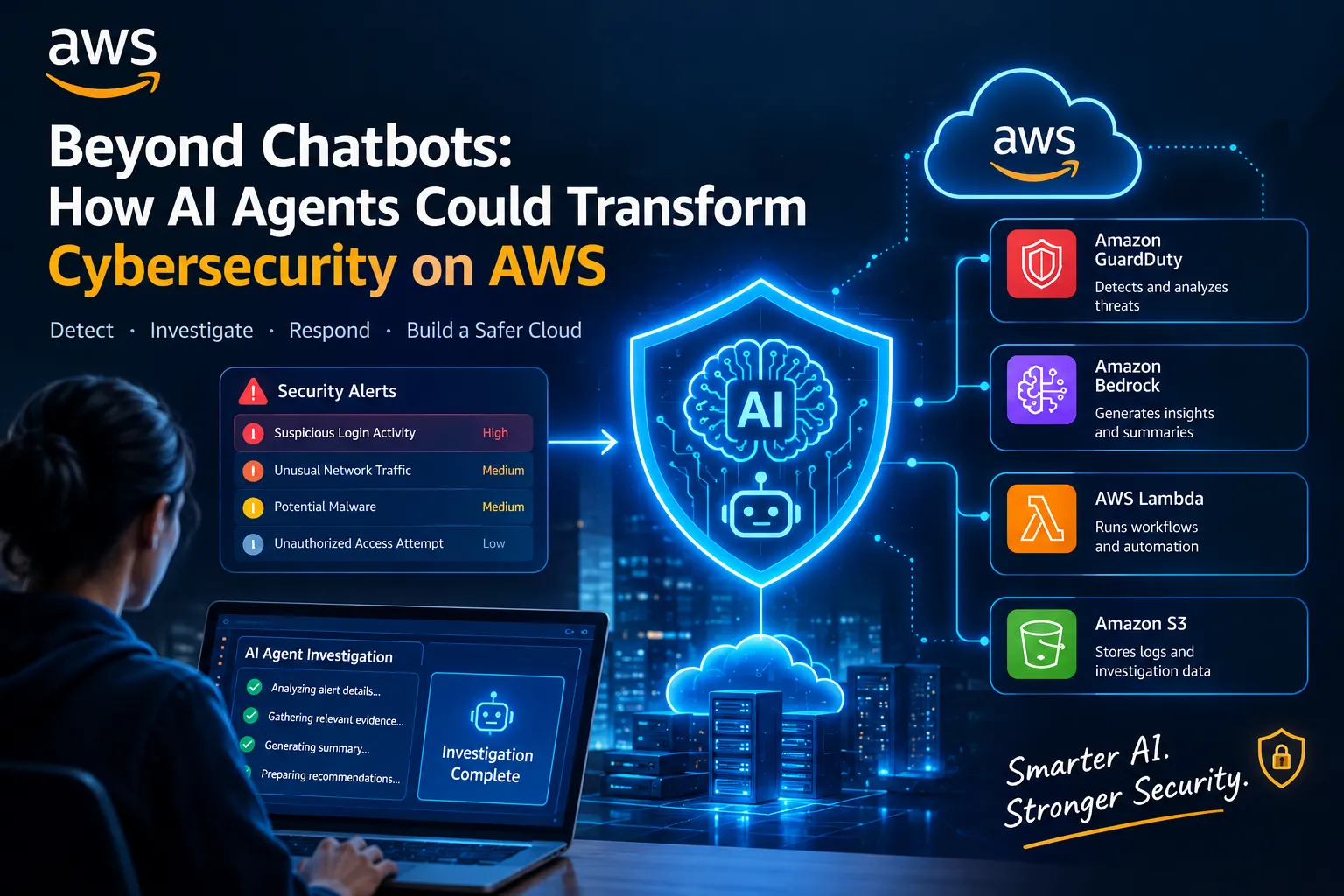
🤖 Beyond Chatbots: How AI Agents Could Transform Cybersecurity on AWS
AI is moving beyond answering questions and entering the world of autonomous action. Discover how AI agents, Amazon Bedrock, and AWS security services could work together to investigate suspicious activities, prioritize cyber threats, and support faster incident response. Explore a practical architecture, real-world use cases, key challenges, and the future of intelligent cloud security.

🤖 Beyond Chatbots: How AI Agents Could Transform Cybersecurity on AWS
Imagine receiving hundreds of security alerts while managing a cloud application. Some alerts are harmless. Others could indicate a serious cyberattack.
How do you identify the real threats without wasting hours investigating every notification?
Now imagine having an intelligent assistant that can summarize alerts, gather relevant evidence, explain suspicious behavior, and recommend the next steps.
This is where AI agents meet cybersecurity.
Artificial Intelligence is evolving beyond chatbots that simply respond to prompts. AI agents can use tools, follow defined workflows, and help complete multistep tasks. When designed with appropriate permissions and human oversight, they could become valuable assistants for cybersecurity teams.
But how can we build such systems using AWS?
Let's explore!
🔍 1. What Are AI Agents, and Why Do They Matter?
A traditional chatbot generally answers questions based on the information available to it. An AI agent can go a step further by working toward a goal through a sequence of actions.
For example, consider this request:
"Investigate why a cloud account generated an unusual security alert."
An AI-assisted workflow could:
- Retrieve the relevant security finding.
- Gather related information from approved data sources.
- Summarize what happened.
- Identify evidence that needs further investigation.
- Recommend appropriate next steps for a security analyst.
Instead of manually searching through multiple sources, a security professional receives a structured explanation to review.
However, an AI agent should not automatically be trusted to make every decision. Its findings must be checked against evidence, and sensitive actions should require appropriate authorization.
The goal is not to replace security professionals. It is to help them work more efficiently.
☁️ 2. How AWS Can Power Intelligent Security
AWS provides services that can form the building blocks of an AI-powered security application.
Here are four important services to understand.
🛡️ Amazon GuardDuty
Amazon GuardDuty is a threat detection service that analyzes supported AWS data sources to identify potentially malicious or unauthorized activity.
It can help security teams investigate findings involving suspicious access, unusual behavior, and potential threats to cloud workloads.
In an AI-assisted architecture, GuardDuty could provide security findings for further investigation.
🧠 Amazon Bedrock
Amazon Bedrock provides access to foundation models through managed APIs and offers capabilities for building generative AI applications and agents.
A developer could use it to build an assistant that summarizes security findings, explains technical events in simpler language, or organizes investigation results.
The model should receive only the information it needs, and its explanations should be verified against the original evidence.
⚡ AWS Lambda
AWS Lambda lets developers run code without managing servers.
It could execute specific tasks in a security workflow, such as processing an approved event, preparing relevant information, or invoking a controlled investigation step.
📦 Amazon S3
Amazon S3 provides object storage that can be used for appropriate security reports, datasets, and investigation artifacts.
Sensitive security information must be protected with suitable access controls, encryption, and retention policies.
The key idea: These services have different responsibilities. GuardDuty detects potential threats, Bedrock supports AI reasoning and summarization, Lambda runs application logic, and S3 stores relevant objects.
Together, they can form part of a broader security solution.
🚀 3. Imagine Building an AI Cybersecurity Assistant
Let's consider a practical example.
A company receives a GuardDuty finding indicating potentially suspicious activity involving an AWS resource.
Instead of requiring an analyst to start from scratch, an AI-assisted application could organize the investigation.
Step 1: Detect
Amazon GuardDuty generates a security finding based on the activity it observes.
Step 2: Trigger
An event-driven workflow receives the finding and invokes a controlled processing function.
Step 3: Gather evidence
The application retrieves relevant details through authorized AWS APIs and collects contextual information needed for the investigation.
Step 4: Analyze
Amazon Bedrock can help summarize the evidence, explain why the finding may matter, and suggest questions the analyst should investigate.
Step 5: Recommend
The application prepares a report containing the finding, supporting evidence, potential impact, and recommended next steps.
Step 6: Verify and respond
A security analyst reviews the report and decides whether further action is necessary. Any automated response must follow predefined policies and safeguards.
This approach can reduce repetitive work while keeping important security decisions under human control.
Importantly, the AI does not replace GuardDuty's detection capabilities. It helps interpret and organize the findings that the detection service produces.
🧩 4. A Simple AWS Architecture
A possible architecture for a learning project could look like this:
GuardDuty → EventBridge → Lambda → Amazon Bedrock → Investigation Summary → Security Analyst
Here's the purpose of each component:
- Amazon GuardDuty: Produces security findings.
- Amazon EventBridge: Routes supported events to the appropriate workflow.
- AWS Lambda: Processes the event and retrieves authorized context.
- Amazon Bedrock: Helps generate a structured explanation and investigation summary.
- Security analyst: Reviews the evidence and approves any necessary response.
Amazon S3 could optionally store investigation reports, while Amazon CloudWatch could help monitor application behavior and execution.
This is a proposed architecture, not a turnkey AWS solution. The developer must configure the event rules, IAM permissions, model access, error handling, monitoring, and security controls.
⚠️ 5. Can We Trust AI With Cybersecurity Decisions?
This is one of the most important questions.
AI agents can be useful, but giving them unrestricted access to cloud infrastructure could create serious risks.
Incorrect conclusions
An AI model might misunderstand an event or produce an explanation that the evidence does not support.
Solution: Keep the original security findings available and require evidence-based verification.
Excessive permissions
An agent with broad access might perform actions beyond what the task requires.
Solution: Follow least-privilege access, use narrowly scoped permissions, and separate investigation capabilities from response capabilities.
Prompt injection
If an AI system processes untrusted text, an attacker may attempt to manipulate its behavior through malicious instructions embedded in that content.
Solution: Treat logs and external text as untrusted data, validate tool inputs, and enforce security policies outside the model.
Unintended automated actions
Automatically disabling accounts or modifying infrastructure could disrupt legitimate business activity.
Solution: Begin with read-only investigation and recommendations. Introduce automated response only after rigorous testing, with explicit approval gates where appropriate.
Cost and reliability
AI requests, repeated tool calls, and large amounts of contextual data can increase cost and complexity.
Solution: Limit the information processed, monitor usage, define timeouts, and test the workflow with realistic scenarios.
A powerful AI security assistant is not simply one that can take action. It is one that knows what it is allowed to do—and when it must stop and ask for approval.
💡 6. A Project Idea for Students and Developers
You don't need to build an enterprise security platform to explore this concept.
Start with a project called CloudGuard AI: An AI-Powered Security Investigation Assistant.
Its first version could include:
- A collection of sample security findings.
- A Python application that organizes and categorizes the findings.
- An AI-powered explanation of selected findings.
- A dashboard displaying severity, evidence, and recommended investigation steps.
- An optional AWS integration using GuardDuty findings and Amazon Bedrock.
You could begin with sample data before connecting a real AWS account. This makes it easier to learn the architecture without immediately incurring cloud costs or handling sensitive production information.
For a more advanced version, add event-driven processing, structured output validation, audit logs, and human approval before any response action.
This project can help students explore Python, cloud architecture, generative AI, application security, and responsible automation in one practical application.
🔮 7. What Could the Future Look Like?
AI-assisted security workflows could evolve in several directions:
- Faster investigations: Assistants could collect relevant context and prepare initial reports.
- Better alert prioritization: Applications could help analysts organize findings according to severity and supporting evidence.
- Natural-language security insights: Teams could ask questions about security events without manually interpreting every technical field.
- More consistent workflows: Carefully designed automation could standardize repetitive investigation tasks.
- Human-supervised response: Security professionals could review evidence and approve well-defined actions through controlled workflows.
These possibilities depend on the quality of the underlying data, the reliability of the models, and the safeguards implemented around them. AI agents are not a substitute for a comprehensive security strategy.
🎯 Conclusion: Smarter Security Starts With Responsible AI
The future of cybersecurity may not be about choosing between human expertise and artificial intelligence.
It may be about combining the strengths of both.
AWS services such as Amazon GuardDuty, Amazon Bedrock, AWS Lambda, and Amazon EventBridge can provide building blocks for applications that help investigate security findings and organize complex information.
For developers, this creates an exciting opportunity to build practical AI applications that solve real problems.
For organizations, it also creates a responsibility to design these systems carefully, protect sensitive information, verify AI-generated conclusions, and maintain control over critical actions.
The real innovation is not giving AI unlimited power. It is giving AI the right tools, the right boundaries, and the right human supervision to make cybersecurity more effective. 🚀
💬 Let's Discuss!
If you could build an AI agent for cloud security, what would you want it to do first?
- 🔎 Investigate suspicious security alerts.
- 📊 Summarize security logs and identify patterns.
- 🛡️ Recommend ways to strengthen cloud security.
- ⚡ Help automate approved incident-response workflows.
Share your thoughts in the comments! I'd love to hear how developers and AWS enthusiasts imagine the future of AI-powered security.
#AWS #ArtificialIntelligence #GenerativeAI #AmazonBedrock #AmazonGuardDuty #Cybersecurity #CloudComputing #MachineLearning #CloudSecurity #Innovation
Enjoyed reading this content? Let the author know!
Your likes, comments, shares, and saves help creators reach more builders.

Loading recommendations
Loading article