
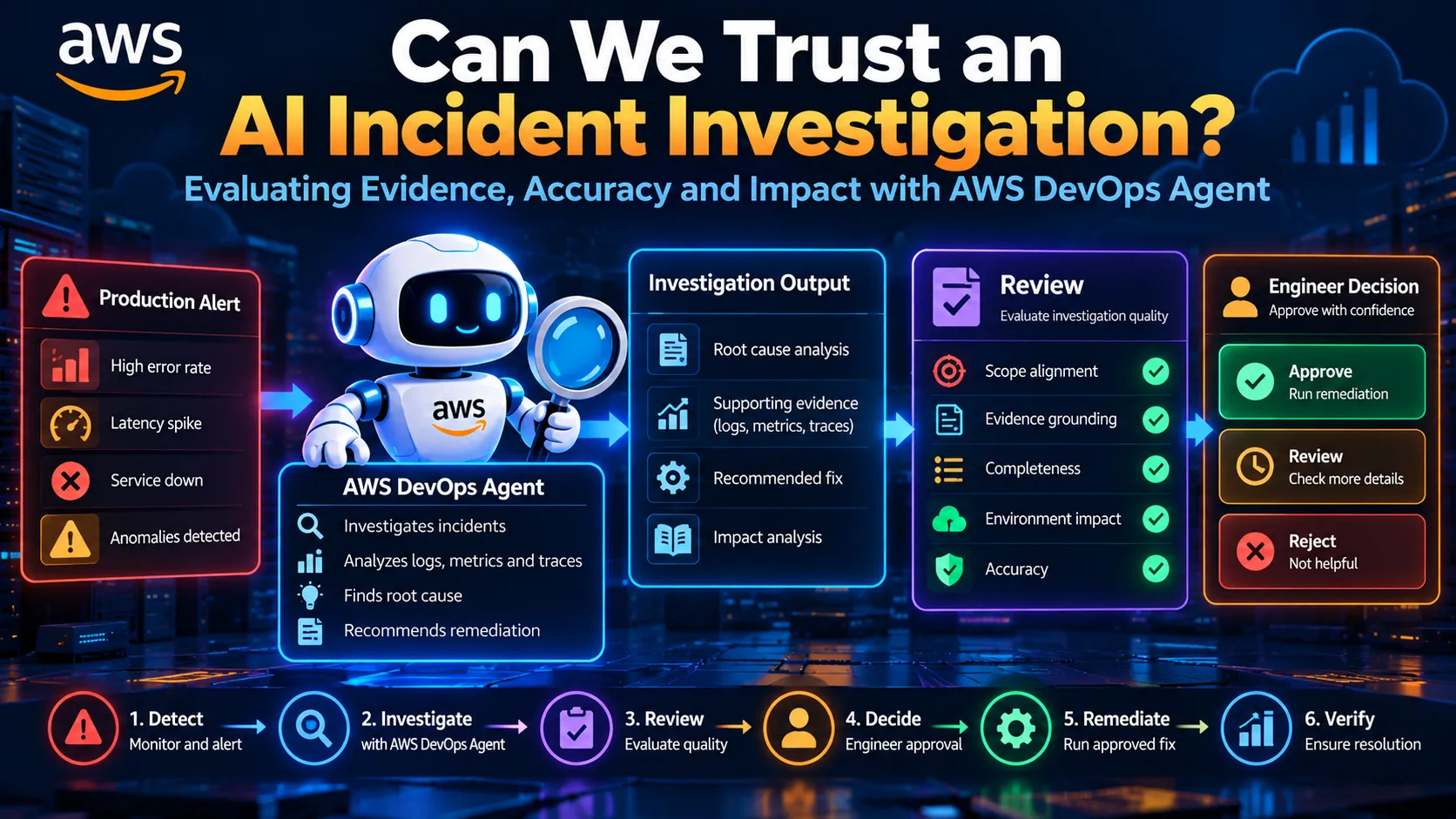
Can We Trust an AI Incident Investigation?
AWS DevOps Agent can review completed investigations. Explore why evidence, accuracy, and impact validation matter before trusting an AI diagnosis.

Can We Trust an AI Incident Investigation?
Imagine your production application suddenly becomes slow.
An AI agent investigates the incident, analyzes logs and metrics, identifies a possible root cause, and recommends a fix.
The investigation looks convincing. The explanation sounds logical.
But there is one question every DevOps engineer should ask:
What evidence proves that the AI got it right?
In production, a confident answer is not the same as a correct diagnosis.
A new step in AI-powered incident response
AWS DevOps Agent now supports a Review capability for completed investigations. It provides an overall helpful or not-helpful verdict and evaluates the investigation against individual quality criteria.
These include scope alignment, evidence grounding, completeness, environment impact, and accuracy.
This is an important concept for teams moving from traditional incident investigation toward AI-assisted operations.
Five things I would check before trusting an AI diagnosis
1. Evidence grounding
Can the agent connect its conclusion to actual logs, metrics, traces, or other relevant evidence?
2. Scope alignment
Did it investigate the reported problem, or get distracted by unrelated symptoms?
3. Completeness
Did it examine the relevant components and dependencies before reaching a conclusion?
4. Environment impact
Did it consider the possible consequences of its recommendation for the affected environment?
5. Accuracy
Does the proposed root cause match what actually happened, rather than merely sounding plausible?
These checks help engineers assess the quality of an investigation instead of relying on the AI's confidence alone.
From AI diagnosis to reliable DevOps
I would design an incident-response workflow like this:
Alert → AI investigation → Quality review → Engineer validation → Approved remediation → Health verification
Not every incident requires the same level of human involvement. A low-risk, well-understood issue might eventually qualify for automated handling, while a critical production incident may require explicit approval.
The important part is that automation should depend on evidence, risk, and validation—not just on an AI-generated explanation.
A review result is useful input, but it is not an absolute guarantee that an investigation is correct. Engineers still need to consider the available evidence and the operational context.
My takeaway
The next stage of AI-powered DevOps isn't just about investigating incidents faster.
It's about knowing when an AI investigation is reliable enough to act on.
For production systems, trust should be earned through evidence, evaluation, and verification—not assumed because an AI agent produced an answer.
I'd love to hear from other AWS builders:
Would you require a quality review before allowing an AI agent's recommended fix to reach production, or is human approval enough?
Follow along for more practical AWS, DevOps, AI-agent, and cloud engineering insights. Let's keep building! 🚀
Enjoyed reading this content? Let the author know!
Your likes, comments, shares, and saves help creators reach more builders.

Loading recommendations
Loading article