
The Missing Layer in Video & AI: Building a Scale-to-Zero Ingestion Engine on AWS
Hard-won architectural lessons on surviving multimodal data spikes, defeating S3 partition throttling at 896,000 req/s, and eliminating the idle cloud tax.

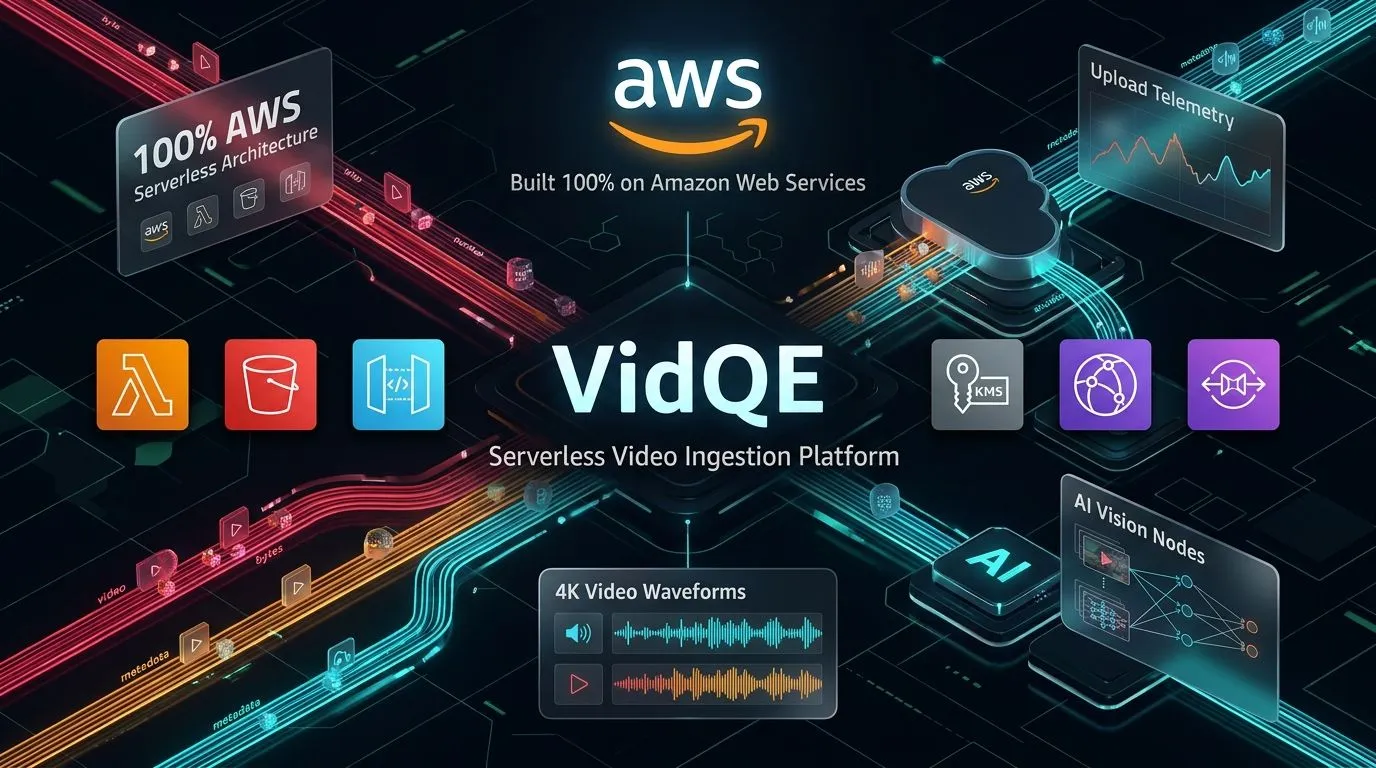
1. The Silent Crisis Behind the Multimodal AI Boom
Over the past eighteen months, the software industry has undergone a tectonic shift. We have poured billions of dollars into training and deploying frontier multimodal foundation models—GPT-4o, Grok Vision, Gemini, Claude 3.5 Sonnet, and next-gen video generators like Sora and Runway Gen-3. Autonomous agents are analyzing factory floor camera feeds in real time. Browser-based Non-Linear Editors (NLEs) are compiling 4K ProRes timelines inside WebAssembly workers. Fintech institutions are enforcing dual-camera synchronized streams to combat generative deepfake fraud.
Yet, despite state-of-the-art GPU inference clusters and global edge distribution networks, the modern video stack harbors an embarrassing dirty secret:
The ingestion layer is fundamentally broken.
Every cloud engineer knows the heartbreak of customer churn at the finish line: a user records a critical 2 GB video, waits four minutes on an unstable cellular connection, and watches the upload crash at 97% because of a transient 300-millisecond network blip. They don't blame TCP windowing algorithms or cellular tower handovers. They blame your product, close the tab, and never return.
To make matters worse, engineering teams routinely reach for the traditional cloud playbook to solve this problem:
- They spin up Application Load Balancers fronting fleets of EC2 or ECS instances running Node.js or Python upload proxies.
- They attach provisioned EBS volumes to hold temporary chunks.
- They route the entire stack through multi-AZ VPC NAT Gateways.
Within ninety days, that naive architecture creates an operational and financial disaster:
- The 10 MB Hard Wall: Managed serverless entry points like Amazon API Gateway reject incoming HTTP payloads exceeding 10 MB, immediately breaking monolithic file upload handlers.
- The "Idle Tax": A standard AWS NAT Gateway deployed across three Availability Zones quietly drains over $100 every single month before processing a single byte of video. Idle container clusters sit burning investor capital 80% of the day just waiting for peak spikes.
- Memory Bloat and Double-Egress Penalties: Forcing multi-gigabyte video streams through backend application memory causes severe garbage collection pauses, buffer bloat, and doubles cloud bandwidth bills—because you pay for bytes entering your application proxy, and pay again as they exit into storage.
When we set out to build VidQE, we refused to accept these compromises. We asked a fundamental question: What does a true, production-grade video ingestion engine look like if it is engineered to be indestructible, mathematically immune to storage throttling, and scales down to literally $0.00 when idle?
Here is the architectural field guide of how we built it on AWS.
2. Decoupling the Planes: The Zero-Byte Compute Axiom
The original sin of legacy file upload architectures is conflating the control plane with the data plane.
When you allow heavy binary payloads to pass through application compute (whether EC2, Fargate, or Lambda), your backend becomes a stateful bottleneck. You are forced to manage socket lifecycles, buffer allocations, disk I/O, and CPU contention—all while paying cloud providers for transit hops.
In VidQE, we enforce an absolute, non-negotiable architectural axiom: video bytes must never touch backend application memory.

The Two-Tier Topology:
- The Control Plane (Orchestration & Governance): Powered entirely by Amazon API Gateway, AWS Lambda, and AWS Cognito. Its sole responsibility is identity verification, cryptographic token issuance, partition layout planning, and audit logging. Its payload footprint is strictly JSON metadata (rarely exceeding 2 KB).
- The Data Plane (Direct S3 Acceleration): Video streams directly from the client client SDK into Amazon S3 via parallel multipart byte-range chunking, sealed at rest with AWS Key Management Service (KMS) envelope encryption.
How the Transaction Works in Practice:
- Initiation (< 30ms): The client invokes
POST /multipart-initiatethrough API Gateway. A lightweight Lambda function authenticates the tenant via Cognito JWT, validates tier limits, calculates an optimal chunk size (e.g., 20 MB chunks for a 1 GB file), and pre-allocates an entropy-sharded S3 key path. - Presigned Dispatch: Instead of receiving the file, Lambda returns a lightweight chunk manifest containing cryptographically signed S3 PUT URLs. Each URL is strictly scoped to a single part number and expires within 3,600 seconds.
- Parallel Saturation: The client SDK immediately opens 6 to 10 concurrent HTTP/2 streams directly to Amazon S3. Video bytes flow directly from the user's network card into AWS object storage hardware.
- Resilient Chunk Retries: If part #14 drops due to packet loss, the client SDK retries only part #14 with exponential jitter. The other 49 parts continue streaming unhindered.
- Zero Compute Footprint: Throughout the entire 2 GB transfer, your AWS Lambda and API Gateway compute consumption is exactly zero milliseconds.
3. Defeating the 503 SlowDown: 256-Way S3 Partition Sharding
One of the most insidious traps awaiting cloud architects at scale is Amazon S3 prefix contention.
Under the hood, Amazon S3 is a massively distributed storage mesh. However, individual storage partitions automatically scale based on object key prefixes. Each discrete partition prefix supports up to:
- 3,500 PUT/POST/DELETE requests per second
- 5,500 GET/HEAD requests per second
If your system stores customer video uploads under chronological or sequential folder hierarchies like this:
1
2
s3://my-production-bucket/uploads/2026/10/12/tenant_alpha/chunk_001.mp4
s3://my-production-bucket/uploads/2026/10/12/tenant_beta/chunk_001.mp4
You have created a massive architectural bottleneck. When a viral product launch or an automated AI batch workload hits your platform with 20,000 concurrent video chunks, all writes target the exact same physical storage partition.
Once you breach the 3,500 PUT/s limit, S3 returns HTTP
503 SlowDown errors. Upload streams stall, retries avalanche, and client applications enter death spirals.
The Entropy Sharding Solution
To guarantee deterministic stability under any burst load, VidQE implements an entropy-driven key distribution algorithm.
Every object key is prepended with a two-character hexadecimal hash prefix (
00/ through ff/), generated from a SHA-256 digest of the tenant identity, file metadata, and a high-resolution timestamp:1
2
3
4
5
6
7
8
9
10
11
12
13
14
15
16
17
18
19
20
21
22
23
24
// VidQE S3 Entropy Sharding Engine
const crypto = require('crypto');
function generatePartitionLayout(tenantId, fileId, originalFilename) {
// Generate cryptographic entropy from tenant and file metadata
const entropyHash = crypto.createHash('sha256')
.update(`${tenantId}:${fileId}:${Date.now()}`)
.digest('hex');
// Extract a 2-character hexadecimal partition bucket: '00' to 'ff' (256 slots)
const partitionPrefix = entropyHash.substring(0, 2);
const objectHash = entropyHash.substring(2, 12);
const dateStamp = new Date().toISOString().split('T')[0];
// Sanitized filename without special characters
const cleanName = originalFilename.replace(/[^a-zA-Z0-9._-]/g, '_');
return {
partitionPrefix,
basePrefix: `${partitionPrefix}/raw/${tenantId}/${dateStamp}/`,
storageKey: `${partitionPrefix}/raw/${tenantId}/${dateStamp}/${objectHash}_${cleanName}`,
manifestPrefix: `${partitionPrefix}/manifests/${tenantId}/${fileId}/`
};
}The Mathematics of Scale
By prepending keys with 256 uniform hexadecimal prefixes, incoming writes are mathematically guaranteed to distribute evenly across 256 independent physical S3 storage partitions:
Aggregate Write Throughput = 256 Partitions × 3,500 PUT/sec = 896,000 Requests / Second
Without provisioning a single caching server, Redis cluster, or custom disk array, the storage plane can absorb nearly 900,000 concurrent video chunks per second without triggering a single
503 SlowDown throttle.4. The Stability Equation: Invisible Enterprise Resilience
True cloud stability is never achieved by adding more monitoring dashboards or praying that virtual machines don't run out of memory. True stability is an intrinsic property of an architecture where every subsystem is stateless, least-privileged, decoupled, and self-healing.
In VidQE, we engineered stability into every layer of the system:

1. Zero-Trust Security at the Edge
In an enterprise environment, allowing client devices to write directly to Amazon S3 sounds terrifying to security auditors—unless you implement strict Zero-Trust boundaries:
- Granular Identity Claims: Every upload session is gated by AWS Cognito User Pools issuing short-lived JWTs with tenant-isolated role claims.
- Single-Part Presigned Scoping: Lambda never mints bucket-wide write credentials. Each presigned URL is mathematically constrained to a single chunk part number, an exact content length, and an immutable S3 key path.
- KMS Envelope Encryption: Ingestion buckets enforce
aws:SecureTransport: true(TLS 1.3 only) and mandate server-side encryption via dedicated AWS Key Management Service (KMS) Customer Managed Keys (CMKs) with automated annual rotation. If unencrypted data attempts to enter the bucket, S3 hardware rejects the write at the gate.
2. Slaying the $100/Month NAT Gateway Tax (FinOps Sanity)
One of the most widespread anti-patterns in the AWS ecosystem is deploying Lambda functions inside private VPC subnets by default. The moment an engineer does this, Lambda loses internet connectivity to AWS public endpoints (S3, Cognito, KMS) unless an AWS NAT Gateway is provisioned.
At $32.40/month per Availability Zone plus $0.045 per gigabyte of data processing, a three-AZ VPC NAT setup burns over $100 every single month before processing a single byte of video.
Because Amazon S3, Cognito, and KMS are fully managed AWS public services, VidQE keeps its orchestration Lambdas outside the VPC. We secure every inter-service call using IAM execution roles with strict resource-level policies and AWS SigV4 cryptographic request signing.
- The FinOps Reality: Zero NAT Gateways. Zero provisioned concurrency costs. Zero standing compute. If your platform experiences zero uploads over a weekend, your infrastructure bill is literally $0.00. When a customer drops 50,000 video files on Monday morning, the platform scales instantaneously without human intervention.
3. Asynchronous Blast-Radius Decoupling
What happens when a 5 GB video upload finishes? In naive architectures, the upload handler synchronously triggers thumbnail generation, AI embedding tokenization, and transcoding before responding to the client. This inevitably causes HTTP 504 Gateway Timeouts and cascades failure across the system.
In VidQE, completion is an asynchronous event boundary:
- When all parts are uploaded, the client issues
POST /multipart-complete. - Lambda verifies all part ETags with S3, seals the object, writes an immutable audit record, and pushes a lightweight event message to an Amazon SQS Queue with a Dead-Letter Queue (DLQ).
- The HTTP response completes in under 150 milliseconds.
- Downstream worker pools (FFmpeg transcoders, Claude Vision frame extractors, Grok multimodal workers) consume from SQS at their own pace.
If an external AI API experiences a transient outage or 429 rate limit, the message safely retries with exponential backoff and jitter. Your ingestion pipeline never stalls, and customer uploads are never lost.
4. Eco-Efficiency and Carbon Zero
Running container fleets on standby 24/7 generates hundreds of kilograms of wasted carbon emissions annually across idle CPU cycles. By relying strictly on on-demand event-driven invocation and direct-to-S3 bitstreams, compute resources consume electrical power strictly during active microsecond metadata transformations. When traffic halts, energy consumption collapses to absolute zero.
5. Built for the Modern Media Matrix: 4 Specialized Pipelines
VidQE is designed as developer infrastructure—the foundational engine for modern applications that process visual data. Rather than forcing every use case into a generic one-size-fits-all uploader, VidQE exposes four purpose-built ingestion pipelines:
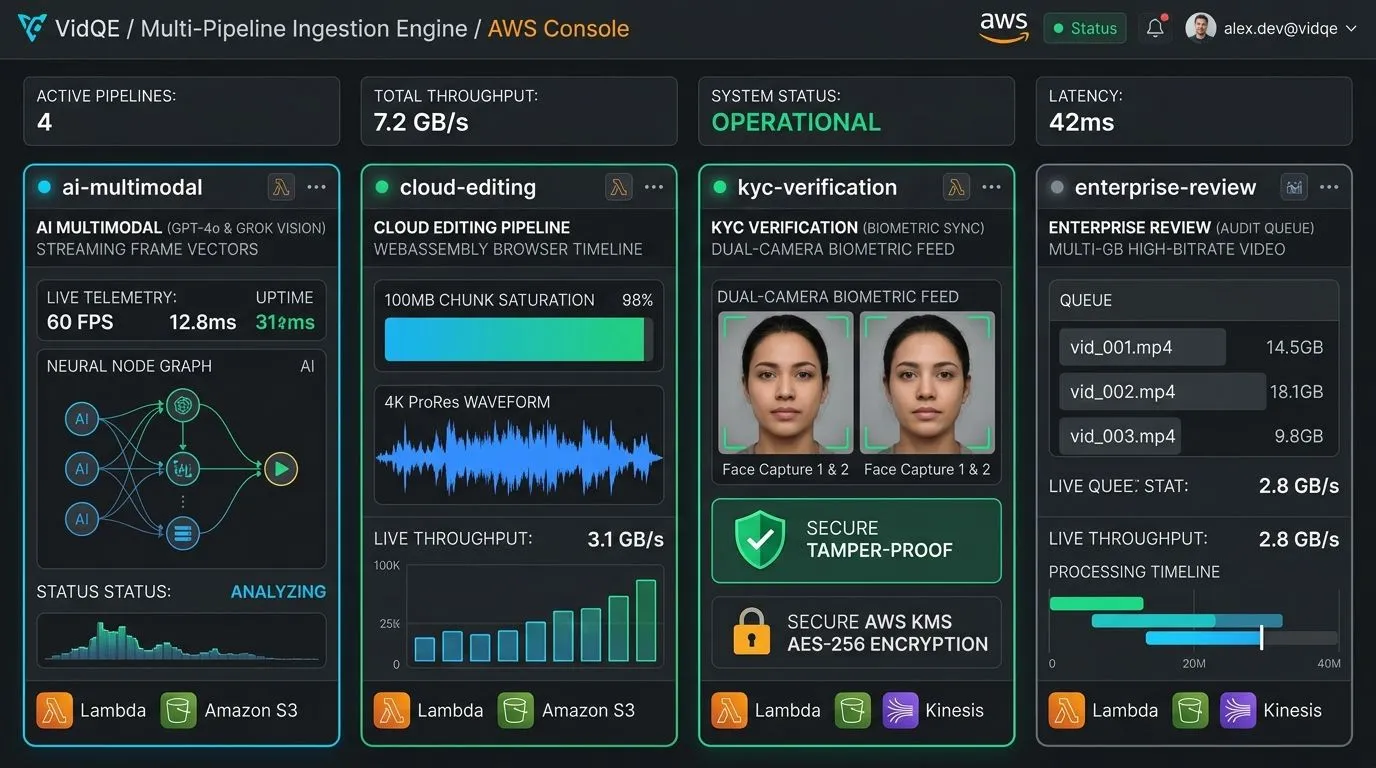
ai-multimodal(Multimodal AI & Foundation Models): Micro-chunked frame streaming with direct SQS vector worker dispatch for GPT-4o, Grok Vision, and robotic video feeds.cloud-editing(Browser NLEs & Web Timelines): 100 MB parallel byte-range chunking preserving timeline metadata for WebAssembly editors like Clipchamp or CapCut.kyc-verification(Biometric & Banking Identity): Synchronized dual-camera video streams sealed with AWS KMS envelope encryption at rest for tamper-proof eKYC.enterprise-review(Audits, Pitches & Talent Reviews): Multi-gigabyte candidate submissions with automated jury queue distribution.
Ingesting AI Datasets via Python SDK:
1
2
3
4
5
6
7
8
9
10
11
12
13
14
15
16
17
18
19
import vidqe

# Initialize VidQE Developer Client
client = vidqe.Client(api_key=os.environ.get("VIDQE_API_KEY", "your_vidqe_api_key_here"))

# Ingest high-framerate multimodal dataset with 256-way partition sharding
session = client.ingest(
    pipeline="ai-multimodal",
    file_path="./training_data/grok_vision_stream_4k.mp4",
    metadata={
        "model_target": "grok-vision-v2",
        "fps_sample": 60,
        "batch_id": "batch_9921_oct26"
    }
)

# Stream chunks in parallel directly into Amazon S3 partitions
session.upload(parallel_streams=8)
print(f"✓ Ingestion complete: {session.size_mb} MB in {session.elapsed_s}s [S3 Key: {session.s3_key}]")
Ingesting Web NLE Timelines via TypeScript Browser SDK:
1
2
3
4
5
6
7
8
9
10
11
12
13
14
15
16
17
18
19
import { VidQEEngine } from '@vidqe/engine-sdk';

const engine = new VidQEEngine({
  apiKey: process.env.VIDQE_API_KEY || 'your_vidqe_api_key_here',
  region: 'us-east-1'
});

// Stream 4K video timeline directly from client browser Web Worker
const upload = await engine.createMultiStream({
  file: videoFile,
  pipeline: 'cloud-editing',
  concurrency: 6,
  onProgress: ({ percent, speedMb, currentPart, totalParts }) => {
    console.log(`Ingesting part ${currentPart}/${totalParts}: ${percent}% @ ${speedMb} MB/s`);
  }
});

const result = await upload.complete();
console.log('✓ Video timeline sealed & ready for cloud rendering:', result.s3Key);
6. Real-World Benchmark: Traditional Clusters vs. VidQE
To quantify the operational and financial impact of this architecture, we audited a mid-sized production media workflow ingesting 12,000 video files (averaging 750 MB each) per month:
- Standing Idle Compute: $4,559.06 / month (EC2/ECS proxy cluster) ➔ $0.00 / month (VidQE Serverless)
- Ingestion Bandwidth Cost: ~$0.09 / GB (via proxy transit) ➔ ~$0.02 / GB (direct S3 ingestion — 78% savings)
- Peak Write Capacity: Hard-limited by EC2 RAM & socket pool ➔ 896,000 Req/sec (256-way partition sharded)
- API Gateway 10 MB Ceiling: Blown immediately ➔ 100% Bypassed via Direct S3 Presigning
- Single Point of Failure (SPOF): Application Load Balancers & proxy containers ➔ Zero SPOF (Pure S3 distributed mesh)
- Infrastructure as Code (IaC): Drift-prone manual bash scripts ➔ 100% Declarative Terraform
- Time-to-Scale on Sudden Burst: 4 to 8 minutes (Auto Scaling spin-up) ➔ Instantaneous (< 50 ms)
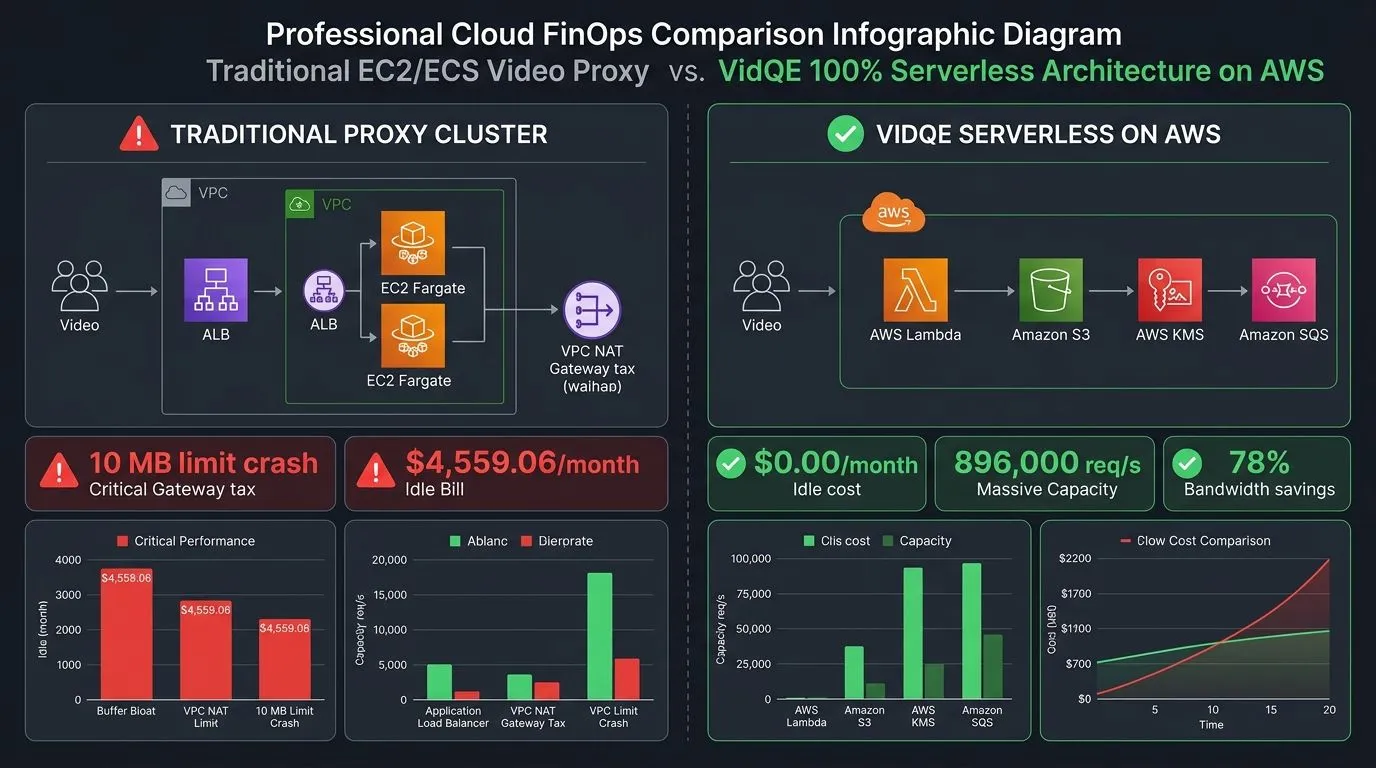
By decoupling compute from the data path and routing chunk streams directly into Amazon S3, VidQE achieves a 78% reduction in cloud bandwidth costs and eliminates standing infrastructure bills entirely.
7. Production Takeaways: 5 Cloud Architecture Rules to Steal Today
If you take only five lessons away from this build for your own cloud systems, make them these:
- Never pass binary streams through application servers. If your Node.js, Python, or Go backend is receiving multipart form-data for files larger than 10 MB, you have built a ticking time bomb. Refactor to presigned direct-to-storage uploads immediately.
- Inject cryptographic entropy before scale catches you. Amazon S3 scales infinitely, but only if you distribute write keys across multiple partition prefixes. A 2-character hexadecimal hash prefix (
00/toff/) unlocks 896,000 requests per second with zero operational complexity. - Audit your VPC boundaries for the "NAT tax." Do not drop Lambda functions into private VPC subnets by default unless they genuinely require access to internal resources like Amazon RDS. Managed services like S3, Cognito, and KMS are secured far more cleanly with IAM execution roles and SigV4.
- Scope presigned credentials to single byte ranges. Never mint bucket-wide or wildcard write tokens. Bind presigned URLs strictly to an explicit part number, content length, and immutable partition key path with aggressive expiration windows.
- Decouple ingestion completion from downstream processing. Never run transcoding, embedding generation, or AI inference on the upload response path. Acknowledge the upload in milliseconds and let queue workers process asynchronously with Dead-Letter Queues and exponential backoff.
The Road Ahead
We built VidQE because developers building the next wave of generative AI and video applications shouldn't have to spend six months reinventing resilient chunking algorithms, partition sharding, and cryptographic token lifecycles just to let their users upload media.
The future of software is real-time, high-definition, and multimodal. The infrastructure that powers it should be fast, indestructible, and scale to zero.
👉 Explore the live platform, Developer Console, and interactive SDK playground at vidqe.secada.in
Enjoyed reading this content? Let the author know!
Your likes, comments, shares, and saves help creators reach more builders.

Loading recommendations
Loading article