
Found: Building an AI-Powered Disaster Response Platform on AWS
Found is an AI-powered disaster-response platform built on AWS that verifies report sources, tracks conflicting information, and helps families and responders access reliable updates about missing persons, shelters, and hazards.

Using serverless architecture and AI-powered provenance tracking to make disaster information more transparent and trustworthy.
Introduction
During a disaster, information comes from everywhere: hospitals, police departments, NGOs, volunteers, and news outlets. Reports can be duplicated, outdated, or contradictory, making it difficult for families and responders to understand what is actually known.
This inspired me to build Found, an AI-powered disaster-response platform that brings reports together while preserving their sources, tracking changes, and identifying conflicting information.
The goal is not simply to collect more data, but to help people understand where information originated and whether the available evidence supports it.
Architecture Overview
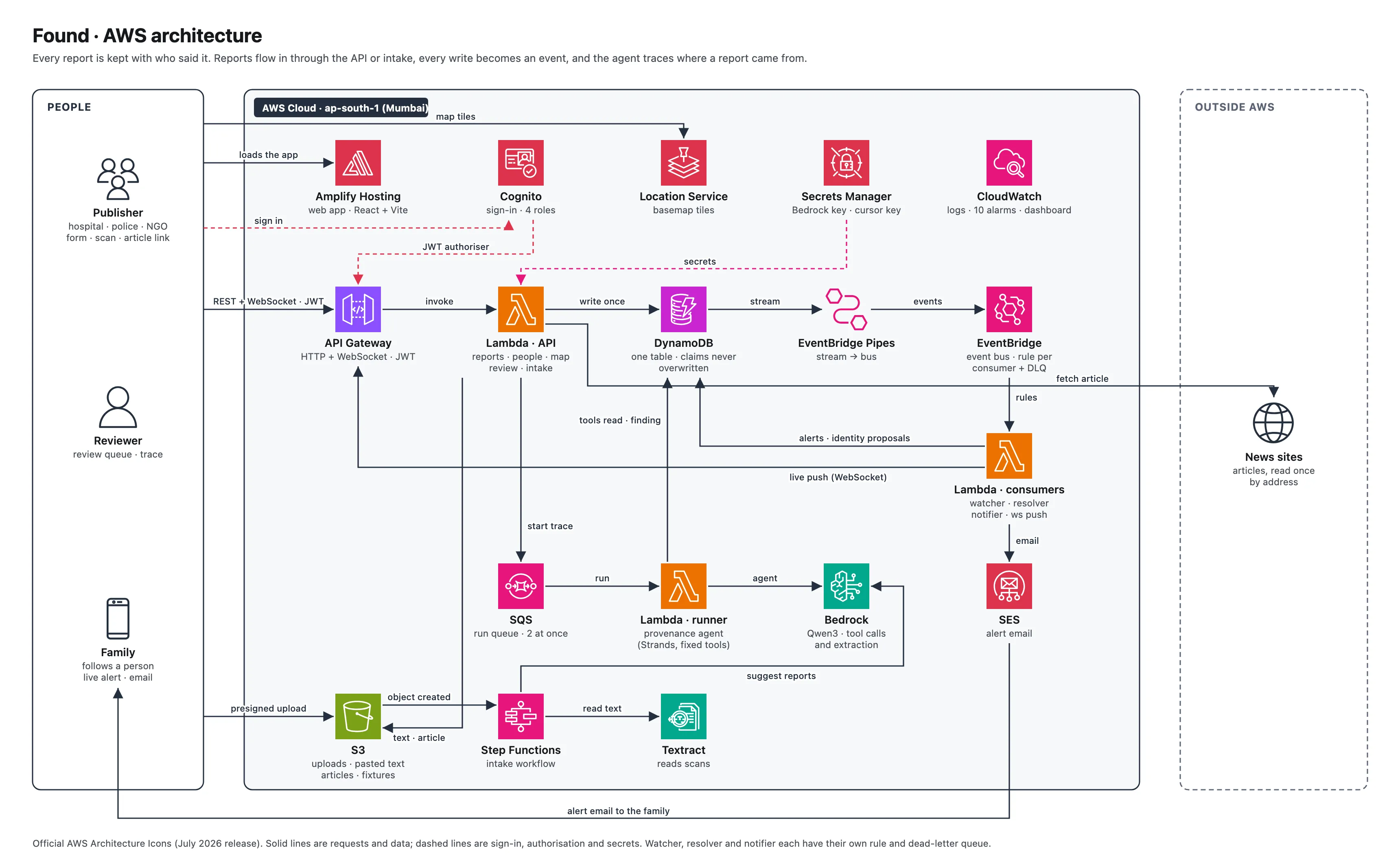
Found uses an event-driven, serverless architecture on AWS, deployed in the Mumbai Region (
ap-south-1 ).The frontend is built with React and TypeScript and hosted using AWS Amplify Hosting. Amazon Cognito handles authentication, while Amazon API Gateway exposes HTTP and WebSocket APIs backed by AWS Lambda.
Amazon DynamoDB stores reports and their associated claims. Rather than silently overwriting older information, the system preserves report history so reviewers can understand how information changes over time.
The architecture also uses DynamoDB Streams, Amazon EventBridge Pipes, Amazon EventBridge, and Amazon SQS to process report updates asynchronously. This keeps report submission separate from background work such as identity resolution, notifications, and provenance investigations.
Using AI to Trace Information Sources
One of Found's central features is its AI-powered provenance agent, built using Strands Agents and Amazon Bedrock.
Consider a report claiming that a missing person has been found safe. Instead of accepting the statement at face value, the agent investigates the cited sources and determines whether the information is first-hand, relayed, or unclear.
The agent produces structured findings, but AI does not make the final decision. Application code validates citations and controls subsequent actions. Conflicting or sensitive information can be sent for human review instead of being automatically published or communicated to families.
This separation between AI reasoning and deterministic validation is fundamental to building a system where incorrect information can have serious consequences.
Turning Documents into Reviewable Reports
Disaster information often arrives in scanned documents, printed lists, or pasted article text.
Found uses Amazon S3 to store uploaded documents, AWS Step Functions to orchestrate intake, and Amazon Textract to extract text from scans. Amazon Bedrock helps suggest potential reports from the extracted material.
Before suggestions enter the review workflow, application code verifies that their quoted text actually appears in the source material. Reviewers approve suggestions before they become published reports.
This approach combines automation with evidence checks and human oversight.
Notifications, Monitoring, and Reliability
Families can follow individuals and receive email alerts when meaningful new information becomes available. Amazon SES supports email delivery, while Amazon API Gateway's WebSocket API enables live application updates.
Amazon CloudWatch provides logs, alarms, and dashboards for monitoring the distributed workflows. Dead-letter queues help isolate events that cannot be processed successfully.
The system also incorporates limits on investigation runs, model calls, execution time, and concurrency. These controls help manage the cost and operational risks associated with asynchronous AI workloads.
Key Engineering Lessons
Building Found reinforced three important principles:
- Preserve evidence: Historical claims and their sources are essential when information conflicts or changes.
- Design for retries: Event-driven systems must handle duplicate delivery without producing duplicate outcomes.
- Constrain AI with code: Models can investigate and suggest, but deterministic validation and human review should control sensitive decisions.
Conclusion
Found demonstrates how AWS serverless services and generative AI can work together to support disaster-response information workflows.
Lambda, DynamoDB, EventBridge, and SQS provide the foundation for asynchronous processing, while Amazon Bedrock and Strands Agents support source investigations. Step Functions and Textract help transform documents into reviewable reports.
Ultimately, the most important design decision is not the choice of any single service. It is ensuring that every report remains traceable and that uncertainty is never mistaken for certainty.
In a crisis, knowing where information came from can matter just as much as knowing what it says.
Tags: AWS, Serverless, Generative AI, Amazon Bedrock, AWS CDK
Enjoyed reading this content? Let the author know!
Your likes, comments, shares, and saves help creators reach more builders.

Loading recommendations
Loading article