
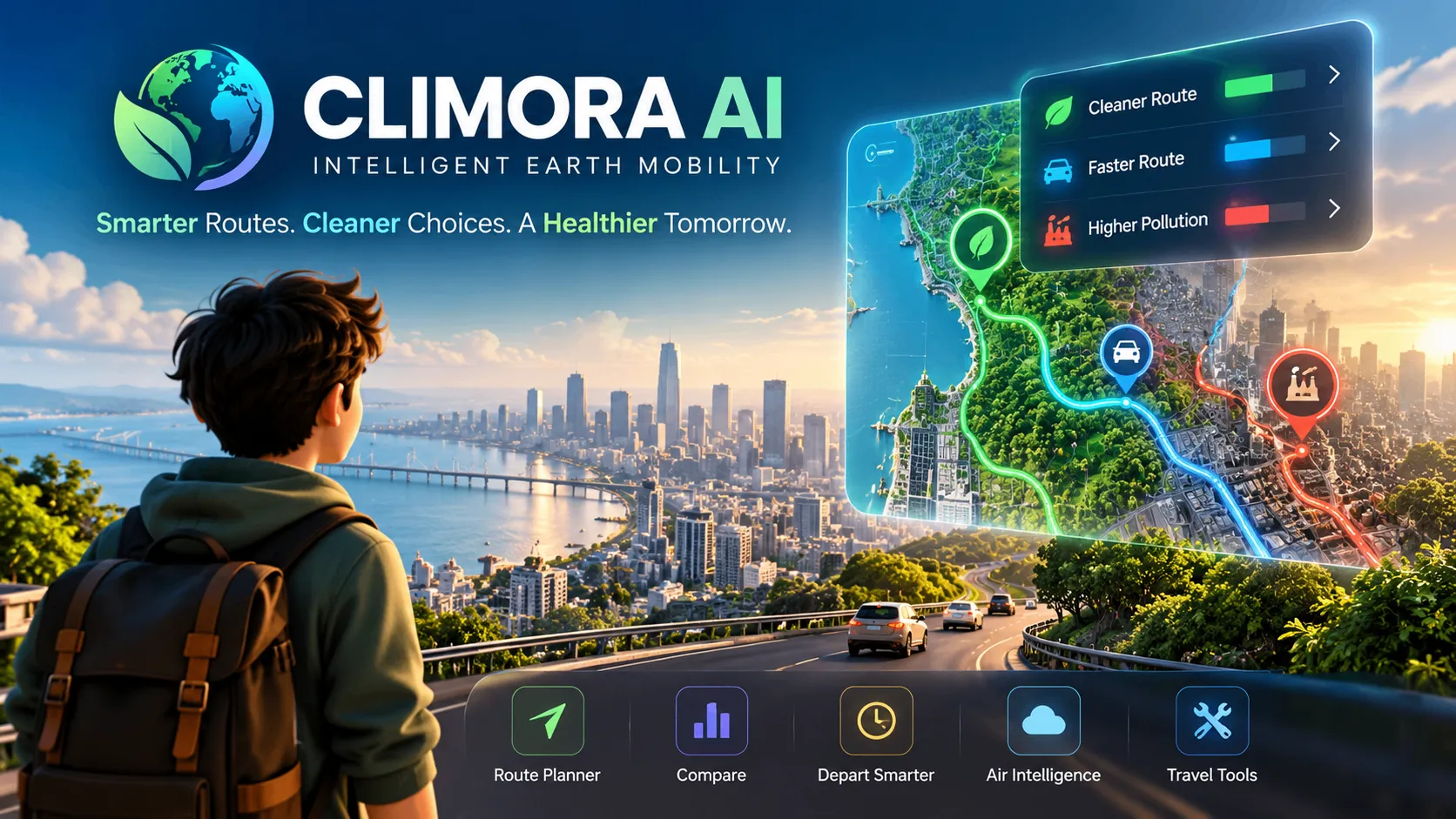
Building Climora AI: Smarter, Pollution-Aware Navigation with AWS
Climora AI is an environmentally conscious navigation platform that explores smarter route choices beyond just travel time. Discover how we used React, AWS Amplify, AWS Lambda, API Gateway, and other cloud technologies to build a route-planning prototype that combines navigation with environmental awareness.

AI/ML Student | Building Real-World Solutions | Hackathon Enthusiast | Future Entrepreneur
Building Climora AI: Smarter, Pollution-Aware Navigation with AWS
Introduction: The Problem We Wanted to Solve
Every day, millions of people use navigation applications to travel between locations. These applications provide valuable information about travel time, distance, and traffic.
But we wanted to explore another question:
What if the fastest route is not always the best route for the environment or the air we breathe?
Urban commuters regularly travel through congested roads and areas affected by air pollution. Choosing a route based only on the shortest travel time may overlook these environmental conditions.
This inspired us to build Climora AI — Intelligent Earth Mobility, a navigation prototype that brings environmental awareness into everyday travel decisions.
Our project was developed for AWS Environmental Hacks 2026.
What Is Climora AI?
Climora AI is a web-based navigation platform designed to help people explore road routes while considering travel efficiency and environmental context.
The platform brings together route planning, estimated travel duration, route comparison, and environmental information in a single interface.
Our goal is to help users make better-informed journey decisions without requiring unrealistic detours.
How Is Climora Different from Google Maps?
Google Maps is already a powerful navigation platform with traffic information, alternative routes, fuel-efficient routing, and air-quality features.
Climora AI is not intended to replace Google Maps. Instead, we are exploring a more focused environmental decision-making layer.
Imagine two possible routes between the same locations.
One route takes 25 minutes but travels through areas with potentially higher pollution. Another takes 28 minutes and may offer lower estimated pollution exposure.
Which one should a commuter choose?
Climora's route-analysis approach evaluates estimated pollution exposure alongside journey duration.
An important part of our design is allowing users to limit how much additional travel time they are willing to accept.
This helps prevent recommendations that might be environmentally preferable in theory but impractical for everyday travel.
Our current pollution-exposure approach uses simplified estimates rather than direct measurements of an individual traveler's inhaled pollution dose.
Exploring the Climora Website
We developed a responsive interface using React and Vite.
Users can explore the route planner, enter starting points and destinations, and interact with the mapping interface.
Our travel-planning experience includes different travel-mode options, such as driving, cycling, walking, and e-bikes.
The platform also includes several dedicated sections:
Route Planner: Explore routes, destinations, distances, and estimated journey times.
Compare: Examine travel alternatives with greater emphasis on informed decision-making.
Depart Smarter: Explore planning information intended to support better departure decisions.
Air Intelligence: Bring environmental context and estimated air-quality information into the travel experience.
Travel Tools: Provide additional utilities to support journey planning.
We have also designed an upcoming Nearby Friends feature, intended to support private invitations and optional, time-limited approximate location sharing. This feature is currently under development and is not available to users.
How We Used Amazon Web Services
AWS provided the cloud foundation for developing and deploying Climora AI.
Our architecture combines open-source frontend technologies with serverless AWS services.
1. AWS Amplify — Frontend Hosting
We used AWS Amplify to deploy our React application.
By connecting our GitHub repository to Amplify, we established a deployment workflow in which code updates can trigger new builds and deployments.
This simplified the process of moving from local development to a publicly hosted web application.
2. AWS Lambda — Python-Based Route Analysis
We developed route-analysis logic in Python using AWS Lambda.
Our algorithm explores the trade-off between journey duration and an estimated pollution-exposure indicator.
It also applies travel-time constraints to avoid selecting excessively long alternative routes.
Lambda provides a serverless environment for this backend functionality.
3. Amazon API Gateway — Backend Connectivity
We configured Amazon API Gateway to expose backend functionality through HTTP APIs.
This separates our React frontend from server-side processing and provides a structured foundation for integrating additional services.
4. Amazon Cognito — Authentication
We integrated Amazon Cognito into our authentication architecture to support user sign-in.
Authentication is particularly important when developing personalized features that may handle private user information.
5. Amazon DynamoDB — Future Friends Functionality
We configured DynamoDB as part of the backend architecture for our upcoming Nearby Friends feature.
Our design emphasizes privacy, mutual acceptance, and short-lived location sharing.
The feature remains disabled in the public interface while development and testing continue.
Challenges We Faced
Building Climora AI involved challenges across frontend development, cloud integration, and deployment.
One challenge was connecting multiple AWS services while maintaining a consistent frontend experience.
We also worked through GitHub deployment workflows, missing build dependencies, API Gateway configuration, and browser security settings such as CORS.
Integrating mapping services introduced additional considerations, including API-key restrictions and domain authorization.
These experiences helped us better understand cloud architecture, deployment troubleshooting, and practical application security.
Future Scope
Climora AI is a working web prototype with an evolving environmental-navigation architecture.
Our next development goals include improving the accuracy of pollution estimates, expanding environmental data integration, validating route recommendations using more representative data, and strengthening end-to-end testing.
We also want to improve personalized journey planning and eventually launch privacy-conscious collaborative travel features.
Conclusion
Climora AI began with a simple question:
Can navigation help people make decisions that consider both their time and their environment?
Using React, Python, AWS Amplify, AWS Lambda, Amazon API Gateway, Cognito, and DynamoDB, we built a cloud-based foundation to explore this idea.
Our journey showed us how serverless technologies can support innovative approaches to real-world environmental challenges.
We believe the future of mobility is not only about reaching a destination faster, but about making smarter decisions along the way.
Climora AI — Beyond the Fastest Route. Towards Smarter Journeys.
Explore Our Project
Built for AWS Environmental Hacks 2026.
Enjoyed reading this content? Let the author know!
Your likes, comments, shares, and saves help creators reach more builders.

Loading recommendations
Loading article