
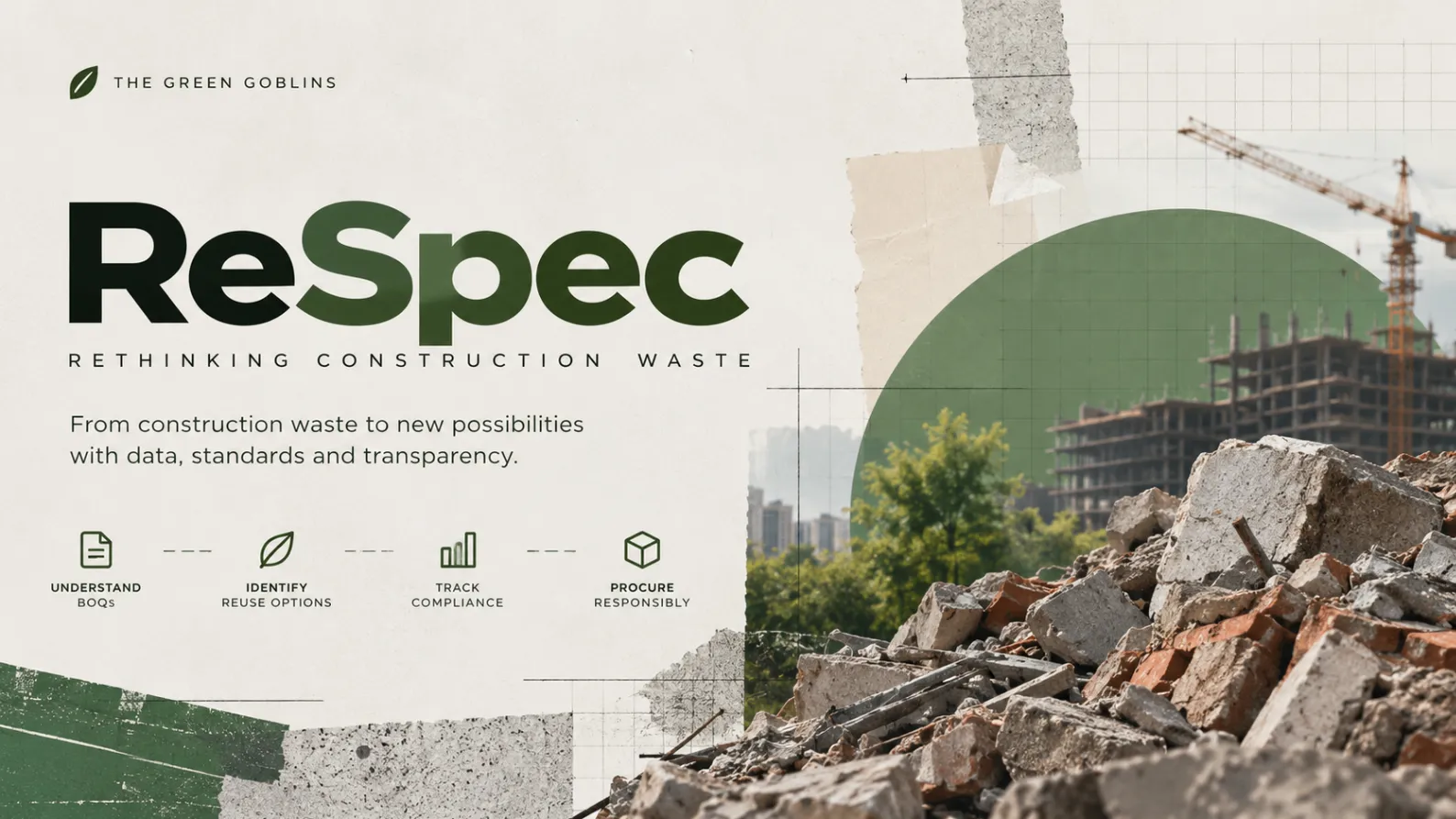
ReSpec: Rethinking Construction Waste
Exploring how AWS can help make construction-waste reuse smarter, more transparent, and actionable with ReSpec at Environmental Hacks 2026.

Construction and demolition waste is a growing challenge for cities like Delhi. While recycling facilities can process discarded construction materials, ensuring that recycled products find appropriate uses in new projects remains a significant challenge.
At Environmental Hacks 2026, organised by WeMakeDevs in collaboration with AWS Builder Center, our team, The Green Goblins, explored this problem through ReSpec — a decision-support platform designed to help construction teams identify potential opportunities for recycled-material use and track procurement more transparently.
I attended the in-person build day at Delhi Technological University (DTU) on October 10, as part of the Bharat Builds Tour. The experience gave us an opportunity to approach an environmental challenge through practical engineering, thoughtful system design, and collaboration.
---
The idea behind ReSpec
Construction projects rely on Bills of Quantities (BOQs) to describe materials and quantities required for execution. However, identifying where recycled alternatives may be appropriate involves reviewing material specifications, applicable standards, and project requirements.
ReSpec aims to simplify this process through four key capabilities:
- BOQ processing: Extract structured information from construction documents and allow users to review uncertain entries.
- Rules-based evaluation: Identify potential recycled-material substitutions using applicable, source-backed standards.
- Compliance-gap analysis: Estimate how permitted substitutions contribute towards relevant recycled-material targets.
- Procurement tracking: Distinguish between eligible, planned, ordered, and verified quantities using a delivery-evidence ledger.
The objective is not to replace engineering judgement. Instead, ReSpec is designed to help procurement teams make better-informed decisions while keeping assumptions, limitations, and approval requirements visible.
---
How ReSpec works
Plain text
Construction BOQ (PDF / CSV / XLSX)|vExtract Material Data(Amazon Textract)|vReview & Correct Data|vClassify Material Items|vEvaluate Applicable Rules|vCalculate Gap vs Target|vHuman Review & Approval|vGenerate Procurement Plan|vTrack Order & Delivery|vVerify Supporting Evidence|vReport Verified Quantities
Figure: ReSpec's proposed workflow, from construction-document processing to evidence-backed procurement tracking.
---
Where AWS fits in
We designed ReSpec around AWS services that support document processing, workflow orchestration, and reliable data management.
- Amazon Textract is intended to extract tables from uploaded BOQs, converting document content into structured information that can be reviewed and processed.
- AWS Step Functions coordinates the proposed document-processing workflow, connecting extraction, normalisation, classification, and persistence into manageable stages.
- AWS Lambda and Amazon API Gateway provide the planned backend processing logic and API layer, while Amazon S3 and Amazon DynamoDB support document storage, project records, decisions, and delivery tracking.
- Amazon CloudWatch provides logging and observability to help diagnose processing failures and understand workflow execution.
Each service has a specific role in the architecture. The goal is to use cloud technology to make a document-heavy workflow more manageable, traceable, and easier to maintain.
---
AWS architecture at a glance
Plain text
Web Application|vAmazon API Gateway|vAWS Lambda|+---------+----------+| |v vAmazon S3 Amazon DynamoDBDocuments & Evidence Projects & Records^|AWS Step Functions|vAmazon TextractAmazon CloudWatchLogging & Monitoring
Figure: Simplified view of ReSpec's proposed AWS architecture. Step Functions orchestrates asynchronous document processing, while S3 and DynamoDB support storage and application records.
---
Building responsibly
One of our key design considerations was handling uncertainty. Construction documents can contain ambiguous descriptions, incorrect quantities, or missing specifications. Similarly, a recycled-material substitution should never be recommended without adequate supporting rules.
ReSpec therefore incorporates human review and conservative eligibility checks into its proposed workflow. Where a rule is missing or a specification is unclear, the system should flag the item for manual review rather than inventing a recommendation.
We also designed the procurement ledger to distinguish planned quantities from verified deliveries. A proposed substitution is not proof of environmental impact, and a delivery should only count as verified when the required supporting evidence has been recorded.
These principles shaped our approach: build for traceability, make limitations visible, and avoid claims that cannot be substantiated.
---
Lessons from Environmental Hacks
Environmental Hacks reinforced the importance of beginning with a clearly defined problem rather than choosing technology first. It also highlighted how much thought goes into turning an idea into a system that can handle imperfect data, real-world constraints, and responsible decision-making.
Working on ReSpec helped us connect environmental sustainability with practical software engineering. It challenged us to think not only about what a system should do, but also about how it should behave when information is incomplete or a recommendation cannot be made safely.
---
What's next?
ReSpec is designed to help bridge the gap between recycled-material opportunities and construction procurement. Further validation of applicable standards, document extraction, and delivery-evidence workflows will be essential to making it useful in real projects.
Our goal is to continue developing a tool that helps construction teams evaluate appropriate reuse opportunities and track progress with greater transparency.
Participating in Environmental Hacks 2026 was a valuable reminder that technology can contribute to sustainability when it is built around a genuine problem, supported by careful engineering, and evaluated honestly.
Build thoughtfully. Measure honestly. Make reuse actionable.
ReSpec was developed by The Green Goblins for Environmental Hacks 2026, part of the WeMakeDevs Bharat Builds Tour in collaboration with AWS Builder Center.
Enjoyed reading this content? Let the author know!
Your likes, comments, shares, and saves help creators reach more builders.

Loading recommendations
Loading article