
Building CURE: Exploring Climate-Aware Utility Management
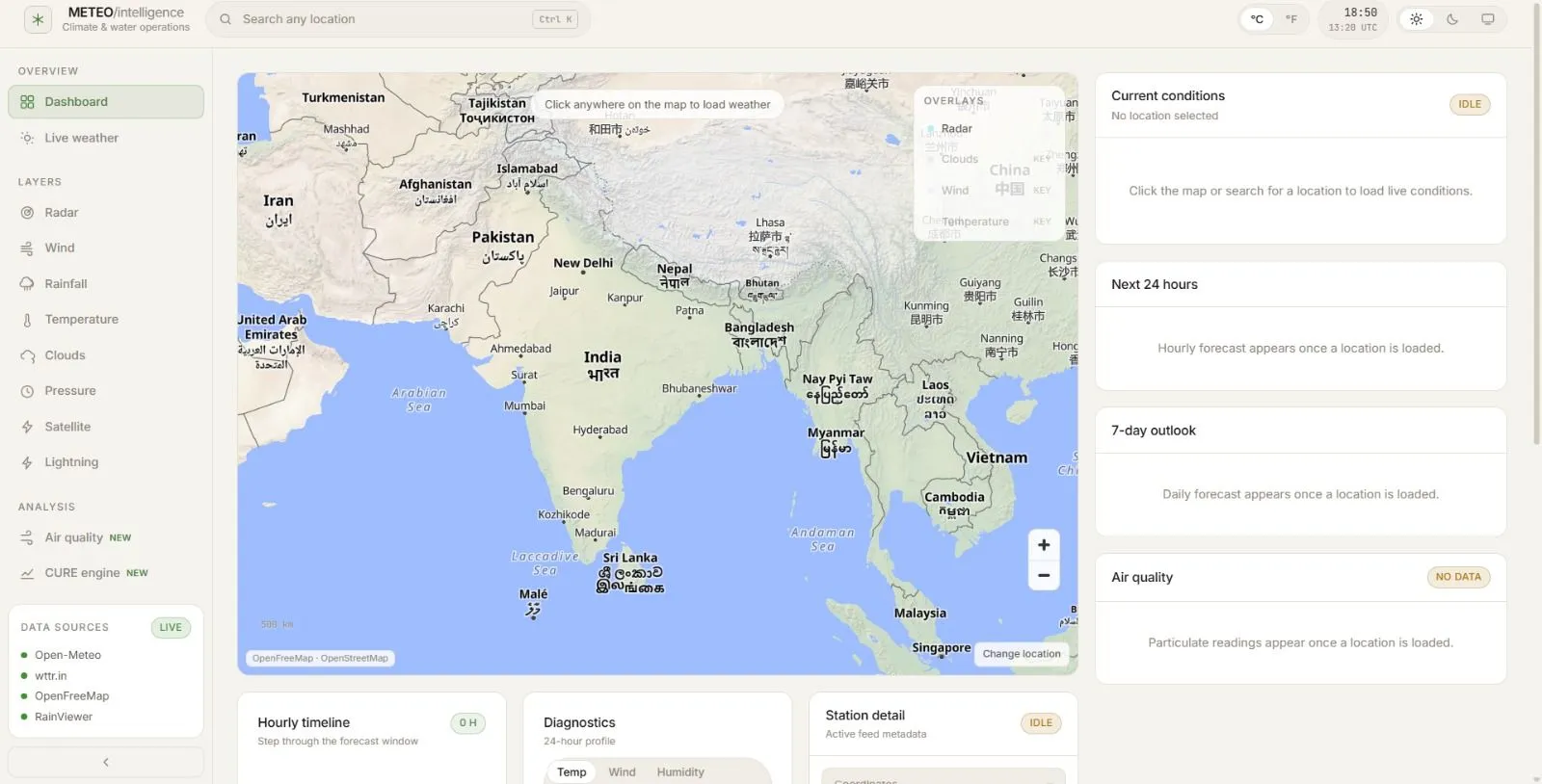
Explore how CURE (Climate & Utility Risk Engine) brings together weather insights, utility monitoring, demand prediction, and risk analysis in a unified dashboard. Discover the technologies behind the project, key learning experiences, and opportunities for future improvements in climate-aware resource management.


Building CURE: Exploring Climate-Aware Utility Management
Introduction
Environmental conditions play an important role in how communities and organizations manage essential resources such as water and energy. Changes in weather, rising temperatures, and variations in consumption can create challenges for effective resource planning.
Through the CURE (Climate & Utility Risk Engine) project, I explored how weather information, utility monitoring, and risk analysis can be combined in a single application.
The project focuses on making environmental and utility-related information more accessible and understandable, helping users explore resource usage and potential climate-related risks.
Project links
Understanding the Problem
Environmental conditions and utility consumption are often analyzed separately, making it difficult to understand how weather changes may influence resource demand.
For example, higher temperatures can increase cooling requirements and electricity consumption. Having access to weather information alongside utility-related indicators can help users explore these patterns more effectively.
CURE aims to address this challenge by bringing weather insights, consumption information, demand estimates, and risk indicators together in one dashboard.
The main objective is to provide a unified view of relevant information and support more informed resource-management decisions.
What Does CURE Offer?
CURE combines several useful capabilities within one application:
- Weather Insights: Provides access to weather-related information that helps users understand environmental conditions.
- Utility Monitoring: Helps users explore consumption data and identify usage patterns.
- Demand Prediction: Estimates potential resource demand using available data and analytical methods.
- Heat-Risk Indicators: Highlights conditions that may be associated with heat-related risks.
- Risk Analysis: Organizes relevant inputs into indicators that are easier to interpret.
- Unified Dashboard: Brings important information together in a centralized interface.
By combining these capabilities, CURE provides a foundation for understanding the relationship between environmental conditions and utility management.
Technology Behind the Project
CURE follows a frontend-and-backend architecture that separates the user interface from application logic and data processing.
React and Vite
The frontend is built using React, which supports the development of reusable interface components, while Vite provides the development environment and production build tools.
Together, these technologies help deliver an interactive dashboard for exploring weather information, utility-related data, and risk indicators.
Python and FastAPI
The backend uses Python and FastAPI to expose API endpoints and handle application logic.
The backend processes relevant inputs and provides information to the frontend, allowing the dashboard to display the results.
Data Processing and Analysis
Data processing and risk-analysis functionality help transform available inputs into more useful information.
The frontend communicates with the backend through API requests, and the returned results are presented through the dashboard. This separation helps organize the application and makes individual components easier to maintain and improve.
What I Learned from the Project
Working with CURE provided an opportunity to understand how different software components can be integrated into a practical application.
Some important takeaways from the project include:
- Learning how frontend interfaces communicate with backend APIs.
- Understanding the importance of data validation and error handling.
- Exploring how environmental information can support data-driven analysis.
- Recognizing how dashboards can simplify the interpretation of complex information.
- Understanding why predictions and risk indicators need proper testing and validation.
One important lesson is that building a useful application involves more than displaying information. Reliable data processing, meaningful analysis, and clear presentation are all essential to creating software that users can understand and trust.
Future Possibilities
There are several opportunities to improve and expand CURE in the future.
Potential enhancements include analyzing historical weather and consumption data, evaluating demand predictions against real observations, improving risk indicators, and strengthening data validation and error handling.
Cloud technologies could also be explored to support application hosting, data storage, monitoring, and future scalability. Any AWS integration should be selected according to actual application requirements and verified through implementation and testing.
These improvements could help make the platform more reliable and useful for climate-aware utility planning.
Conclusion
CURE demonstrates how software engineering and data analysis can be combined to explore climate-aware utility management.
By bringing together weather information, utility monitoring, demand estimates, and risk indicators, the project provides a foundation for understanding environmental conditions and resource usage through a unified interface.
Working on this project has been a valuable learning experience in application architecture, frontend and backend integration, data processing, and practical problem-solving.
The project also offers opportunities for further development, testing, and exploration of cloud technologies to support more informed resource-management decisions.
Explore the project
#AWS #Sustainability #Python #WebDevelopment #ClimateTechnology
Any opinions in this article are those of the individual author and may not reflect the opinions of AWS.
Enjoyed reading this content? Let the author know!
Your likes, comments, shares, and saves help creators reach more builders.

Loading recommendations
Loading article