
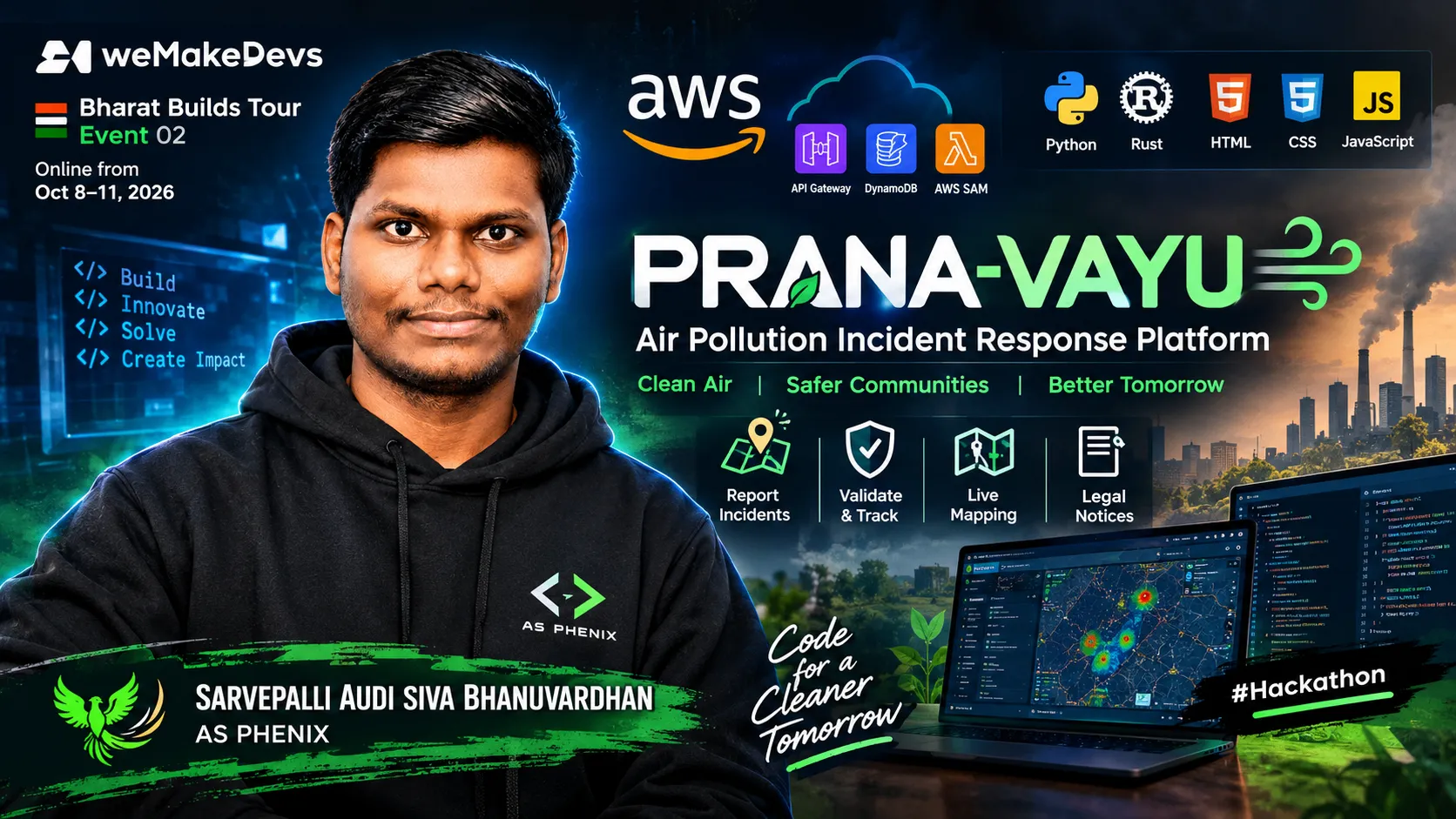
PRANA-VAYU: Turning Air Pollution Reports into Action
Air pollution is not just a city-wide statistic. Local incidents need clear reporting, reliable data, and a structured response. Learn how PRANA-VAYU aims to connect community observations with environmental incident management.

QUANTUM AS PHENIX || CRYPTOGRAPHY BIOS CYBERSECURITY ARCHITECT USING RUST, VERILOG , GOLANG ...!
PRANA-VAYU: Turning Air Pollution Reports into Action
Description
Air pollution is not just a city-wide statistic. Local incidents need clear reporting, reliable data, and a structured response. Learn how PRANA-VAYU aims to connect community observations with environmental incident management.
From Observation to Action
Air pollution affects communities in many ways. Open waste burning, vehicle emissions, and construction dust can create local problems that are difficult to report and track.
PRANA-VAYU is my project to help bridge the gap between observing pollution and taking action. It is an air-pollution incident reporting and response platform designed to help users record incidents, identify their locations, validate reports, and track response stages.
The project is being developed under my technology initiative, AS PHENIX.
The Problem
A person may notice smoke or construction dust near their home or campus, but reporting the incident is only the first step. Information must be organised, the location must be clear, and the response should be trackable.
PRANA-VAYU aims to provide a structured workflow for citizens, environmental volunteers, campus safety teams, and local authorities.
One important principle is data integrity: unmeasured air-quality values should never be presented as verified measurements. If reliable sensor or monitoring data is unavailable, the system should clearly indicate that the measurement is unavailable.
Technology and Architecture
PRANA-VAYU uses a modular architecture:
- HTML, CSS, and JavaScript: Web interface and user interaction.
- Python: API and application request handling.
- Rust: Core processing and validation logic. live link: https://prana-vayu-web.onrender.com/ Github Repo: https://github.com/Sarvepalliaudi/prana-vayu
Separating these components makes it easier to test the system, identify errors, and improve individual parts without redesigning the whole application.
Building the MVP First
MVP stands for Minimum Viable Product. Instead of building every possible feature immediately, I am focusing on the essential workflow first:
- Report an environmental incident.
- Validate the submitted information.
- Record and display the incident location.
- Track the incident through defined response stages.
Advanced mapping, response guidance, and downloadable reports can be expanded after the core workflow is implemented and tested.
My Cloud Deployment Approach
My planned AWS architecture uses:
- AWS Serverless Application Model (AWS SAM): To define and manage serverless infrastructure.
- Amazon API Gateway: To expose the application API.
- Amazon DynamoDB: To store incident information.
- AWS Identity and Access Management (IAM): To manage permissions using the principle of least privilege.
AWS SAM CLI is also planned for building, testing, and deploying the serverless application.
At the time of writing, my AWS account is still undergoing payment verification. I have therefore not yet deployed these components on AWS. Meanwhile, I am using Render to work on deploying and testing the application components.
I believe it is important to distinguish between a proposed cloud architecture and services that have actually been deployed.
A Real Engineering Lesson
During my Render deployment, the Rust code compiled successfully, but the service failed to start because the configured executable name did not match the generated binary name.
This taught me an important lesson: a successful build does not automatically mean a successful deployment.
Reading logs, checking start commands, validating port binding, and testing health endpoints are all essential steps in making software work outside a development environment.
What Comes Next?
My immediate goal is to complete and test the MVP, verify communication between the frontend and backend, and improve the reliability of the incident workflow.
Once my AWS account is ready, I plan to evaluate and deploy the appropriate AWS services for the application.
PRANA-VAYU is a step towards making environmental incident reporting more structured, transparent, and useful to communities.
The goal is simple: turn environmental observations into information that can support action.
- SARVEPALLI AUDI SIVA BHANUVARDHAN
AS PHENIX
Enjoyed reading this content? Let the author know!
Your likes, comments, shares, and saves help creators reach more builders.

Loading recommendations
Loading article