
Beyond Environmental Dashboards: Building ECHO-FLOW
Discover how ECHO-FLOW brings flood intelligence, heat-aware mobility, and water-security decision support into one environmental platform. This article explores scenario-based reasoning, human oversight, AWS architecture, and the importance of distinguishing simulations from verified real-world data.
Beyond Environmental Dashboards: Building ECHO-FLOW, an Environmental Decision Intelligence OS
How I brought seven environmental challenges into one platform using simulation-driven reasoning, human oversight, and an AWS-oriented architecture.
Environmental problems rarely arrive one at a time.
A heatwave increases demand for water and electricity. Intense rainfall can overwhelm drainage systems, flood roads, and disrupt access to hospitals. A water shortage creates difficult choices about tanker allocation, groundwater use, and which communities need support first.
We have dashboards that visualize these risks. We have datasets that measure parts of the problem. But there is another question worth asking:
Once we understand the risk, how do we compare our options before taking action?
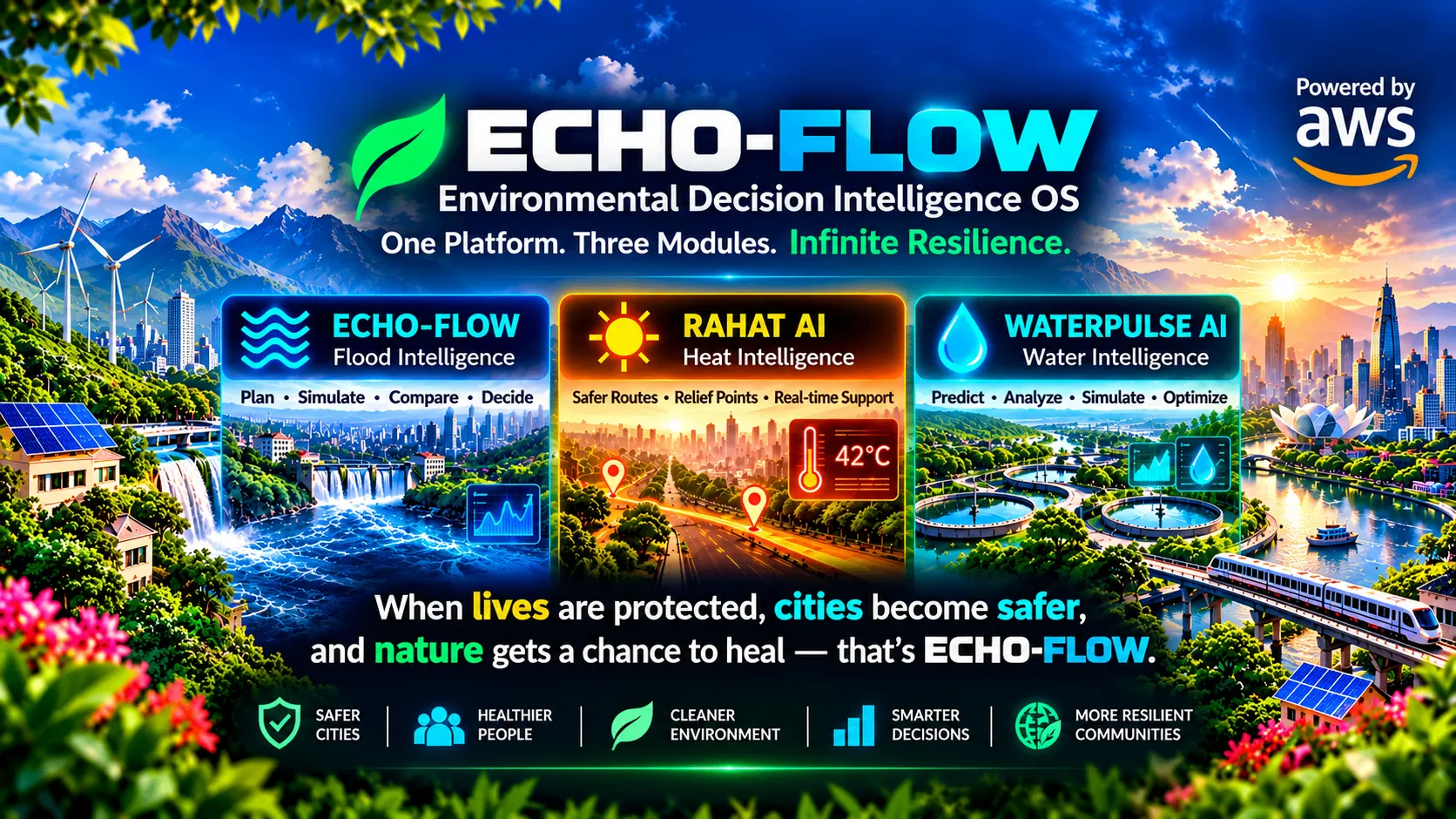
That question inspired me to build ECHO-FLOW — an Environmental Decision Intelligence OS that brings three specialized systems together to support more informed environmental decisions.
1. The Problem: Information Is Not the Same as a Decision
Environmental decision-makers often face three challenges:
- Fragmented risks: Floods, extreme heat, and water shortages are handled through different tools and workflows.
- Uncertain consequences: An intervention that helps one area may create a new problem elsewhere.
- Limited resources: Emergency teams and local authorities must prioritize routes, water distribution, and other responses with incomplete information.
A dashboard can show a concerning condition. A useful decision-support system should go further: compare possible responses, make assumptions visible, consider what happens if no action is taken, and help people understand the trade-offs.
ECHO-FLOW is my attempt to build that additional layer.
2. One Platform, Three Specialized Systems
Rather than building three unrelated applications, I organized the platform around one environmental mission and three specialized modules.
🌊 ECHO-FLOW — Flood and Emergency Intelligence
Flooding is not only a water-level problem. It can affect road connectivity, emergency access, critical services, and downstream communities.
ECHO-FLOW explores flood-related scenarios and compares intervention options against a no-action baseline. Its decision-support workflow considers downstream consequences, emergency accessibility, resource allocation, and safety checks.
The objective is to help users reason about the consequences of a proposed intervention rather than treating an individual action as an isolated fix.
☀️ RAHAT AI — Heat Intelligence
For delivery riders, outdoor workers, and commuters, the shortest route may not always be the most comfortable or thermally safer route.
RAHAT AI helps users compare routing options using estimated heat exposure and shade, with potential access to water, rest, and cooling points.
The goal is to make heat-aware mobility and relief planning part of the route decision, rather than considering distance alone.
💧 WATERPULSE AI — Water Security Intelligence
Water shortages create difficult allocation decisions. Where should a tanker go first? How could redistribution affect other areas? What happens if a proposed intervention is delayed?
WATERPULSE AI supports water-availability analysis, supply-demand comparisons, shortage scenarios, and potential interventions such as tanker allocation, redistribution, and water-loss reduction.
These are decision-support workflows, not claims that every water source or intervention is connected to live operational systems.
3. Seven Environmental Challenges, One Decision-Support Vision
The platform's interface organizes its scope around seven challenges:
- Heatwaves
- Floods
- Monsoon waterlogging
- Drought and water shortage
- Water tankers
- Water leaks
- Groundwater
These challenges share a common pattern: understand the situation, explore possible responses, compare their consequences, and identify the information still needed before making a decision.
The three modules provide specialized experiences for these problems while preserving a consistent platform identity.
4. Inside the Decision-Intelligence Workflow
The core idea is to move from simply displaying a risk to evaluating possible responses.
The conceptual workflow is:
OBSERVE → UNDERSTAND → GENERATE OPTIONS → SIMULATE → COMPARE → CHALLENGE → VERIFY → HUMAN AUTHORISATION
Each stage serves a purpose.
- Understand: Identify the environmental scenario and the resources or communities potentially affected.
- Generate options: Consider interventions alongside the no-action baseline.
- Simulate: Explore possible outcomes under the model's assumptions.
- Compare: Examine trade-offs instead of relying on a single recommendation.
- Challenge: Look for weaknesses, unintended consequences, and missing information.
- Verify: Check relevant constraints and evidence before proceeding.
- Human authorisation: Keep consequential decisions under appropriate human control.
A simulation is not a forecast simply because it produces a number. Its output depends on the quality of its inputs, assumptions, and model. This is why simulated scenarios must remain distinguishable from verified observations.
5. Architecture and Technology
The platform combines web interfaces with Python-based environmental scenario analysis and decision-support logic.
The architecture is organized around:
- User interfaces: Separate experiences for flood and emergency intelligence, heat-aware mobility, and water security.
- Simulation and analysis: Scenario modelling, what-if comparisons, and evaluation of possible interventions.
- Decision support: Comparison of options, safety considerations, and human-reviewed outcomes.
- Cloud architecture: An AWS-oriented foundation intended to support storage, APIs, workflow orchestration, authentication, and monitoring.
The ECHO-FLOW infrastructure foundation includes an AWS SAM template describing components such as Amazon S3, Amazon DynamoDB, Amazon API Gateway, AWS Lambda, AWS Step Functions, Amazon CloudWatch, and Amazon Cognito.
These components have distinct potential roles: S3 for object storage, DynamoDB for structured records, API Gateway and Lambda for API-driven processing, Step Functions for orchestration, CloudWatch for monitoring, and Cognito for authentication.
An infrastructure definition is not the same as a deployed production system. Components that have not been configured, invoked, and verified should be treated as architectural foundations rather than active integrations.
6. What I Learned from AWS Integration
Cloud integration taught me an important lesson: creating a resource does not guarantee that an application can use it correctly.
During work on location-based functionality, I encountered a permission mismatch between route-related capabilities and map rendering. A browser key that permits route calculations does not automatically have permission to render map tiles or map resources.
The practical lesson was to check the resource region, permitted actions, resource scope, and browser-origin restrictions independently.
For base-map rendering, MapLibre with OpenStreetMap tiles offers an alternative to relying on a single map-rendering service. However, a base map is not flood intelligence: verified flood extent, road closures, and live water observations require their own data sources and validation.
This distinction matters because environmental applications can influence consequential decisions. A visually convincing map must not imply that unverified information is real-time evidence.
7. What I Deliberately Keep Honest
ECHO-FLOW is a work in progress, and several engineering boundaries matter:
- Simulated environmental scenarios must be labelled as simulations.
- Estimated heat exposure and shade must not be presented as verified measurements.
- Water-resource scenarios must not be confused with confirmed local supply records.
- A proposed intervention must not be described as executed merely because the interface can model it.
- Cloud components in an architecture template must not be described as deployed services without verification.
These are not just presentation details. They are part of building environmental software that people can interpret responsibly.
8. Who Could Benefit?
The intended users include communities, outdoor workers, emergency planners, local authorities, and water-resource decision-makers.
A practical next step is to evaluate the platform against specific local scenarios with reliable datasets and domain experts. That would help establish where the models are useful, where their assumptions fail, and which data integrations should be prioritized.
The goal is not to replace human expertise. It is to make alternatives, assumptions, uncertainties, and potential consequences easier to examine before decisions are made.
9. What's Next?
The next stage is to strengthen the evidence layer and validate the system against real-world scenarios.
Priorities include:
- Integrating verified environmental data sources with clear timestamps and provenance.
- Testing scenario outputs against known events and expert-reviewed cases.
- Measuring whether intervention comparisons improve decision quality.
- Expanding safety checks and auditability.
- Verifying AWS integrations and deployment behaviour end to end.
These steps are essential before treating the platform as operational decision infrastructure.
Final Thoughts
Building ECHO-FLOW changed how I think about environmental technology.
The challenge is not only to collect data or display a warning. It is to help people reason about their options, understand the trade-offs, and make better-informed decisions without hiding uncertainty.
With ECHO-FLOW, RAHAT AI, and WATERPULSE AI, I am exploring how one platform can support decisions across flooding, extreme heat, and water security.
One platform. Three specialized systems. Seven environmental challenges. One goal: more resilient communities.
This is the beginning of a larger engineering journey toward environmental decision intelligence — built with transparency, human oversight, and responsible use of technology at its core.
Enjoyed reading this content? Let the author know!
Your likes, comments, shares, and saves help creators reach more builders.

Loading recommendations
Loading article