
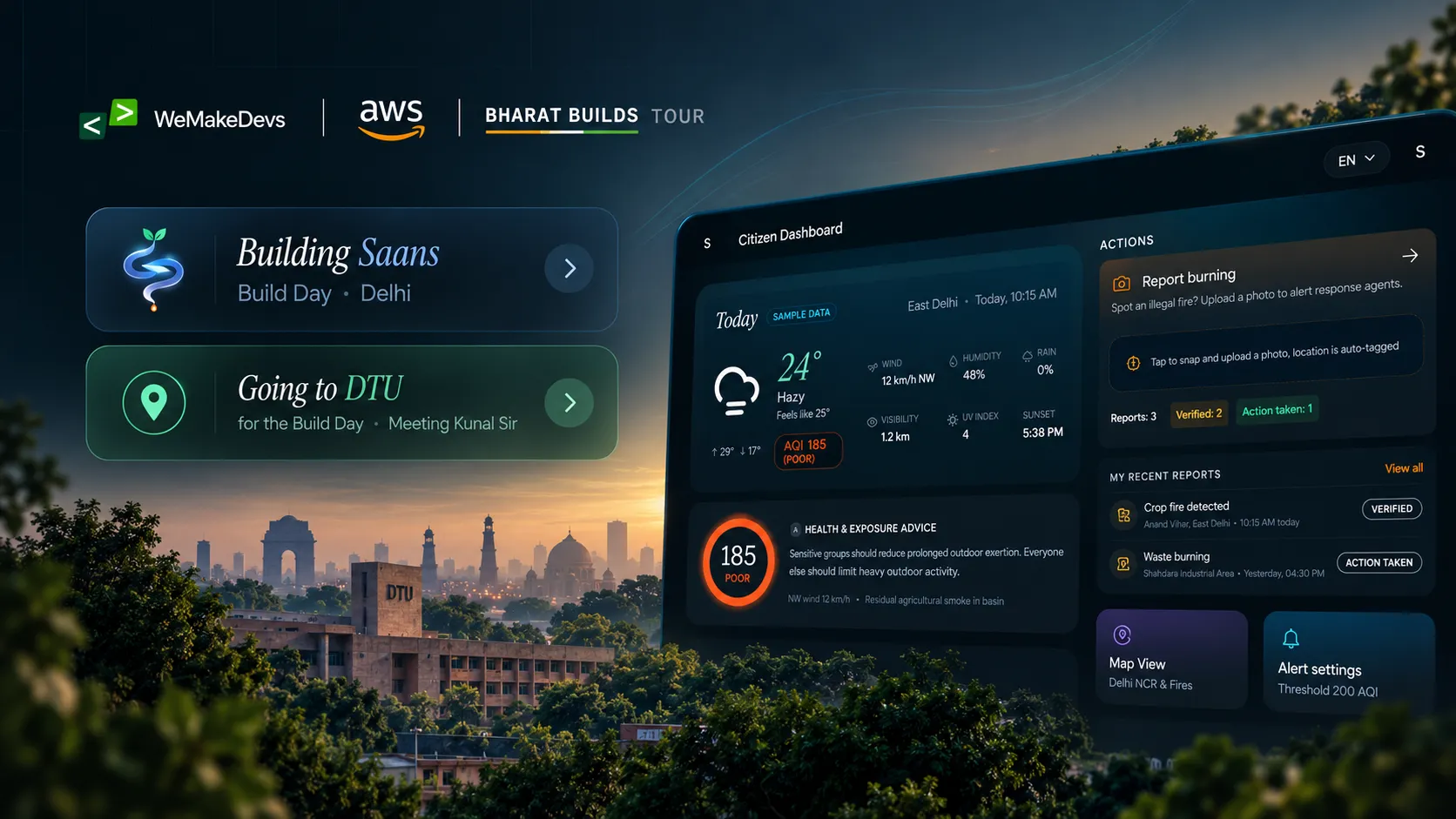
From Delhi’s Smog to AWS Agents: Building "Saans"
My Bharat Builds journey building Saans with AWS, serverless infrastructure and AI agents to tackle Delhi’s air pollution.

If you have ever lived in Delhi NCR during November, you already know the drill. The air turns thick, the sky goes a murky grey and stepping outside feels like walking into a gas chamber. As someone born and raised in Delhi, I have faced this every single year. The narrative is always the same: blame the stubble burning in Punjab and Haryana, blame the Diwali firecrackers, wait for the wind to pick up and repeat next year.
But complaining does not give a solution. So, I decided to tackle this massive, systemic issue the best way I knew how.
I built Saans (means breathe), a web portal designed to bridge the gap between the two main stakeholders in this crisis: the farmers who need a practical way to clear their land and the citizens choking on the consequences.

The Core Philosophy: Empathy Over Blame
For farmers, burning stubble is not an act of malice. It’s the cheapest, fastest way to prepare their fields for the next sowing cycle. Most simply lack the time or machinery to do it differently. Saans operates on a simple principle: we know the burning won't stop overnight, so our goal is to make the easier choice the right one.
The Farmer’s Dashboard
To give farmers a viable alternative, I built a multi-factor Planning Agent. It pulls real-time meteorological forecasts (rain, wind speed, wind direction), NASA FIRMS satellite fire detections for their district, and their specific crop sowing schedules.
Instead of just saying "don't burn," the agent evaluates the next seven days and recommends the optimal day to clear the field. It explains the exact rationale behind its choice in simple terms (with infrastructure laid out for English, Hindi, and Punjabi). If an alternative is needed, the platform helps them reserve a machine slot or directs them to ranked straw outlets, alongside details on available government subsidies.

The Citizen’s Arsenal
On the flip side, Delhi NCR residents need actionable data and a way to hold the system accountable. The citizen dashboard features:
- The "Today" View: Real-time AQI of the user’s specific ward, weather conditions, and straightforward health guidelines on whether it’s safe to step out.
- AI-Powered Incident Reporting: If you see a fire, you snap a picture. An AI model analyzes the image and categorizes it into crop burning, garbage burning, firecrackers or construction dust.
- The Triage Agent: Once the user confirms the category, an autonomous agent handles the backend magic, compiling duplicate reports, marking the status and pinning the verified incident on a public NCR map alongside live AQI and fire hotspots.
- Emergency Lifeline: A quick-access button to connect with ambulances or emergency contacts if breathing problems escalate.

Note: Weather, wind, NASA fire detection and AQI data are all live and updated every few hours. Machine listings and the initial impact data are currently sample datasets to demonstrate the platform's potential.
Designing the Smog: UI & UX
I wanted the frontend to visually reflect the problem we were solving. I opted for a deep dark mode combined with fluid, murky gradients that mimic the look of smoke and smog.
Using Next.js 15, React 19 and Tailwind CSS v4, I built a responsive, touch-first interface. To make the "smoke" feel alive, I integrated GSAP 3 for custom scroll reveals and smooth staggered micro-interactions. Typography plays a huge role too, using Plus Jakarta Sans for modern UI elements and Instrument Serif for editorial accents, with full Devanagari and Gurmukhi support ready for localization.

The AWS Struggle (Or: How I Learned to Stop Worrying and Love the Agents)
This was my first time seriously architecting something with AWS and doing it entirely alone during a hackathon was humbling. Building and orchestrating AI agents in the cloud is notoriously difficult and I spent hours staring at logs, wondering if the infrastructure was broken or if I had just misconfigured a policy.
Here is the engine that actually powers Saans under the hood:
The AI & Agent Architecture:
- AWS Strands Agents SDK: The backbone of the platform, orchestrating multi-step autonomous loops for the Planner Agent, Triage Agent, and conversational Ask Agent.
- Amazon Bedrock (Claude 3 Sonnet): The brain powering the recommendations, vernacular explanations, and image classification for citizen reports.
- Python 3.12 + Pydantic: Handling typed API schemas, spatial indexing with
pygeohash, and EXIF metadata extraction (using Pillow) to verify the GPS coordinates of citizen smoke reports.
The Cloud Infrastructure:
- AWS SAM & Lambda: Running the serverless backend for planning logic, bookings, and report processing.
- Amazon API Gateway & DynamoDB: Connecting the Next.js frontend to the backend REST APIs and storing users, reports, and machinery availability.
- Amazon Cognito: Handling authentication for both farmers and citizens.
- Amazon S3 & EventBridge: Storing uploaded pollution reports and automating background data syncs from external APIs (NASA FIRMS, Open-Meteo, OpenAQ).

Building Saans pushed me to my absolute limits as a developer. Orchestrating autonomous agents that need to cross-reference satellite thermal data with local tractor availability while ensuring the frontend stays buttery smooth, was a massive technical puzzle. But seeing the pieces finally click together, turning complex environmental data into a tool that could actually help my city breathe a little easier, made every broken deployment and sleepless hour worth it.
To cap it all off, I attended the Build Day at DTU on 10th Oct, which was an incredible experience. Between heads-down building and listening to invaluable insights from the mentors, the energy in the room was exactly what I needed. I even got incredibly lucky and ran into Kunal sir just as I was leaving the venue!

Peace out ✌️!
Enjoyed reading this content? Let the author know!
Your likes, comments, shares, and saves help creators reach more builders.

Loading recommendations
Loading article