
AQI Is a Number. Exposure Is a Daily Story.
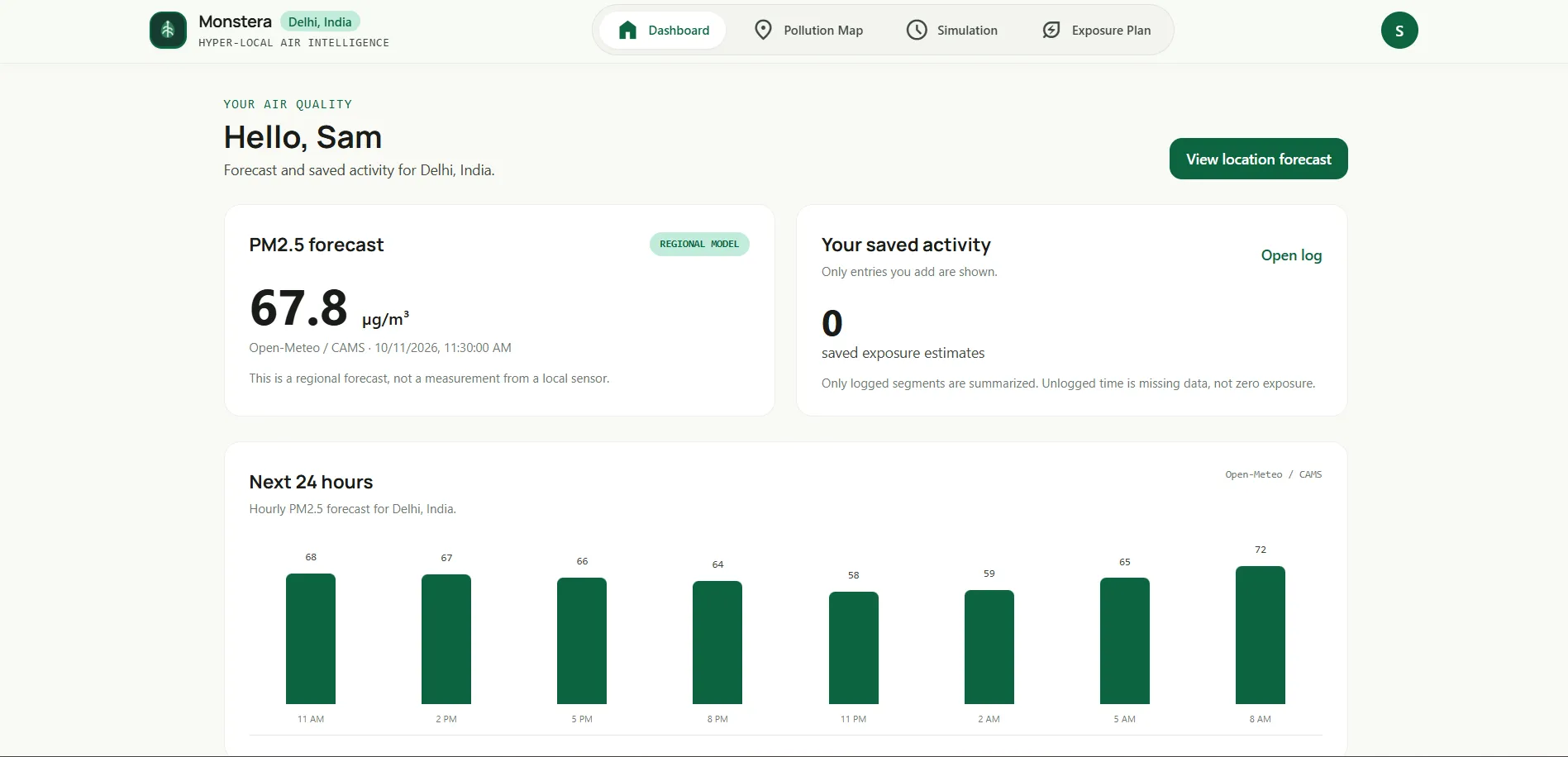
A citywide AQI reading cannot tell the whole story of the air we breathe. We're building Monstera, a personal air pollution exposure intelligence platform that explores how everyday routes, schedules, and outdoor activities affect individual exposure.

AQI Is a Number. Exposure Is a Daily Story.
Every winter, Delhi has a familiar ritual.
We check the AQI. We send screenshots to friends. We look at the sky and wonder whether it is a good idea to go outside.
But there is a question we rarely ask:
What does the air we breathe throughout an entire day actually look like?
Consider two students living in the same neighborhood. One walks along a busy road during the morning commute. The other travels at a different time and spends more time indoors. A citywide AQI reading may be the same for both, but their pollution exposure can be very different.
That difference is the problem we're exploring with Monstera.
The problem with looking at AQI alone
AQI is useful. It communicates air quality in a way that people can understand quickly.
However, it describes air quality at a particular place and time, based on a standardized index. It does not directly measure an individual's personal exposure throughout the day.
To understand that exposure, we need to consider more than a single number:
- Concentration: How much particulate pollution is present in the air?
- Duration: How long is someone exposed?
- Location: Does their commute pass through different pollution hotspots?
- Daily routine: When do they travel, exercise, study, or work outdoors?
These factors create a more useful picture of the relationship between the environment and everyday life.
This is especially relevant to people who spend significant time outside, including students, delivery workers, street vendors, and daily commuters.
Introducing Monstera
Monstera is our project exploring a more personal approach to air pollution intelligence.
Instead of stopping at the question, "How polluted is my city?", we want to help people explore three more practical questions:
- How much pollution might I encounter throughout my day?
- Could changing my routine reduce that exposure?
- What patterns should I pay attention to when planning tomorrow?
We're designing Monstera around three connected capabilities.
1. Personal Exposure Twin
The first capability estimates an individual's time-weighted PM2.5 exposure using available pollution measurements, location, time, and activity information.
Imagine seeing a timeline of your day that highlights when estimated exposure was highest, rather than simply seeing the current AQI.
The challenge is to combine environmental data with a person's routine while being honest about uncertainty. An estimate based on nearby monitoring stations is not the same as a personal sensor measurement.
Monstera should make that distinction clear.
2. Exposure Time Machine
What if you left for college 30 minutes earlier?
What if you chose a different street for part of your commute?
What if you moved an outdoor activity to a period when forecast pollution levels were lower?
The Exposure Time Machine is designed to compare a baseline routine with alternative scenarios.
The goal is not to promise that a particular route is always clean. It is to estimate how different decisions might change exposure, while accounting for travel time, available pollution data, and uncertainty.
A useful recommendation should explain its trade-offs, not simply display a green badge.
3. Pollution Debt Planner
Exposure is not just a momentary event. Patterns can emerge across days and weeks.
Monstera's Pollution Debt Planner is intended to help users identify recurring high-exposure periods, review their history, and explore practical ways to reduce future exposure.
Here, "Pollution Debt" is a product metaphor for cumulative exposure patterns. It is not a clinical measurement or a medical diagnosis.
We want the feature to encourage informed decisions rather than create unnecessary fear.
Building Monstera: From frontend to cloud deployment
A useful environmental application needs more than an attractive dashboard. It needs a reliable way to serve the application, manage its backend, and eventually process environmental data.
For Monstera, we're using Amazon EC2 to deploy our application and run it on AWS infrastructure. This gives us a real cloud environment in which to host the project and work toward a production-style deployment.
Using EC2 also gives us hands-on experience with the practical side of building software: configuring a server, managing application processes, handling environment variables, and making the application accessible beyond a local development environment.
Our planned technical architecture brings together:
- FastAPI and Python for backend APIs and exposure-calculation services.
- PostgreSQL for pollution readings, activity records, exposure history, and simulation results.
- Environmental data sources for available pollution observations and forecasts.
- Data analysis and machine learning to investigate spatial patterns and improve estimates when sufficient training data is available.
- Amazon EC2 for cloud deployment and hosting.
We are treating deployment as part of the engineering process rather than an afterthought. A working cloud deployment is an important step toward making Monstera accessible to users and testing its behavior outside a local development environment.
The backend and data pipeline must also distinguish measured data from interpolated values, forecasts, and modeled estimates.
A prediction should never be presented as an observation. Missing readings should not silently become invented values. And a model should not be called accurate until it has been evaluated against appropriate data.
We plan to begin with transparent calculations and measurable baselines before introducing more complex models.
For an environmental application, trust is part of the engineering.
From information to decisions
Environmental dashboards often give people more information without making their next decision any easier.
We want Monstera to take a different approach.
Imagine opening the dashboard and reviewing current air quality. Your daily timeline highlights a period of potentially elevated exposure. You open the Exposure Time Machine and compare an alternative schedule. The application presents the estimated difference, additional travel time, and uncertainty so you can decide whether the change makes sense.
The important output is not another number on a screen.
It is a better-informed decision.
Changing a commute cannot solve the underlying pollution problem. Personal exposure tools should complement public-health guidance and broader efforts to reduce emissions, not shift responsibility for clean air onto individuals.
What we want to learn
Building Monstera raises several questions we want to investigate:
- How reliably can we estimate personal exposure using available monitoring data?
- How much do location and time-of-day differences matter for everyday routines?
- How should an application communicate uncertainty without making the results unusable?
- Can scenario comparisons help people identify practical exposure-reduction opportunities?
- How can we make these insights accessible without collecting more personal location data than necessary?
These are engineering and product questions, not assumptions we can answer simply by building a dashboard.
They will shape how we evaluate the system as we develop it.
Building for a world that needs better environmental intelligence
Monstera started with a simple observation: knowing the air quality around us is useful, but understanding how our everyday routines interact with that air could be even more useful.
By combining environmental data, a personal exposure perspective, and cloud infrastructure on AWS, we're exploring how pollution information can become something people can act on.
Our goal is to build a tool that helps people understand their exposure, compare their options, and make more informed decisions about their day.
Because clean air is a public concern. Better information should be part of the response.
Monstera is our contribution to the air-pollution hackathon: a project focused on turning environmental data into practical, personal insights while learning how to build and deploy a useful application on AWS.
Enjoyed reading this content? Let the author know!
Your likes, comments, shares, and saves help creators reach more builders.

Loading recommendations
Loading article