
Codebase Welcome Guide: an agent that reads a repository so you don't have to start cold
Turn any public GitHub repository into a clear codebase guide in seconds. Discover the tech stack, key files, project purpose, and next steps with AI.

AWS Community Builder - Dev Tools | 2× AWS Certified | Devops/Cloud Consultant
What it does
You have been handed a repository you did not write. The README is either a marketing page or a stub, the directory listing is forty entries deep, and the question you actually have where do I start? is not one a file tree answers.
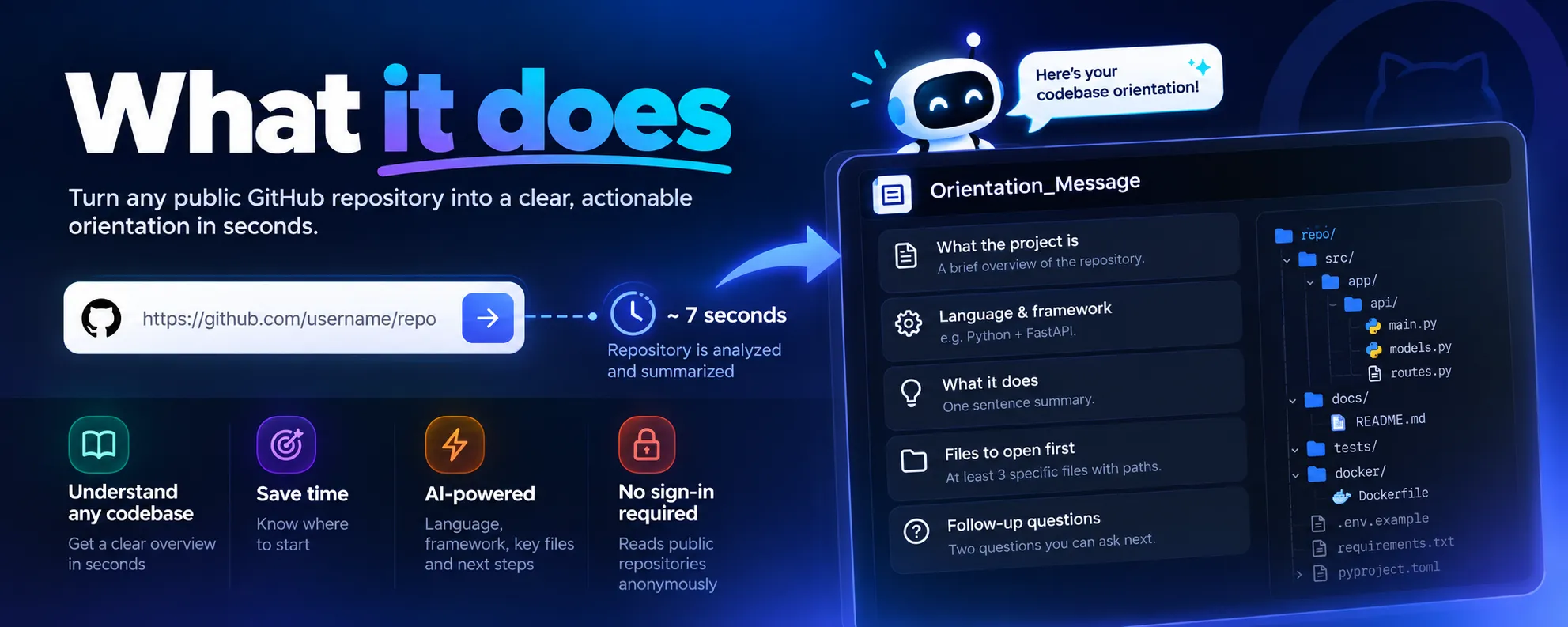
The Codebase Welcome Guide answers it. You paste a public GitHub repository URL into a chat box. About seven seconds later you get an Orientation_Message: what the project is, what language and framework it is built in, one sentence on what it does, at least three specific files worth opening first, and two follow-up questions you could ask next. Then you can ask them, and anything else, against the same ingested context.
What happens in between is fixed, and that is deliberate. The agent validates the URL, fetches repository metadata, lists the default branch's tree, selects up to twelve files by a five-tier priority order, reads them fr
raw.githubusercontent.com , truncates each to 8,000 characters, fits the whole thing inside a 30,000-token budget, and asks the model. No tools, no agent loop choosing its own next move, no database, no server-side session. One HTTP request does the entire job.It reads public repositories anonymously. There is no sign-in, no token to paste, and nothing stored between requests.
How it was built
Python 3.12 on AWS Lambda — one function, 1024 MB, a 60-second timeout. It sits behind an AWS Lambda Function URL with
AuthType: NONE and that one function serves both halves of the product: GET / returns the chat UI straight out of the deployment package, and POST /api/chat runs the agent. Because one origin serves the page and the API, every request is same-origin, and the project has no CORS configuration.
Inference is Amazon Bedrock Nova Lite (
amazon.nova-lite-v1:0 ) through the Converse API, at temperature 0.3 with a 600-token output cap. Nova Lite is the right size for this: the job is summarizing text that is already in the prompt, not reasoning hard, and the orientation has a 20-second budget to land in.
Amazon CloudWatch Logs holds the structured log line each request emits — correlation id, per-step durations, token estimate against actual, and the orientation repair count — with 7-day retention, set explicitly in the template so the function cannot fall back to "never expire".
Amazon SNS carries the one alert the system has: a CloudWatch billing alarm on
EstimatedCharges at 10 USD, publishing to a topic with an email subscription. The alarm and the topic live in the same stack as the function, which works only because the region is us-east-1 — that metric publishes there and nowhere else. It's all one AWS SAM template. No agent framework: the flow has no decision to delegate, so a direct Converse call is the whole model layer.The build experience
Five things are worth writing down, because four of them were not in the plan.
The preflight gate was deliverable zero. Before any infrastructure existed, I wrote a script that checks four things in order: that a region was explicitly configured, that credentials resolve, that CloudFormation answers a read-only probe, and that Nova Lite returns a real inference. It writes a marker file, and the deploy script refuses to run without one newer than the template. Writing it first paid for itself immediately — it is where I found that botocore's
retries.max_attempts counts retries, not attempts, and that the default retry mode would have multiplied my three-attempt loop into fifteen real calls against a model I was being billed for. "Up to 2 retries" is a claim in my requirements. It would have been false.
The Orientation_Message is a validate-and-repair step, not a prompt and a hope. You cannot promise that a small fast model will return five specific things inside 20 seconds. So
orientation.finalize inspects what came back, appends whatever is missing from the manifest the agent already ingested, and returns the list of repairs it had to make so the handler can log it as a metric. Repairs are appended, never substituted, so a good answer is left exactly as the model wrote it. The word cap is paid for before the repairs are written, because capping first and appending second would either breach the 350-word limit or have the final cut remove the follow-up questions the repair just added. A rising repair rate is the signal that the prompt needs work, and in production it is the only way to know.
The error taxonomy is one table. Error code to HTTP status to the exact user-facing sentence, cause first and next action last, one row per code, no second place where error copy is written. The useful constraint is what the copy is allowed to contain: static text plus whitelisted numbers. A string is refused even under a whitelisted key, because a string is the one type that could carry an ARN, an account ID, a file path, or a token. That makes "never leak internals" a property of the structure rather than a filter someone has to remember to maintain.
Repository content is untrusted input going into a prompt. A README can be written to address a model. The boundary has two halves: the context builder rewrites any file line that opens with
=== so a file cannot forge a block delimiter and close the context early, and the system prompt states that everything in the context is data rather than instruction. Residual risk stays low because the model has no tools, performs no writes, and its output returns only to the caller who supplied the URL.
The scope cut is the part I would tell another builder about. The design started with a CloudFront distribution over a private S3 bucket with Origin Access Control, an API Gateway REST API with a usage plan, a generated API key, a 500-request daily quota, and nineteen property-based tests. What shipped is one Lambda behind a Function URL with four properties. Each removal is a numbered entry in
docs/out-of-scope.md with what was proposed, why it was declined, and what would change the call — because a declined proposal with its reasoning is more useful later than a silent omission. Two of those entries are uncomfortable and say so. Entry 7 admits that dropping the property test for "errors never leak internals" was a real loss and names the order to buy properties back in. Entry 9 is not a deferred nicety at all: it is an accepted risk. The endpoint is public with no rate limit; the account's concurrency ceiling bounds the rate, but nothing bounds the total, and the billing alarm can lag the spend it reports by most of a day. That entry got worse during the build, which is the useful part: the reserved concurrency of 2 it leaned on would not deploy — this account's whole limit is 10 executions, and AWS holds 10 back unreserved, so no reservation fits — and the real ceiling turned out to be five times the rate the entry had priced. The fix was an alarm on invocations that fires in minutes instead of hours, and a corrected set of numbers in the entry. Bounded enough for a weekend demo, not bounded enough for anything else. Writing that down was more useful than pretending the quota was still there.The proof
- Source and infrastructure-as-code: https://github.com/Binod231/Agent-people-hackathon
Two pieces of the Proof_Bundle are evidence that the two design decisions above actually changed the experience rather than just the code.
Enjoyed reading this content? Let the author know!
Your likes, comments, shares, and saves help creators reach more builders.

Loading recommendations
Loading article