
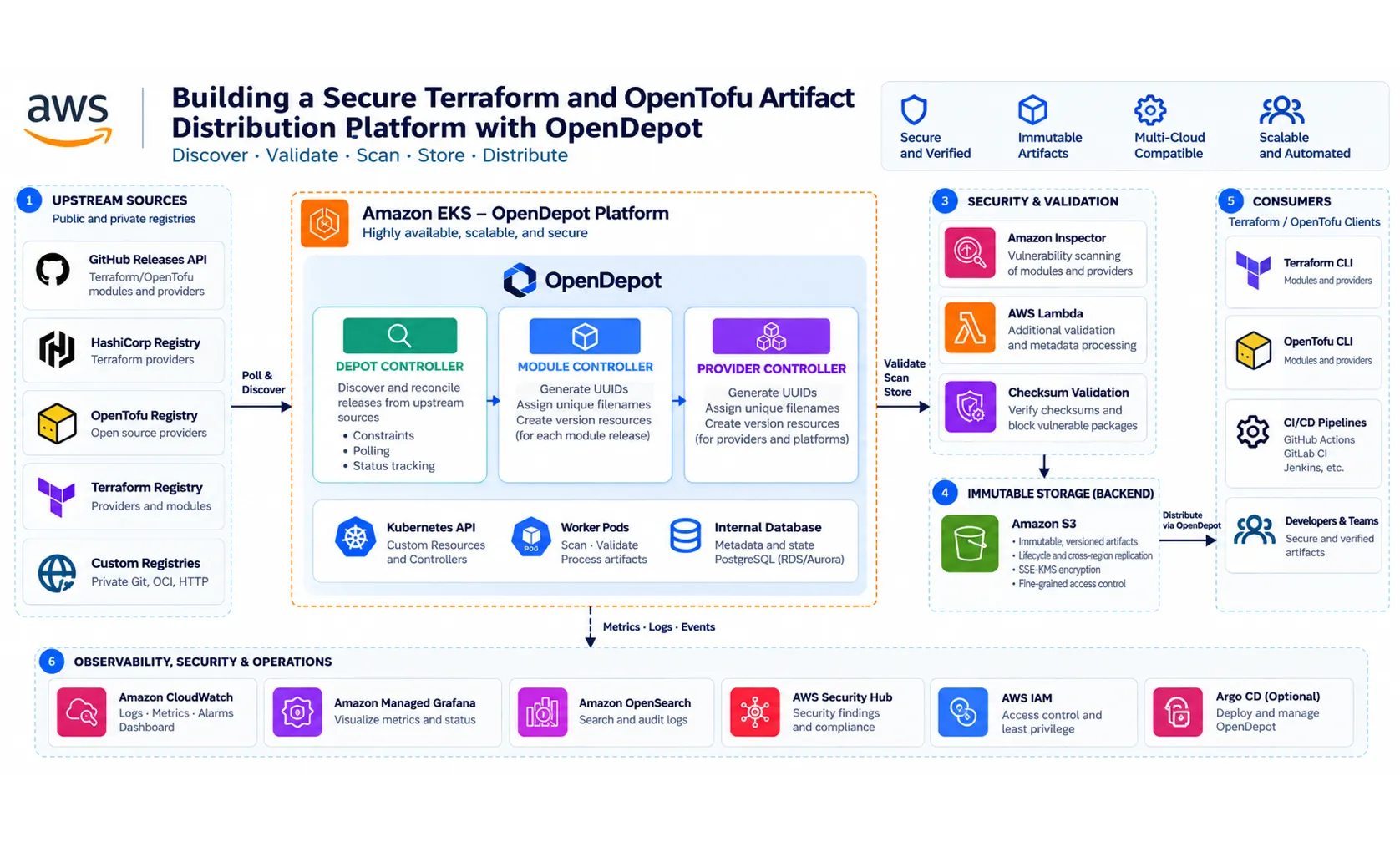
Building a Secure Terraform and OpenTofu Artifact Distribution Platform with OpenDepot
Explore how to build a secure, scalable Terraform and OpenTofu artifact distribution platform on AWS using OpenDepot.

Modern platform engineering teams depend on Terraform and OpenTofu to provision infrastructure consistently across cloud environments. As infrastructure automation grows, managing provider binaries, modules, release versions, and artifact integrity becomes an increasingly important operational challenge.
Relying exclusively on upstream repositories introduces dependencies on external availability, release lifecycle changes, and artifact distribution mechanisms. For enterprise environments, these dependencies can affect deployment reliability, security controls, and the ability to reproduce infrastructure consistently.
OpenDepot provides an approach to managing infrastructure artifacts through a centralized, Kubernetes-based architecture. By combining automated release discovery, controller-driven reconciliation, artifact validation, and object storage, platform teams can build a controlled distribution layer for infrastructure dependencies.
This article explores the architecture, explains the responsibilities of its components, and discusses how the design can be applied to AWS and multi-cloud platform engineering environments.
Architecture Overview
The architecture consists of four primary layers:
- Upstream sources that publish modules, providers, and release metadata.
- A depot controller that discovers releases and reconciles the desired state.
- Kubernetes controllers that manage module, provider, and version resources.
- A storage backend that retains verified artifacts for distribution.
The central design principle is to separate release discovery, resource reconciliation, artifact validation, and artifact storage into distinct responsibilities.
This separation makes the platform easier to operate, extend, and integrate into existing infrastructure delivery workflows.
1. Upstream Sources: Discovering Infrastructure Releases
The process begins with upstream repositories and provider registries.
Typical sources include:
- GitHub Releases API for release metadata and downloadable assets.
- OpenTofu or Terraform provider registries for provider versions and platform-specific binaries.
- Public or private repositories that distribute infrastructure modules and related artifacts.
These systems remain the source of release information, while OpenDepot provides a controlled layer for discovering and managing the artifacts required by internal infrastructure workflows.
Instead of relying exclusively on individual deployment pipelines to retrieve external dependencies, a centralized platform can automate release discovery and apply consistent validation and retention policies.
This approach is particularly useful when multiple teams share the same infrastructure dependencies across development, testing, staging, and production environments.
2. Depot Controller: Discover and Reconcile
At the center of the architecture is the depot controller.
Its primary responsibility is to discover upstream releases and reconcile the observed state with the resources managed by the platform.
The controller periodically polls configured sources, evaluates available release information, and initiates the creation or update of the relevant Kubernetes resources.
This follows the reconciliation model commonly used in Kubernetes operators.
Rather than depending exclusively on one-time execution, the controller repeatedly evaluates the current state and works toward the intended state.
The reconciliation model provides several operational benefits:
- Automation: Newly discovered releases can enter the processing workflow without manual intervention.
- Consistency: Release processing follows a common set of rules.
- Recoverability: Reconciliation can resume work after temporary failures, subject to the controller's retry and state-management implementation.
- Visibility: Kubernetes resources provide a natural place to expose processing status and operational state.
Polling intervals, API rate limits, authentication, error handling, and retry policies are important design considerations when integrating with external release sources.
3. Kubernetes Controllers: Managing Modules and Providers
Once a release is discovered, specialized controllers manage the corresponding infrastructure artifacts.
Module Controller
The module controller manages module release resources.
According to the architecture, it generates UUIDs, assigns unique filenames, and creates Version resources for individual module releases.
Unique identifiers help distinguish artifacts independently of their upstream naming conventions. Version resources also provide a structured representation of individual releases within the platform.
For teams consuming infrastructure modules, this can support more consistent release tracking and centralized artifact management.
Provider Controller
The provider controller performs a similar role for infrastructure providers.
Provider distributions introduce additional complexity because binaries are commonly published for multiple operating systems and processor architectures.
A provider release may therefore require separate artifacts for platforms such as Linux AMD64, Linux ARM64, and other supported combinations.
The controller's responsibilities include generating identifiers, assigning filenames, and creating Version resources associated with provider releases and their platforms.
Keeping module and provider processing separate allows the platform to evolve each workflow independently while maintaining a consistent resource model.
4. Version Controller: Fetch, Scan, and Verify
The version controller is responsible for processing artifacts and validating them before they become available for distribution.
Its workflow includes three key activities:
Fetch: Retrieve the relevant artifact from its upstream source.
Scan: Perform configured security checks against the artifact and its metadata.
Checksum verification: Validate artifact integrity against an appropriate trusted checksum or signature source.
These controls are important because infrastructure providers and modules directly influence the infrastructure that deployment pipelines create.
A compromised or unexpectedly modified dependency could introduce risks into an otherwise trusted infrastructure-as-code workflow.
A centralized artifact pipeline creates an opportunity to enforce consistent security controls before artifacts reach downstream consumers.
For example, a production platform could require successful checksum verification and applicable security checks before promoting an artifact to an approved repository.
The architecture describes blocking vulnerable packages before publishing. The effectiveness of that control depends on the scanning implementation, vulnerability intelligence, policy configuration, and enforcement behavior.
Important security distinction: A checksum confirms that an artifact matches the expected digest; it does not independently prove that the artifact is trustworthy. The expected checksum must come from a trusted source. Where supported, signature verification, provenance validation, and upstream source verification provide additional assurance.
5. Storage Backend: AWS S3 and Multi-Cloud Distribution
After successful processing and validation, artifacts can be stored in the configured storage backend.
The architecture identifies several options:
- Amazon S3
- Azure Blob Storage
- Google Cloud Storage
- Filesystem-based storage
For an AWS deployment, Amazon S3 is a natural candidate for centralized artifact storage.
S3 can provide durable object storage and integrate with AWS identity, encryption, monitoring, and data protection capabilities. This allows infrastructure platform teams to manage artifacts separately from the compute resources running their controllers.
A production implementation can consider the following controls:
- Encryption at rest: Configure appropriate S3 encryption and key-management policies.
- Least-privilege access: Grant controllers only the permissions required to retrieve and store approved artifacts.
- Versioning: Enable bucket versioning where it supports recovery and audit requirements.
- Immutability: Consider S3 Object Lock and retention policies when regulatory or operational requirements call for write-once retention.
- Network security: Apply suitable endpoint, routing, and bucket access policies.
- Auditability: Monitor object access and administrative operations using appropriate AWS logging services.
- Lifecycle management: Define retention and archival policies that balance compliance, availability, and cost.
The distinction between storage durability and immutability is important. Standard object storage does not automatically guarantee that stored artifacts cannot be overwritten or deleted. Immutability requires appropriate configuration, permissions, and retention controls.
For multi-cloud organizations, supporting several storage backends can also help align artifact distribution with existing cloud strategies and operational requirements.
6. End-to-End Release Lifecycle
The complete workflow can be understood as a sequence of automated stages:
- The depot controller polls upstream repositories and registries.
- New releases are discovered and evaluated.
- The appropriate module or provider controller creates the corresponding Version resources.
- The version controller retrieves the artifact.
- The artifact undergoes the configured security checks and checksum verification.
- Artifacts that satisfy the required policies are published to the configured storage backend.
- Downstream infrastructure workflows retrieve the approved artifacts according to the platform's distribution and access model.
This design separates the discovery of a release from the decision to publish it.
That distinction is especially valuable in enterprise environments, where detecting a new version should not necessarily mean immediately making it available to production pipelines.
A controlled release lifecycle makes it possible to introduce approval gates, promotion workflows, and environment-specific policies where required.
7. Running OpenDepot on Kubernetes in AWS
Kubernetes provides the orchestration layer for running the controllers and managing their resources.
When deployed on Amazon EKS, the platform can use AWS services to support identity, storage, monitoring, and operational resilience.
A potential implementation includes:
- Amazon EKS: Runs the OpenDepot controllers and associated workloads.
- IAM roles for service accounts or EKS Pod Identity: Provides workload-specific AWS permissions, depending on the selected integration.
- Amazon S3: Stores infrastructure artifacts.
- Amazon CloudWatch: Supports operational monitoring and log collection where configured.
- AWS KMS: Manages encryption keys when customer-managed encryption is required.
- AWS CloudTrail: Provides visibility into relevant AWS API and administrative activity.
These are complementary AWS integration options, not a claim that every integration is enabled by default in OpenDepot.
A production deployment should also consider controller availability, resource requests and limits, Kubernetes access controls, network policies, backup and recovery, and monitoring of reconciliation failures.
For workloads that manage infrastructure dependencies, the artifact distribution platform itself should be treated as a critical component of the software supply chain.
8. Security and Operational Best Practices
A secure artifact platform requires more than a successful download and upload process.
The following practices help strengthen the overall design.
Establish a clear trust boundary
Define which upstream sources are permitted, how they are authenticated, and which release types are eligible for ingestion.
Verify artifacts before publication
Make checksum and signature verification requirements explicit. Ensure that failures prevent publication when policy requires verification.
Separate discovery from promotion
Treat release discovery as an input to the workflow rather than automatic authorization for production use.
Enforce least privilege
Use separate permissions for Kubernetes resource management, upstream access, and storage operations where practical.
Monitor reconciliation health
Track polling failures, processing errors, validation failures, storage errors, and delays between release discovery and publication.
Define retention and recovery requirements
Determine which versions must remain available, how long they should be retained, and how the platform will recover from accidental deletion or operational failures.
Test failure scenarios
Validate how the system behaves when an upstream API is unavailable, an artifact cannot be downloaded, checksum verification fails, storage permissions are incorrect, or a controller restarts during processing.
These measures help ensure that automation improves reliability without removing essential security and governance controls.
9. Benefits for Platform Engineering Teams
A centralized artifact distribution platform can deliver value across several areas.
Standardization: Teams can consume infrastructure dependencies through a common distribution layer.
Security governance: Validation policies can be applied consistently before artifacts are published.
Operational control: Release processing and artifact availability become easier to observe and manage centrally.
Resilience: A controlled artifact repository can reduce repeated reliance on upstream availability during downstream deployment workflows, provided the required artifacts have already been cached and retained.
Multi-cloud flexibility: Supporting S3, Azure Blob Storage, Google Cloud Storage, or filesystem storage can accommodate different deployment environments.
Scalability: Kubernetes-based controllers provide a foundation for scaling processing capacity as release volume and workload requirements grow.
These benefits depend on the implementation, configuration, and operational maturity of the platform; they are not automatic guarantees.
Enjoyed reading this content? Let the author know!
Your likes, comments, shares, and saves help creators reach more builders.

Loading recommendations
Loading article