
Beyond Chatbots: How AWS AI Agents Could Transform Cloud Computing
AI agents are changing how we build cloud applications. Discover how AWS services like Amazon Bedrock, AWS Lambda, and Amazon CloudWatch can power intelligent automation, and explore the real-world challenges of security, scalability, reliability, and cost. Learn how to design AI agents responsibly and share your ideas for the future of cloud computing.

Beyond Chatbots: How AWS AI Agents Could Transform Cloud Computing
Introduction: From AI That Answers to AI That Acts
Artificial Intelligence is evolving rapidly. We started with traditional automation, moved to intelligent chatbots, and are now entering an era of AI agents that can reason through tasks, interact with tools, retrieve information, and perform actions with appropriate permissions.
But here is an important question:
Are we building AI applications that simply answer questions, or are we building intelligent systems that can solve real-world problems safely and efficiently?
With AWS services such as Amazon Bedrock, AWS Lambda, Amazon S3, Amazon DynamoDB, and Amazon CloudWatch, developers have building blocks for exploring this next generation of cloud applications.
Let's explore how we can approach this shift from an AWS cloud engineering perspective.
1. What Makes an AI Agent Different from a Chatbot?
A traditional chatbot generally receives a question, sends it to a language model, and returns an answer.
An AI agent can go further. Depending on its tools, permissions, and design, it can:
- Understand a user's goal and break it into smaller tasks.
- Retrieve relevant information from approved data sources.
- Call APIs or execute specific functions.
- Evaluate the results and determine the next step.
- Report what it accomplished and where human approval is needed.
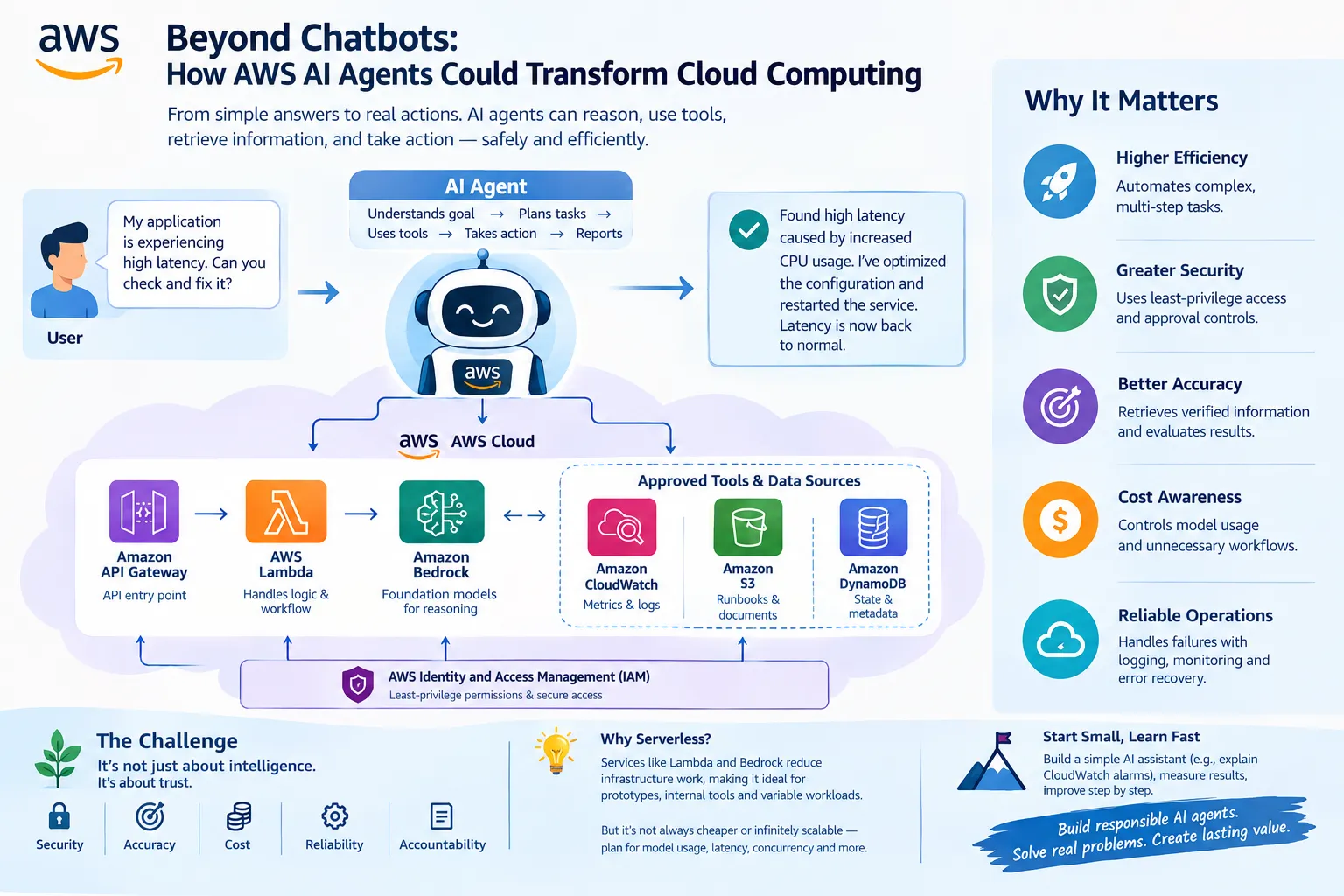
Imagine an application experiencing unexpected latency.
A traditional chatbot might suggest checking CPU utilization, memory usage, and application logs.
An appropriately configured cloud operations agent could retrieve CloudWatch metrics, inspect relevant logs, identify possible causes, and recommend corrective actions. With carefully designed authorization and approval controls, it could also initiate an approved remediation and verify the outcome.
The real opportunity is not simply generating better answers. It is connecting intelligence to useful, measurable actions.
2. A Practical AWS Architecture for an AI Agent
Consider building an AI-powered cloud troubleshooting assistant.
A possible architecture is:
User → Amazon API Gateway → AWS Lambda → Amazon Bedrock → Approved tools and data sources → Response
Each component has a specific responsibility:
Amazon API Gateway: Provides an API entry point for application requests.
AWS Lambda: Handles application logic, validates requests, and coordinates the workflow.
Amazon Bedrock: Provides access to foundation models for interpreting requests, reasoning, and generating responses.
Amazon CloudWatch: Supplies authorized metrics, logs, and operational signals.
Amazon S3: Can store approved documentation, runbooks, and troubleshooting resources.
Amazon DynamoDB: Can store conversation state, task metadata, or workflow records when needed.
AWS Identity and Access Management (IAM): Helps enforce least-privilege permissions for the resources and actions involved.
This is an illustrative architecture, not a one-size-fits-all solution. More complex workloads may require additional orchestration, retrieval, evaluation, and agent-runtime components.
The most important design principle is to give every component a clear responsibility rather than allowing an AI model unrestricted access to the cloud environment.
3. The Biggest Challenge Is Trust, Not Just Intelligence
An impressive AI demonstration does not automatically make a reliable production application.
AI agents introduce important engineering challenges.
Security: What happens if a user attempts to make an agent access unauthorized data or execute a dangerous command?
Accuracy: How do we prevent an agent from acting on incomplete information or an incorrect interpretation of logs?
Cost: How do we control model inference, repeated tool calls, and unnecessarily long workflows?
Reliability: What happens when an API times out, a service throttles requests, or an agent gets stuck in a loop?
Accountability: Can we determine which tools were called, what decisions were made, and whether a human approved a sensitive action?
These challenges require deliberate engineering.
Some practical safeguards include:
- Apply least-privilege IAM permissions.
- Validate and authorize every sensitive tool invocation.
- Use human approval for high-impact operations.
- Set execution limits, timeouts, and spending controls.
- Log tool calls and relevant decisions while protecting sensitive data.
- Evaluate outputs against realistic test cases before deployment.
- Test failure scenarios, including incorrect outputs and malicious instructions embedded in retrieved content.
A powerful agent is useful. A powerful agent with clear boundaries, observable behavior, and reliable failure handling is much closer to production readiness.
4. Why Serverless Can Be a Strong Starting Point
For many AI applications, serverless services can reduce the operational work involved in provisioning and maintaining infrastructure.
AWS Lambda can handle event-driven application logic, while managed AI services can provide access to foundation models. Supporting services can store application data, expose APIs, and collect operational telemetry.
This approach can be particularly useful for prototypes, internal assistants, document-processing systems, and workloads with variable traffic.
However, serverless does not automatically mean inexpensive or infinitely scalable. Model usage, concurrency, downstream service limits, data transfer, latency, and retries still need careful consideration.
A good architecture begins with the workload's requirements, not with the assumption that one technology is always the best choice.
5. A Learning Roadmap for Cloud Builders
For developers and aspiring cloud engineers who want to explore agentic AI, I would approach the learning journey in stages:
- Build the foundation: Learn IAM, networking basics, API Gateway, Lambda, S3, and CloudWatch.
- Create a simple AI application: Connect an application to a foundation model through Amazon Bedrock.
- Add knowledge retrieval: Let the application retrieve relevant information from an approved knowledge source.
- Introduce controlled tool use: Allow the application to call a small number of explicitly authorized functions.
- Add production safeguards: Implement validation, logging, evaluation, error handling, and human approval where appropriate.
- Measure the results: Test accuracy, response latency, reliability, and cost per completed task.
For a first project, an AI assistant that explains CloudWatch alarms using approved documentation could be a useful starting point. It can begin in read-only mode and gradually introduce more capabilities as the security and testing requirements become clear.
Conclusion: Build Responsibly, Not Just Quickly
The future of cloud computing will not be defined by AI capabilities alone. It will also depend on how effectively we combine AI with secure infrastructure, reliable architectures, cost awareness, and responsible automation.
AWS gives builders a broad set of services with which to experiment, learn, and create practical solutions. Our responsibility is to connect those services thoughtfully and verify that our applications behave as expected.
You do not need to start with a complicated multi-agent system. Start with one meaningful problem, build a small solution, measure its performance, and improve it step by step.
The best cloud projects are not necessarily the most complex ones. They are the ones that solve real problems reliably.
Let's Discuss
I would love to hear perspectives from the AWS community:
If you could build one AI agent using AWS today, what real-world problem would you solve first—and what would be your biggest concern: security, accuracy, latency, or cost?
Would you begin with a read-only assistant or allow the agent to execute approved actions from the beginning?
Let's exchange ideas, lessons learned, and architectural approaches that can help all of us become better cloud builders.
Enjoyed reading this content? Let the author know!
Your likes, comments, shares, and saves help creators reach more builders.

Loading recommendations
Loading article