

Recorded as the Session Runs, Kept When It Ends: LangGraph on Amazon Bedrock AgentCore
Run a LangGraph agent on Amazon Bedrock AgentCore Runtime and record every turn, model prompt, tool call and file change in Apache SkyWalking AI Sessionizer while the session runs, kept after it ends, with no change to the agent’s logic.
Series: AI × Observability (6 articles)
- …
- 6Recorded as the Session Runs, Kept When It Ends: LangGraph on Amazon Bedrock AgentCore This article

On Amazon Bedrock AgentCore Runtime , each session runs in its own isolated execution environment, with its own CPU, memory and disk. An agent that keeps its conversation in that memory and its working files on that disk, as the simplest LangGraph agent does, loses both when AgentCore stops the environment, by default after 15 idle minutes. The session id stays valid; the next call with it gets a new environment, empty.
So when an answer is wrong, or a file the agent wrote is, the evidence can be gone before anyone asks the questions that matter: what exactly was the model sent on that turn, which tool result led it there, and what did the tools actually change?
This post runs a LangGraph agent on AgentCore Runtime with Apache SkyWalking AI Sessionizer recording each turn as it happens: the runs, model calls and tool calls through LangChain’s own tracing client, and the files a tool changed through a small recorder. Sessionizer, a separate, long-lived service, keeps that record after the session’s environment stops. The agent’s logic does not change for it; the runtime’s environment and a package in the image switch it on. Everything below ran on AWS in
us-east-1 on October 10, 2026, with Amazon Nova Pro on Amazon Bedrock, from one OpenTofu configuration: wu-sheng/aws-agentcore-asz-demo . The previous post (also on AWS Builder Center ) did the same for an agent on a laptop.Configuration, not code
The agent is a small LangGraph “deployment advisor” with six tools. Three look facts up:
search_docs, check_deployment and estimate_cost. Three work on a clone of the demo repository inside the session’s environment: clone_demo_repo, read_file and write_file. Its only AgentCore-specific code is the entrypoint, which any agent on AgentCore has. Shortened from the demo’s agent/app.py:1
2
3
4
5
6
7
8
9
10
11
12
13
14
15
16
from bedrock_agentcore.runtime import BedrockAgentCoreApp, BedrockAgentCoreContext
from langchain_core.messages import HumanMessage
graph = build_graph() # Nova Pro, six tools, compiled with an InMemorySaver
app = BedrockAgentCoreApp()
def invoke(payload: dict) -> dict:
# One AgentCore runtime session is one conversation.
thread_id = payload.get("thread_id") or BedrockAgentCoreContext.get_session_id()
result = graph.invoke(
{"messages": [HumanMessage(payload["prompt"])]},
config={"configurable": {"thread_id": thread_id},
"metadata": {"thread_id": thread_id}},
)
return {"thread_id": thread_id, "answer": result["messages"][-1].text}Nothing there is about Sessionizer. The recording rides on two things a LangChain agent already has: the
langsmith tracing client, which comes with langchain-core, and LangChain’s callback hooks. The runtime’s environment turns both on:1
2
3
4
5
6
7
8
9
10
11
environment_variables = {
# The conversation: runs, model calls, tool calls.
LANGSMITH_TRACING = "true"
LANGSMITH_ENDPOINT = "http://${aws_lb.ingest.dns_name}:1985"
LANGSMITH_API_KEY = random_password.asz_ingest_token.result
LANGSMITH_PROJECT = "aws-agentcore-asz-demo"
# What the tools changed on disk.
ASZ_CHANGES = "true"
ASZ_WATCH = "/home/agent/workspace"
ASZ_CHANGES_DATA = "/mnt/changes"
}The first four point the tracing client at Sessionizer’s receiver instead of LangSmith’s cloud, the same four as on the laptop with a different address. The other three switch on file-change recording. The image carries
asz-changes, built from the Sessionizer source, and a small LangChain shim, installed with pip and switched on with asz-langchain enable; the application never imports it. At interpreter start the shim attaches a callback that runs asz-changes before and after each tool the settings name, here write_file only, and asz-changes writes what changed to a directory Sessionizer reads. What the agent supplies is the conversation’s identity: on AgentCore, the runtime session id the caller sent, which the agent reads from the request, passes to LangGraph as the thread, and also puts in the run metadata.That is the convenience: the agent’s logic, its framework and its model calls stay as they are. What changes is configuration on the runtime and a package in the image.
Two services, two lifecycles
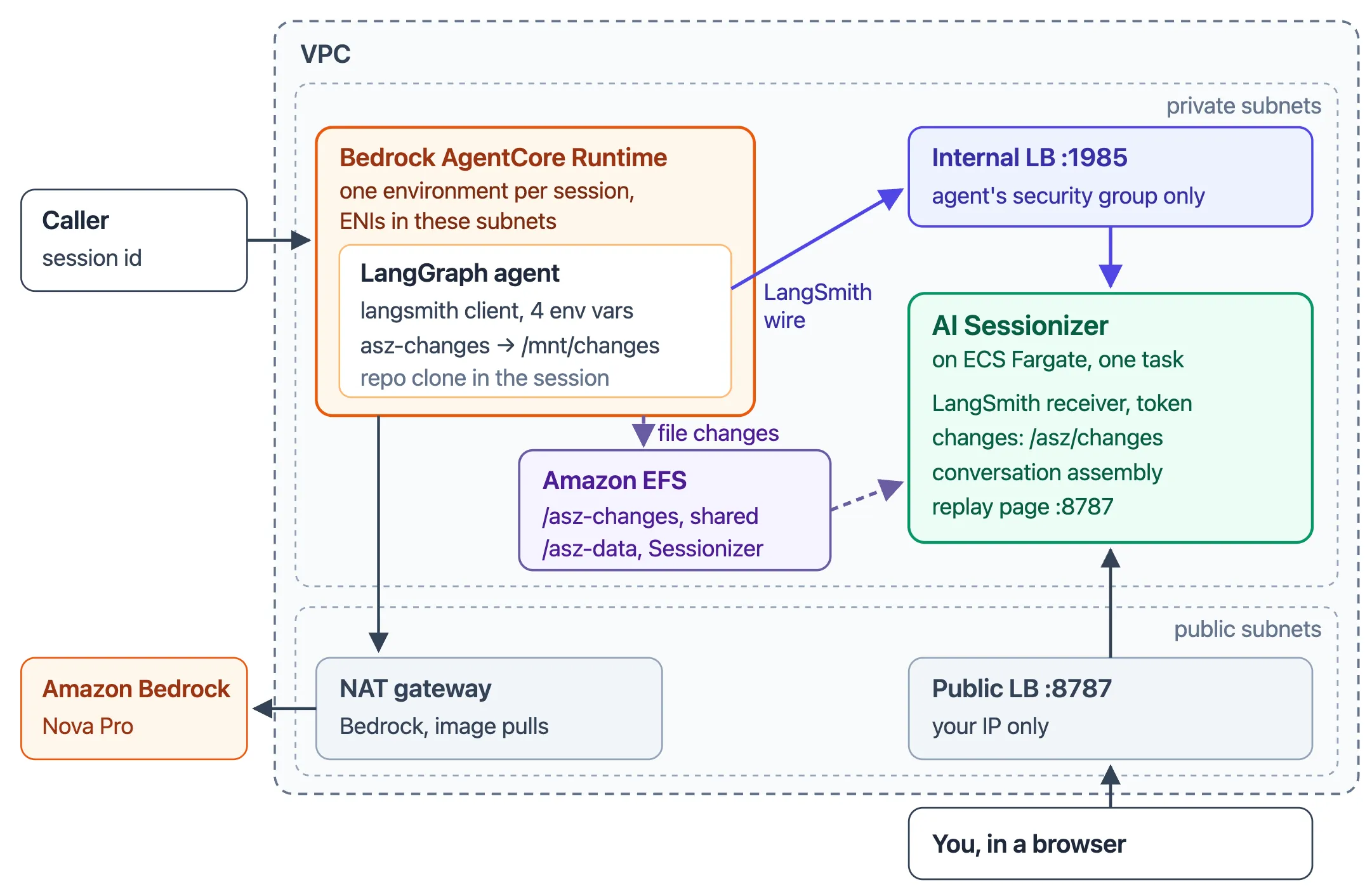
The tracing client inside the agent neither knows nor cares that it runs on AgentCore. Four things around it change on AgentCore.
- There is no sidecar. AgentCore Runtime runs one image per agent, in an environment per session, and an environment lives only as long as its session. Sessionizer is the opposite: a long-lived service with durable storage and a replay page. So the two run as separate services, Sessionizer as one task on Amazon Elastic Container Service (ECS) with AWS Fargate.
127.0.0.1is now the session’s environment. AgentCore’s VPC mode places the agent’s network interfaces in subnets you choose of your Amazon Virtual Private Cloud (VPC), so the receiver can stay private, behind an internal Application Load Balancer (ALB) only the agent’s security group may call.- File changes need shared storage.
asz-changeswrites on the agent’s side and Sessionizer reads on its own, so the two share a directory on the network: Amazon Elastic File System (EFS), AWS’s managed network file system, mounted over NFS inside the VPC. AgentCore mounts an EFS access point into every session’s environment at/mnt/changes, and Sessionizer’s task mounts the same directory at/asz/changes. Neither side reaches into the other. - The session is the conversation. The caller keeps the session id: it picks one, at least 33 characters, or takes the one AgentCore returns from the first call, and sends it with every call of the conversation. AgentCore routes calls with the same id to the same session, and the id stays valid after an idle stop. The agent only reads the id of the request, with
BedrockAgentCoreContext.get_session_id(), and uses it as the thread, so one AgentCore session is one Sessionizer conversation.
Wiring it on AWS
The demo repository builds everything in Figure 1 with OpenTofu, the agent included. AWS provider 6.x has an
aws_bedrockagentcore_agent_runtime resource, so the runtime sits in the same state as the network, the storage and the receiver it points at. Beside the environment above, the runtime needs its network and the shared directory:1
2
3
4
5
6
7
8
9
10
11
12
13
14
15
16
17
resource "aws_bedrockagentcore_agent_runtime" "agent" {
# ...
network_configuration {
network_mode = "VPC"
network_mode_config {
subnets = aws_subnet.private[*].id
security_groups = [aws_security_group.agent.id]
}
}
filesystem_configuration {
efs_access_point {
access_point_arn = aws_efs_access_point.changes.arn
mount_path = "/mnt/changes"
}
}
}Sessionizer runs from its published multi-arch image as one ECS Fargate task, with two adapters: the receiver for the conversation and the
changes adapter for the file changes.1
2
3
4
5
6
7
8
9
10
11
12
storage:
root: /asz/data
adapters:
- name: langsmith-ingest
enabled: true
listen: 0.0.0.0:1985
token: <generated>
collector: { mode: watch, interval: 30s }
- name: changes
enabled: true
source_root: /asz/changes
collector: { mode: watch, interval: 30s }A few details decide whether this works the first time:
- The receiver. It is an adapter of its own, off by default, on port 1985, not on the replay page’s 8787. Its default address is
127.0.0.1:1985, which no load balancer can reach inside a container, so it listens on0.0.0.0. And it assembles what it received every 30 seconds here, instead of its default ten minutes. - The shared directory. The EFS access point writes everything as uid 65532, the user Sessionizer runs as, so Sessionizer owns what the agent wrote. The execution role needs
elasticfilesystem:ClientMountandClientWriteon the file system, conditioned on the access point, as the AgentCore guide says.CreateAgentRuntimealso checkselasticfilesystem:DescribeAccessPointsandDescribeMountTargets, which the guide does not list, and it checks them without a resource, so a policy scoped to the file system is refused. The demo grants those two read-only actions on*. - One workspace per conversation.
asz-changeskeeps one baseline per watched directory, and every session shares its data directory. With one workspace path for all of them, a conversation’s first watched tool call is compared with another session’s leftovers. The demo’s agent works in a directory per conversation and pointsASZ_WATCHat it each turn. - The image. AgentCore runs images only from Amazon Elastic Container Registry (ECR). The demo’s image is built and published by GitHub Actions;
up.shcopies it into the account’s ECR.
This is a demonstration, so a few things in it are not how you would run it for a team. The replay page is plain HTTP, behind a load balancer only your IP may reach, and has no login of its own. The receiver token sits in the environment, where AWS Secrets Manager belongs. And the agent’s memory is in memory, the subject of a later section .
One session, one conversation
The demo has no chat application.
invoke.sh stands in for one user’s client: it creates one session id, then sends five prepared questions with aws bedrock-agentcore invoke-agent-runtime, all with that --runtime-session-id, and a sixth follows on the same session after a long pause, sent the same way. Each is a separate invocation, and all of them land in one conversation in Sessionizer, named from the project and the session id.In a real deployment, the application around the agent controls the session itself: it keeps one session id for each user’s conversation, sends it with every message, and starts a new one when a conversation should start fresh. AgentCore does not map sessions to users, and the agent only reads the id each request carries.

Opening a talk shows the agent loop inside it. The second question asks why tracing to port 8787 landed nothing; Nova Pro called
search_docs with ingest_port and answered from the result:
What the model was sent
The first question this post asked is answered by the model call’s Prompt tab. Sessionizer lands what each call was sent beside the conversation and rebuilds it on request:

The prompt proves the session carried the history: the first question, Nova Pro’s reasoning, its tool call, the result and the answer all belonged to an earlier invocation. That is the in-memory checkpointer at work inside one environment. As in the previous post, the body is LangChain’s view of what it sent, not the bytes Bedrock received, and the record says so.
What the tools changed, and what the agent said they changed
The fifth question asks the agent to clone the demo repository and prepare
infra/terraform/terraform.tfvars from the example, with a new IP and idle sessions stopped after five minutes. Nova Pro answered:Theinfra/terraform/terraform.tfvarsfile has been successfully created with the specified values, including theagentcore_idle_timeoutset to stop idle sessions after 5 minutes.
The file is in the session environment’s local workspace, and that copy is lost when the environment stops. Sessionizer keeps what
asz-changes recorded while write_file ran, in that step’s Changes tab.
The IP is right. The last line is not. The demo has no variable named
agentcore_idle_timeout; the line should have read agent_idle_session_timeout = 300, in seconds. With the invented name, OpenTofu would only warn about an undeclared variable and keep the default 15 minutes. The same talk’s tool calls say why: the agent read terraform.tfvars.example, which has no idle-timeout line, never opened variables.tf, and made a name up. The answer reads as done; the record shows what was done.When the session goes idle
By default AgentCore stops a session’s execution environment after 15 idle minutes, or after 8 hours at most. The session id stays valid, and the next call with it gets a new environment. The AgentCore documentation is plain about what that costs: data kept in memory, conversation history included, lasts only as long as the compute it was kept in. The workspace on its disk goes the same way.

The conversation does not stop with the environment. The caller sends the same session id after the stop, the agent uses it as the same thread, and Sessionizer files the next call in the same conversation, after the turns before it. In this run,
invoke.sh sent the sixth question with the session id it had used for the first five, and the sixth talk landed in the conversation that held the first five, about sixteen minutes after the fifth: Figure 3 shows it below the fifth, after a “16 min quiet” mark, and Figure 2 counts six talks. Sessionizer records the pause as a new activity window, a second segment of the same conversation, and every prompt, tool call and file change from before the stop stays in the record.What the stop did take is the agent’s own context. The sixth question went out on the same session id about sixteen minutes after the fifth: “Earlier in this session you changed a file in my repository. Which file was it, and what did you change?” Nova Pro answered:
The file that was changed earlier in this session isinfra/terraform/terraform.tfvars.example. The changes made to the file were the addition of theaws_regionandproject_namevariables, as well as the modification of theasz_ui_cidrsvariable to include your public IP address.
It names the wrong file and misstates what was done: the file was
terraform.tfvars, it was created, and its invented line was agentcore_idle_timeout. Nothing failed, and the answer is fluent. Sessionizer, which received this turn the same way as the five before it, shows why:
That call was sent 791 tokens, about what the first talk’s first call was sent, 796; the fifth talk’s first call, in the old environment, had been sent 2,010. The checkpointer started empty in a new environment. The agent then cloned the repository again, since the clone had gone with the old environment, read the example file, and described it as its own work. In the previous talk of the same conversation, the
write_file step still holds the real change (Figure 6).That is what recording while the session runs is worth on AgentCore. When the session’s environment is gone, the agent’s memory and its files are gone with it, and its account of what happened is only as good as what it can still see. The record is not: in Sessionizer the conversation went on across the stop, six talks in one record, and it still holds what the agent no longer can.
Sessionizer keeps that record for you to read; it does not hand it back to the agent. The fix for the agent’s memory belongs in the agent: keep LangGraph’s checkpoints somewhere that outlives the session’s environment.
AgentCoreMemorySaver from langgraph-checkpoint-aws keeps them in Amazon Bedrock AgentCore Memory, and AgentCore’s session storage , in preview, keeps a session’s files across stop and resume. The idle timeout itself is the runtime’s lifecycle_configuration, which the demo exposes as agent_idle_session_timeout, but changing it only moves the point where the history is lost. After the change, the same Prompt tab is how you check it: the first call after the pause should open with the turns before it.Next to AgentCore Observability
AgentCore has observability of its own. In Amazon CloudWatch it shows the runtime’s sessions, their traces and spans, and with OpenTelemetry instrumentation in the agent, the model and tool calls inside them and their intermediate outputs. That is the place to watch the runtime across every session: latency, errors and usage.
Sessionizer adds a conversation view: the turns of one session as one record across invocations and environments, each model call’s request rebuilt beside it, each watched tool’s diff attached to its step, all of it kept in storage you own. This demo sets up only that part.
Share it through SkyWalking
This post ran Sessionizer in its simple mode: it collects, stores and serves the replay page itself. To make conversations from many agents available in SkyWalking, add an OpenTelemetry Protocol (OTLP) export to the same configuration, as the previous post shows. The conversations then appear in Horizon’s AI Agents views under the runtime LangChain. Collection does not change: the agent still sends the LangSmith wire and the file changes, and OTLP carries only what Sessionizer has already landed.
Try it on your AgentCore agent
On an agent you already run
If your LangGraph or LangChain agent runs on AgentCore Runtime today, recording it takes four steps, none of them in the agent’s logic:
- Run Sessionizer where the runtime can reach it, with the
langsmith-ingestreceiver on, a token, andlisten: 0.0.0.0:1985. The demo runs it as one ECS task behind an internal ALB. - Set four environment variables on the runtime:
LANGSMITH_TRACING=true,LANGSMITH_ENDPOINTat the receiver,LANGSMITH_API_KEYas its token, andLANGSMITH_PROJECT. - Use the session id as the conversation: pass
BedrockAgentCoreContext.get_session_id()as the LangGraph thread and put it in the run metadata. - To record file changes too, add
asz-changesandapache-skywalking-asz-langchainto the image, from the same Sessionizer commit as the server, and runasz-langchain enable. Name the tools that write in the recorder’ssettings.yaml, set the threeASZ_*variables, and mount one EFS access point into the runtime and into Sessionizer, where thechangesadapter reads it.
The LangChain and LangGraph guide covers steps 1 to 3, and the plugin guide covers step 4.
Run the demo
You need an AWS account with the AWS CLI signed in, OpenTofu and Docker. From a clone of the demo repository :
1
2
3
4
5
cp infra/terraform/terraform.tfvars.example infra/terraform/terraform.tfvars
# set asz_ui_cidrs to your IP:  curl -s https://checkip.amazonaws.com
./scripts/up.sh       # about ten minutes
./scripts/invoke.sh   # the five turns; prints the session id and the replay page
./scripts/down.sh # when you are done- The model. Amazon Nova Pro is the default and needs no extra step;
BEDROCK_MODEL_ID=<model id> ./scripts/up.shpicks another. Claude models need the account’s one-time Anthropic use-case form, and AWS does not serve every newer Claude model to every account, soup.shcalls the model once and stops before it creates anything if the account cannot use it. - The agent image. GitHub Actions builds it and publishes it to GitHub Container Registry;
up.shcopies it into your account’s ECR, since AgentCore runs images only from there. Nothing is built on your machine. - The region. AgentCore’s VPC mode works only in some Availability Zones :
use1-az1,use1-az2anduse1-az4inus-east-1. Setavailability_zone_idsifup.shstops at the runtime’s subnets. - The cost. The fixed infrastructure costs about $0.125 an hour while it is up, most of it the NAT gateway and the two load balancers, before AgentCore, Bedrock and storage usage.
- The teardown.
down.shdeletes everything, the recorded conversations included. AWS keeps AgentCore’s network interfaces for hours after the runtime is gone, about ten in our run, and with them the VPC, two subnets and a security group, none of which cost anything.down.shsays so and exits;./scripts/down.sh checkshows the progress, and./scripts/down.sh --yeslater finishes.
What to look at
Open the replay page
invoke.sh printed, then:- The second talk’s last model call, Prompt tab. The first talk is in it, although it ran in another invocation.
- The fifth talk’s
write_filestep, Changes tab. What the tool wrote, next to what the agent said it wrote. - A turn after the idle timeout. Wait at least 15 minutes, send one more turn on the same session with
SESSION=<session id> ./scripts/invoke.sh "<question>", and open its first model call. The earlier turns are not in it, and the agent answers as if they never happened.
Then point an agent you already run at Sessionizer, and the next time a session surprises someone, read what the model was sent, and what its tools did, on the turn that went wrong.
Questions and findings are welcome in Apache SkyWalking Discussions , and the source is in the Apache SkyWalking AI Sessionizer repository .
Series: AI × Observability (6 articles)
- …
- 6Recorded as the Session Runs, Kept When It Ends: LangGraph on Amazon Bedrock AgentCore This article
Enjoyed reading this content? Let the author know!
Your likes, comments, shares, and saves help creators reach more builders.

Loading recommendations
Loading article