
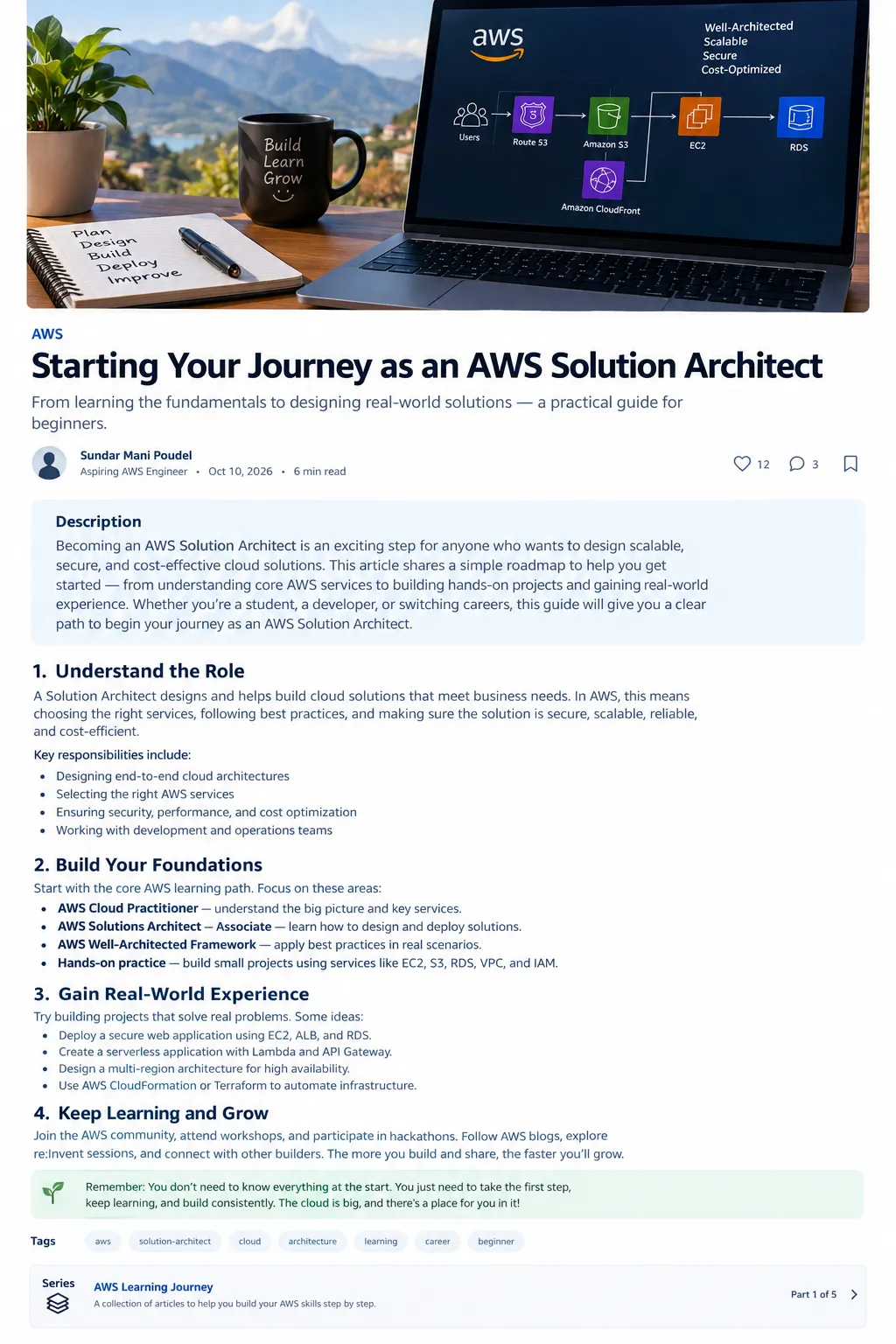
Starting Your Journey as an AWS Solutions Architect: From Fundamentals to Real-World Projects
Interested in becoming an AWS Solutions Architect but unsure where to begin? This article explores the essential AWS fundamentals, core architectural principles, hands-on projects, and learning resources that can help beginners start designing secure, scalable, reliable, and cost-effective cloud solutions.
Series: AWS Learning Journey (2 articles)
- 1Starting Your Journey as an AWS Solutions Architect: From Fundamentals to Real-World Projects This article

Starting Your Journey as an AWS Solutions Architect: From Fundamentals to Real-World Projects
Cloud computing has changed how organizations build, deploy, and scale applications. Instead of managing every piece of physical infrastructure, businesses can use cloud services to create flexible, reliable, and cost-effective solutions.
One role at the center of this transformation is the AWS Solutions Architect.
But how do you start learning cloud architecture when you're still a student or a beginner in cloud computing?
Let's explore a practical roadmap.
1. Understand What a Solutions Architect Does
An AWS Solutions Architect designs cloud solutions that address real business requirements.
The role goes beyond knowing AWS services. It involves understanding how different components work together and making architectural decisions based on security, performance, reliability, cost, and operational requirements.
For example, imagine designing an online shopping application.
You need to consider:
✅Where the application will run.
✅How customer information will be stored securely.
✅How the application will handle increased traffic.
✅How to protect data and manage access.
✅How to monitor failures and recover from them.
✅How to control infrastructure costs.
✅How customer information will be stored securely.
✅How the application will handle increased traffic.
✅How to protect data and manage access.
✅How to monitor failures and recover from them.
✅How to control infrastructure costs.
A good architecture balances these requirements instead of focusing on a single AWS service.
2. Build Your AWS Fundamentals
Before designing complex systems, develop a strong understanding of the core services.
Here are some useful starting points:
▪️Compute
✅Amazon EC2 for virtual servers.
✅AWS Lambda for serverless computing.
✅Amazon EC2 for virtual servers.
✅AWS Lambda for serverless computing.
▪️Storage
✅Amazon S3 for object storage.
✅Amazon EBS for block storage attached to EC2 instances.
✅Amazon S3 for object storage.
✅Amazon EBS for block storage attached to EC2 instances.
▪️Networking
✅Amazon VPC for logically isolated networks.
✅Amazon Route 53 for DNS and domain routing.
✅Elastic Load Balancing for distributing application traffic.
✅Amazon VPC for logically isolated networks.
✅Amazon Route 53 for DNS and domain routing.
✅Elastic Load Balancing for distributing application traffic.
▪️Databases
✅Amazon RDS for managed relational databases.
✅Amazon DynamoDB for managed NoSQL databases.
✅Amazon RDS for managed relational databases.
✅Amazon DynamoDB for managed NoSQL databases.
▪️Security and identity
✅AWS IAM for controlling access to AWS resources.
✅AWS KMS for encryption key management.
✅AWS IAM for controlling access to AWS resources.
✅AWS KMS for encryption key management.
You don't need to master everything immediately. Start by understanding what each service does, which problems it solves, and when you would choose it over an alternative.
3. Learn the Well-Architected Principles
A cloud solution can function correctly and still be poorly designed.
The AWS Well-Architected Framework provides a structured way to evaluate architecture decisions through six pillars:
✅Operational excellence
✅Security
✅Reliability
✅Performance efficiency
✅Cost optimization
✅Sustainability
✅Security
✅Reliability
✅Performance efficiency
✅Cost optimization
✅Sustainability
Consider an application that runs successfully on a single virtual server.
What happens if that server fails? What if traffic suddenly increases? Are sensitive credentials protected? Is the infrastructure more expensive than necessary?
These questions help turn basic cloud knowledge into architectural thinking.
Instead of asking only, "Which AWS service should I use?", start asking, "What requirements must this solution satisfy, and what trade-offs am I making?"
4. Learn by Building Small Projects
Reading documentation is important, but architecture becomes easier to understand when you apply what you learn.
Here are three project ideas for beginners:
▪️Project 1: Static Website Architecture
Host a static website using Amazon S3 and explore how Amazon CloudFront can distribute content efficiently.
Learn about object storage, content delivery, access control, and basic cost considerations.
▪️Project 2: Highly Available Web Application
Design a web application using an Application Load Balancer, EC2 instances across multiple Availability Zones, and Amazon RDS.
Focus on availability, traffic distribution, database protection, and recovery planning.
▪️Project 3: Serverless Application
Design an application using Amazon API Gateway, AWS Lambda, and Amazon DynamoDB.
Explore event-driven architecture, managed services, scalability, and operational simplicity.
For each project, document the requirements, architecture diagram, service choices, security considerations, failure scenarios, and estimated costs.
You can also use AWS architecture icons to create clear diagrams and explain why you selected each component.
Important: AWS services may incur charges. Start with architecture diagrams and cost estimates, check current Free Tier eligibility, and verify pricing before deploying anything. Delete resources you no longer need.
5. Develop an Architect's Mindset
One of the most valuable skills for a Solutions Architect is explaining technical decisions.
For every project, try answering these questions:
✅Why did I choose these services?
✅What alternatives did I consider?
✅ How will the system handle failures?
✅ How will I protect user data?
✅How will the solution scale?
✅What are the major cost drivers?
✅ How would I improve the architecture in the future?
✅What alternatives did I consider?
✅ How will the system handle failures?
✅ How will I protect user data?
✅How will the solution scale?
✅What are the major cost drivers?
✅ How would I improve the architecture in the future?
These questions help demonstrate your understanding beyond simply following a tutorial.
You can publish your diagrams, project documentation, and design decisions on GitHub to create a portfolio that others can review.
6. Explore AWS Learning Resources
You can begin with the following official resources:
✅AWS Skill Builder for structured cloud learning.
✅ AWS Documentation for understanding individual services.
✅ AWS Architecture Center for reference architectures and design examples.
✅AWS Well-Architected Framework for architectural best practices.
✅ AWS Documentation for understanding individual services.
✅ AWS Architecture Center for reference architectures and design examples.
✅AWS Well-Architected Framework for architectural best practices.
Start with foundational learning and gradually progress toward designing complete systems.
Certification can help structure your learning, but practical projects and the ability to explain architectural trade-offs are equally important when developing your skills.
Final Thoughts
Becoming an AWS Solutions Architect is a journey of continuous learning.
You don't need to understand every AWS service before starting your first project. Begin with the fundamentals, learn the principles behind good architecture, and build progressively more realistic solutions.
The goal is not just to learn what AWS services do. It is to understand how to combine them to solve problems securely, reliably, and cost-effectively.
Learn the services. Understand the trade-offs. Build the architecture. Explain your decisions.
That's how you begin developing the mindset of a Solutions Architect.
I'd love to hear from other builders: What was the first AWS project that helped you understand cloud architecture, and what would you recommend to someone just starting out?
Series: AWS Learning Journey (2 articles)
- 1Starting Your Journey as an AWS Solutions Architect: From Fundamentals to Real-World Projects This article
Enjoyed reading this content? Let the author know!
Your likes, comments, shares, and saves help creators reach more builders.

Loading recommendations
Loading article