
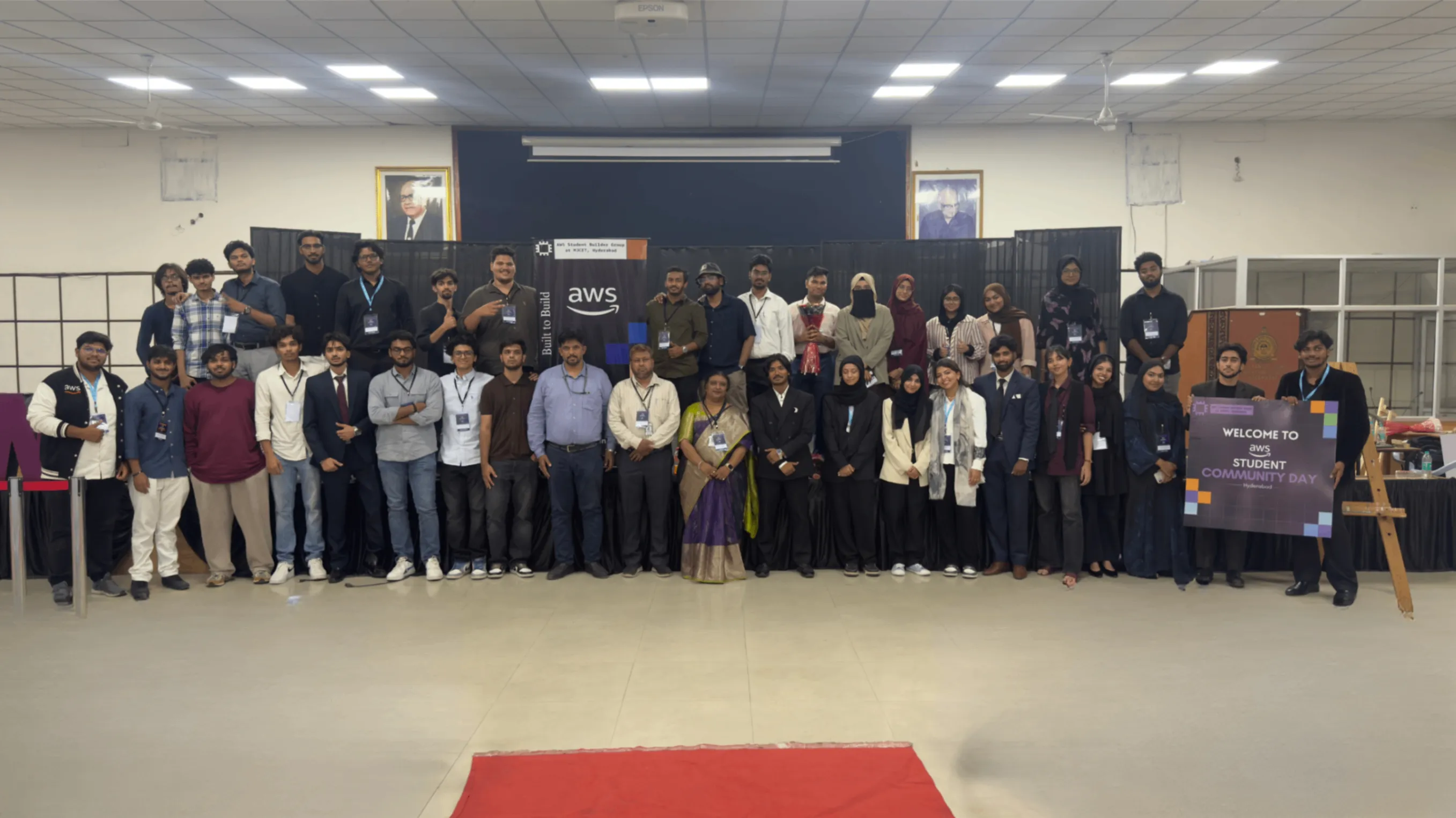
AWS Student Community Day Hyderabad 2026
On June 10, 2026, the AWS Student Builder Group MJCET — Telangana’s first AWS Cloud Club — brought together 300+ students, 6 industry leaders, and 6 sessions of unfiltered cloud and AI knowledge under one roof at Muffakham Jah College of Engineering and Technology, Hyderabad. Five technical talks. One panel discussion. One room that left no one the same.


Introduction: Why We Built This
AWS has always had the power to lead the world in cloud technology. But what makes AWS truly extraordinary isn't the infrastructure, the 200+ services, or the billions in revenue, AWS gave students, people still in college, still figuring things out, the power to build communities. The power to bring people together, bridge the gap between classrooms and boardrooms, and create spaces where real learning happens.
That was the vision behind the AWS Student Builder Group at MJCET. And on June 10, 2026, that vision became AWS Student Community Day Hyderabad.
We didn't wake up one morning and decide to host a 500-person conference. This moment was built over time, through 15+ technical events, workshops, incubation drives, hackathons, and late nights that our community spent building, breaking, and learning together. Every event taught us something. Every workshop sharpened our execution. Every student who showed up added fuel to something that was quietly becoming bigger than any one of us.
We were Telangana's first AWS Cloud Club and we were determined to prove that Hyderabad could build community at the highest level. Not just as students. As leaders.
AWS Student Community Day Hyderabad 2026 was the culmination of that journey, the moment a year of learning, leading, and community-building was distilled into one unforgettable day at Muffakham Jah College of Engineering and Technology. This is the full story of how it happened, what made it special, and everything we learned so the next generation of SBG leaders can go even further.
Session Recaps

AI First Future:Building Skills, Businesses & Careers in the Age of Intelligence
Speaker: Gaurav H. Kankaria Global AWS AI Ambassador
Gaurav's session set the tone for everything that followed. As a technology leader embedded in the AWS ecosystem, he connected the dots between AI, cloud infrastructure, and real business outcomes. His central argument was timely and urgent: being AI-first isn't about using AI tools — it's about developing the instinct to identify where intelligence creates value and building the skills to put it to work. For students still mapping out their paths, it was exactly the kind of framing that makes the road ahead feel both clear and exciting.

Entering the Top 1%: Building a FAANG-Ready Skillset in AI & Data Science
Speaker: Tajamul Khan — Top 1% Data Scientist (Worldwide)
Tajamul didn't come to give students a roadmap, he came to flip the way they think. Drawing from his experience spanning Google, Amazon, and MIT, his session cut through the noise of certification checklists and tech-stack debates to get at something deeper: what it actually means to think like a top-tier AI and data science professional. The message was clear, understanding an algorithm is just the entry ticket. Real competence is built through judgment, problem-solving under pressure, and the discipline to go deeper when everyone else stops at the surface.
**

Beyond Firewalls: Security in the AI and Cloud Era
Speaker: Varsha Verma - Infrastructure Transformation Specialist at Accenture & AWS Community Builder
Varsha's session was the one that made the room go quiet in the best possible way. In a world racing to ship AI features and cloud applications, she brought the conversation that most builders skip until it's too late: security. Not firewalls and checkboxes but identity, access control, data protection, and the emerging threat landscape that comes with AI-powered systems. Her core message landed with precision: innovation and security aren't competing priorities. Building responsibly is simply part of building well.

S3 to Bedrock: Build Your First AI App on AWS
Speaker: Satyajit Samantray - Principal Cloud Architect at Searce & AWS Ambassador
Satyajit's session was where concepts became code. As a cloud architect with deep hands-on experience across AWS, Kubernetes, and generative AI, he walked students through the architectural thinking behind combining AWS S3 and Amazon Bedrock to build real, functional AI applications. The session wasn't just a technical demo, it was a mindset shift. Cloud services aren't valuable in isolation. Their power emerges when you understand how to connect them into solutions that actually solve problems for real users.

AI Agents Are the New Apps: How AWS and AI Are Renewing Software in 2026
Speaker: Avinash Reddy Thipparthi - AWS Community Builder
Avinash continued the session lineup with a look at where software is headed and it was the kind of talk that makes you feel the urgency of the moment. AI agents aren't a future concept anymore; they are redefining what applications can do, how workflows are designed, and what it means to build software in 2026. But Avinash was careful to frame this honestly: agentic systems introduce tremendous capability alongside real engineering challenges around reliability, security, and human oversight. For the students in the room, the takeaway was both exciting and grounding the next generation of builders needs to be as thoughtful as they are bold.
The Panel Discussion
Moderated by: Vahaj Rahman — AWS Student Builder Group Leader,
Panellists: Tajamul Khan · Gaurav H. Kankaria · Varsha Verma · Satyajit Samantray · Avinash Reddy Thipparthi · Sathpal Singh
Panellists: Tajamul Khan · Gaurav H. Kankaria · Varsha Verma · Satyajit Samantray · Avinash Reddy Thipparthi · Sathpal Singh

With all six industry experts seated on stage together, the conversation didn't stick to slides or structured talking points, it went exactly where the moment demanded. The questions were pulled directly from the headlines: AWS commanding 30% of the global cloud market, India's data centre industry racing toward a $22 billion valuation by 2030, Uber burning through its entire annual AI budget in four months, and Jensen Huang calling fears about AI taking jobs "complete nonsense" while simultaneously warning that those who don't use AI will be left behind by those who do. These weren't abstract topics. They were the exact forces shaping the careers of every student in that room, and the panellists didn't shy away from them.
The discussion moved from technical depth to lived experience with ease. Students in the audience pushed back, asked real questions, and got real answers about what it actually takes to break into competitive roles, how to build when you have limited resources, and what the tech industry genuinely looks for beyond a polished resume. One of the most energising threads of the conversation centred on AWS certifications and the AWS Builder Centre speakers spoke directly to how these pathways open doors, provide structure for self-learners, and signal seriousness to employers in ways that university grades alone often can't.
For many students, this was the first time they had sat in the same room as people shaping the industry and been able to ask them anything. That access, that directness, that feeling that the gap between where you are and where you want to be is actually closeable that was the real outcome of the panel.
Thank You - The People Who Made It Real
To our speakers — Tajamul Khan, Gaurav H. Kankaria, Varsha Verma, Satyajit Samantray, Avinash Reddy Thipparthi, and Sathpal Singh:
You didn't just give sessions. You gave time, which is the most valuable thing anyone in your position can offer. You sat with students, answered their questions without filters, and treated every person in that room as someone worth investing in. That is not something we take for granted. Every student who walked out of MJCET on June 10 with a clearer sense of direction carries a piece of what you shared. Thank you for making this real.


To the AWS Student Builder Group MJCET team:
There are people in this world who talk about building things, and there are people who actually build them. You are the second kind. The sleepless nights before the event, the logistics calls that never seemed to end, the last-minute problems that got solved quietly so no one else ever knew they existed, that's what execution looks like when a team actually believes in what they're doing. You didn't just organise an event. You held a vision together under pressure and delivered it without blinking. I am proud of every single one of you.

To our AWS student community:
You are not just attendees or followers or subscribers. You are the reason any of this exists. Your energy, your curiosity, your willingness to show up, that's the heartbeat behind everything the AWS Student Builder Group at MJCET has built. This community belongs to you. And what it becomes next is in your hands.
AWS Student Community Day Hyderabad 2026 happened because a group of students believed it could. And it was everything we hoped it would be, and more.

The Playbook: What Every SBG Leader Needs to Know Before Their SCD
This section is for every SBG Leader and community builder reading this who is thinking about running their own Student Community Day. These are the things we learned not from a playbook someone handed us, but from doing it ourselves.

- 📋 Plan Early. Plan Professionally. Put Everything on Paper.
Here's the truth nobody tells you: most events fail in the planning phase, not the execution phase. By the time execution begins, the damage is already done.
Start earlier than you think you need to. The moment you have the idea, open a document and start writing. Not just the event concept- the schedule, the agenda, the speaker list, the budget, the expenditure tracker, the venue options, the contingency plan. When an idea lives only in your head, it stays an idea. When it's on paper, it becomes a plan and plans have gaps you can actually fix.Choose your date with obsession. Check the academic calendar. Check exam schedules.
For speakers, cast your net wide and aim high. The AWS community is one of the most generous networks in tech - Heroes, Ambassadors, and Community Builders are everywhere, and the vast majority of them genuinely want to be part of events like this. Reach out to more people than you think you need. Invite boldly. Most will say yes.Document everything. Budget line by line. Every expenditure with its receipt. Every speaker confirmation with email. Every venue agreement with its terms. - 🛡️ Build Backups for Your Backups.
As a leader managing a large-scale event, you will not have the luxury of time to process what went wrong. The moment something breaks, your only job is to act. The teams that execute flawlessly aren't the ones who had no problems, they're the ones who prepared for problems so thoroughly that when they arrived, they already knew what to do.
Have a backup speaker. Have a backup venue. Have a backup date window in mind. Assign a team member specifically responsible for monitoring logistics on the day. Build redundancy into every critical dependency. The best insurance against chaos is preparation, and the best time to prepare is weeks before you think you need to. - 🤝 Build a Great Team — Then Trust Them Completely.
This one is personal. Because an event like this doesn't happen because one person worked hard enough. It happens because the right people cared about the same thing.
A great team is not a collection of people who can execute tasks. It's a group of people who understand the vision and feel ownership over itDivide the work early and clearly. Parallelism is what makes large events possible, one team on speakers, one on venue and logistics, one on registrations and communications, one on design and promotions. Each stream should know their lane and have the autonomy to run it. But they must also communicate constantly. Misunderstandings and miscommunications are the silent killers of otherwise great events. Overcommunicate. Always.And after it's all over, celebrate loudly. Recognize the people who made it happen. A small gesture of appreciation does more for team morale than any post-event debrief. After the event, have a proper celebration. - 🎁 Leave People With Something They'll Remember.
Attendees will forget the order of sessions. They'll forget some of the details. But they will remember how the day made them feel and what they carried home from it.
Invest in your swag. A thoughtfully put-together kit whichturns an event into a memory. These are the things they'll have on their desks six months from now, and every time they see them, they'll think about that day and what it meant.Beyond the physical, give people clear next steps. Direct them to AWS certifications, to the AWS Builder Centre, to the community resources that will keep their momentum going long after the event ends. The best community events don't just create a great day they create an on-ramp to something bigger.And to your own team: give them credit publicly and specifically. Thank them by name. Tell the community what they did. Small gestures of recognition keep the energy alive and set the standard for the kind of leader you are, one who builds others up.

AWS Student Community Day Hyderabad 2026 was built by students, for students, on the belief that community is one of the most powerful forces in building a career and a life in tech.
Keep learning. Keep building. The future belongs to those who build it.

# aws-student-builders-groups# aws-community-day-2026# aws-community-builders# aws-community-day-recaps-2026# aws-ambassador
Any opinions in this article are those of the individual author and may not reflect the opinions of AWS.Enjoyed reading this content? Let the author know!
Your likes, comments, shares, and saves help creators reach more builders.

Loading recommendations
Loading article