
Building DocuMind: A RAG Study Assistant That Actually Cares
DocuMind is a RAG-powered study assistant designed to help university students seamlessly query complex course materials. This breakdown covers the serverless AWS architecture behind the application and the specific persona engineering used to create a genuinely encouraging study tool.

What Your Agent Does
As an undergraduate Computer Science and Engineering student, I routinely handle hundreds of pages of technical documentation, academic research papers, and complex lecture slides across every single semester. Navigating dense slides during intense exam preparation often leads to immense friction, wasted time, and cognitive fatigue. I built DocuMind as a dedicated Retrieval-Augmented Generation (RAG) study assistant specifically designed to help university students digest and synthesize their heavy course materials rapidly and effectively.
DocuMind transforms static learning resources into an interactive, intelligent dialogue partner. Instead of manually scanning massive PDF decks for specific algorithms, architectural diagrams, or theoretical definitions, students upload their documents directly into the platform and query them using natural language. The AI assistant retrieves exact passages from course notes, contextualizes the source material, and delivers focused explanations, structured summaries, and interactive revision quizzes on demand. It bridges the gap between raw academic materials and active, engaging study sessions, ensuring students spend time learning rather than just searching.
How I Built It
DocuMind relies on a modern, serverless cloud architecture deployed entirely on AWS infrastructure, prioritizing low latency, operational simplicity, and scalability while maximizing AWS Free Tier services. The core stack leverages Python and several key AWS services:
- Frontend User Interface: Built using Streamlit to deliver a clean, responsive web application. The design is intentionally minimal, focused on clarity and readable typography to reduce visual fatigue during late-night study sessions.
- Model Orchestration and Inference: Powered by Amazon Bedrock for high-performance foundation model inference. I integrated Bedrock seamlessly into the Python backend using LangChain orchestration abstractions. Bedrock allows DocuMind to generate accurate, context-grounded completions while keeping token latency exceptionally low.
- Vector Storage and Retrieval: Managed through Amazon OpenSearch Serverless. Document chunks and their corresponding embeddings are securely stored and queried using vector search indexes. This serverless approach entirely eliminates the need to provision, patch, or scale database clusters manually, keeping operational overhead virtually non-existent.
The custom ingestion pipeline reads uploaded PDF lecture files, strips unnecessary formatting artifacts, and applies recursive character text chunking. I utilized overlapping windows to preserve semantic continuity across slide boundaries. From there, dense vector embeddings are computed and indexed directly into the OpenSearch Serverless collection.
A major technical hurdle was managing context boundaries when processing multi-topic academic decks. Naive chunking often severed mathematical formulas from their accompanying textual explanations. To resolve this specific challenge, I meticulously tuned dynamic chunk sizing with balanced overlap thresholds, ensuring complex derivations and definitions remain bound within the same vector representation for highly accurate retrieval.
The Experience
Most automated educational bots suffer from a sterile, robotic demeanor. When students encounter errors late at night, cold system failures increase frustration and completely break learning momentum. For DocuMind, I prioritized persona engineering and empathetic error recovery to make interactions genuinely supportive and enjoyable to use.
First, the core system prompt explicitly instructs the generative agent to converse as a knowledgeable, encouraging peer rather than an impersonal, rigid reference engine. It highlights progress and frames complex technical breakdowns constructively.
Second, DocuMind features highly adaptive fallback handling. Standard document search engines fail abruptly with unhelpful messages like "Error: No relevant documents found" or "Context missing." DocuMind instead recognizes knowledge gaps and responds with constructive, conversational guidance:
"I couldn't find that specific concept in your current lecture notes! Double-check that you uploaded the right week's slide deck, or let's try breaking down the topic together using the foundational chapters we already have indexed."
Testing this conversational approach showed an immediate reduction in user frustration during complex document queries. It successfully turns edge-case dead ends into natural study breaks, gracefully guiding users back to their workflow without the jarring interruption of a hard system error.
Proof It Works
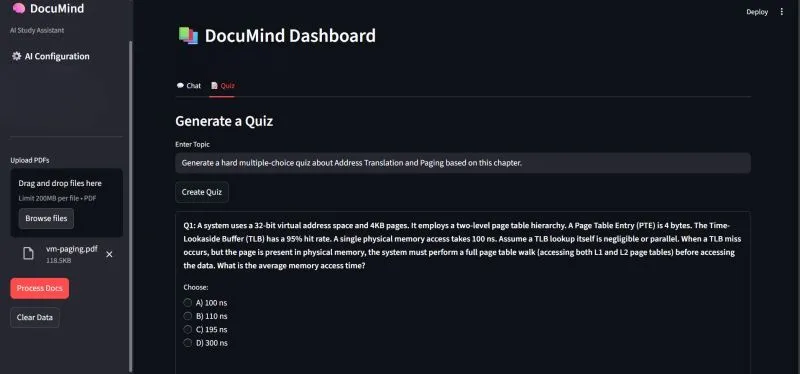
The end-to-end functionality of the agent is demonstrated in the attached cover image (
49913.jpg). The screenshot explicitly showcases the active Streamlit dashboard parsing an uploaded lecture file (vm-paging.pdf) and successfully synthesizing a complex, multi-variable operating systems quiz query in real-time. This validates the seamless integration between the Python frontend, the OpenSearch Serverless vector database, and the Amazon Bedrock inference backend.Enjoyed reading this content? Let the author know!
Your likes, comments, shares, and saves help creators reach more builders.

Loading recommendations
Loading article