
Weekend Challenge: TinyWins — A Productivity Agent That Makes Getting Started Easier
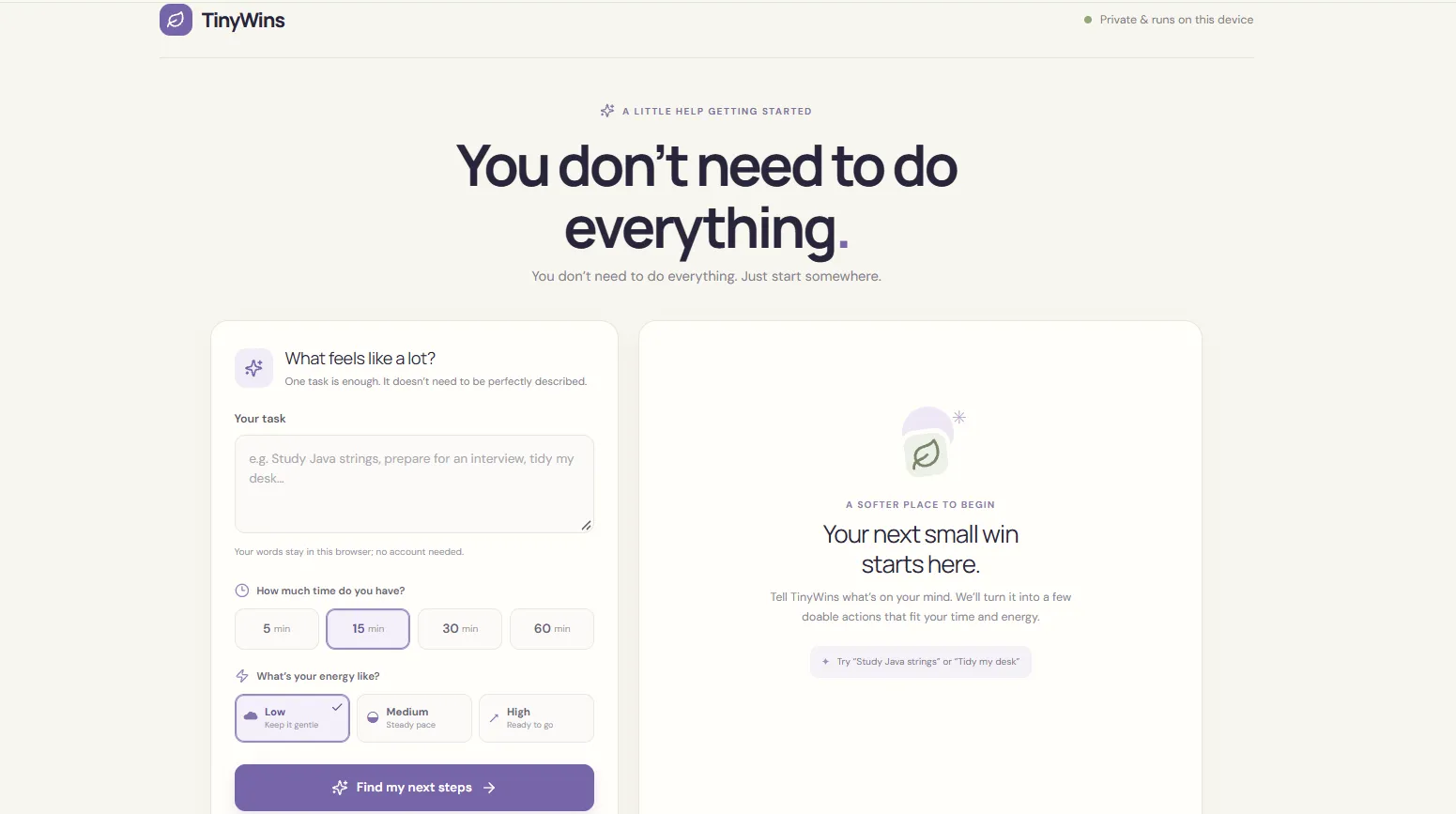
What if getting started on a big task felt a little less overwhelming? Meet TinyWins, a small productivity agent designed to turn one intimidating task into a few manageable next steps. It considers the time available and the user's current energy level to create a practical plan, then helps make the next action smaller when the user feels stuck. The idea is simple: you do not always need a perfect plan. Sometimes, you just need one small win.

The idea behind TinyWins
Students, developers, and job seekers often juggle assignments, interview preparation, coding projects, deadlines, and personal goals. When everything feels important, deciding where to begin can become a task of its own.
Traditional productivity tools often focus on managing long to-do lists, tracking deadlines, or organizing projects. Those tools are useful, but they do not always help when you have limited time or energy and cannot figure out your next step.
I wanted to explore a smaller idea: what if a productivity tool could help someone get started instead of asking them to organize everything first?
That is the motivation behind TinyWins. It is designed around a simple principle: make the next action small enough to begin.
What does TinyWins do?
TinyWins asks the user for three things:
- The task: What do you want to work on?
- Available time: Do you have 5, 15, 30, or 60 minutes?
- Energy level: Is your energy low, medium, or high?
Using these inputs, its planning engine generates a short sequence of actionable steps. It also explains why the plan fits the selected time and energy level.
For example, someone who wants to study Java strings with 15 minutes available and low energy receives three small actions: choose one concept to focus on, read a short example, and try an easy question without notes.
The example plan estimates nine minutes of work, leaving some breathing room within the available time.
TinyWins also supports progress tracking through an interactive checklist. When a user feels stuck, they can choose to make a step easier. Instead of replacing the entire plan, TinyWins can shrink the selected action into something more manageable.
In the Java strings example, “Read one short example of Java strings” can become “Read one sentence about Java strings.” The app explains the change using the remaining time and the selected energy level.
That small interaction is the heart of TinyWins: progress does not have to mean doing everything at once.
How I built it
I built TinyWins using a lightweight web stack:
- React for the user interface and interactive components.
- Vite for development and production builds.
- TypeScript for the planning logic, data structures, and application behavior.
- Tailwind CSS and custom styling for a calm, responsive interface.
- AWS Amplify Hosting to deploy the frontend and make it accessible through a public URL.
- GitHub for source control and version management.
I implemented the planning behavior as a deterministic, rule-based engine in TypeScript. It uses the task, available time, energy level, unfinished steps, and feedback to choose and adapt suggestions.
An important design decision was to keep the application frontend-only. The planner runs locally in the browser, so the current version does not require a backend server, database, API keys, or a generative AI service. Task information stays in the browser rather than being sent to a planning API.
This kept the project small, easy to test, and straightforward to deploy. It also allowed me to focus on the user experience and decision-making behavior instead of adding infrastructure that the core idea did not need.
TinyWins is therefore a rule-based productivity agent, rather than an LLM-powered AI agent. Its behavior comes from explicit planning and adaptation rules, not from a generative AI model.
A small detail that makes a difference
The feature I particularly wanted to get right was what happens when a user cannot complete a suggested action.
A productivity tool can make someone feel worse by presenting another large task when they are already struggling. TinyWins takes a different approach: it makes the next action smaller.
The original plan remains visible, and the other unfinished steps are preserved when an individual action is reduced. This keeps the adaptation focused rather than forcing the user to start over.
The interface also avoids presenting productivity as an all-or-nothing achievement. It uses encouraging language, a simple progress indicator, and a clear next action to make beginning feel less intimidating.
How I tested it
I tested the production build and checked the planner across all 12 combinations of available time and energy level. I also verified deterministic plan variations and the smaller-step adaptation behavior.
After deploying to AWS Amplify, I tested the live application using the Java strings example with 15 minutes and low energy. It generated three actionable steps with a total estimated duration of nine minutes.
I then tested the adaptation interaction in the browser. When I asked TinyWins to make a step easier, it reduced the action to reading one sentence about Java strings while leaving the other unfinished steps unchanged.
I also verified plan creation, checklist progress, and the relevant adaptation behavior before considering the core experience ready to share.
What's next?
TinyWins is intentionally a small experiment, not a complete productivity platform. Future improvements could include more task-specific planning templates, additional feedback options, and better ways to help users choose their next action without adding unnecessary complexity.
The larger lesson from building it is that a useful agent does not always need a complicated architecture. Even a small, transparent decision-making system can respond to context, take an action, and adapt when the first suggestion is not working.
Sometimes the most helpful next step is not a bigger plan. It is a smaller one.
Try TinyWins
Live application: https://main.dqcdnuh07usot.amplifyapp.com/
Source code: https://github.com/aishwaryap27/TinyWins
Try entering a task, choosing your available time and energy level, and seeing what your next small win looks like.
Enjoyed reading this content? Let the author know!
Your likes, comments, shares, and saves help creators reach more builders.

Loading recommendations
Loading article