
VoiceShield CloudForge — Part 3: From Infrastructure Blueprint to Cloud Deployment
Moving VoiceShield from architecture design toward a deployable AWS environment. Explore the planned cloud infrastructure, model-serving strategy, language-aware audio routing, PostgreSQL integration, and the engineering decisions required to prepare for v2.0
Series: VoiceShield CloudForge: Engineering the Infrastructure (3 articles)
- 3VoiceShield CloudForge — Part 3: From Infrastructure Blueprint to Cloud Deployment This article

Introduction: Architecture Must Become Infrastructure
In Part 2 of the VoiceShield × CloudForge series, we designed the infrastructure blueprint for our AI-powered audio deepfake detection system.
But designing an architecture is only one part of building a reliable cloud-native application.
The next challenge is translating that blueprint into an infrastructure strategy that can support model inference, audio processing, data persistence, API communication, and future scaling.
For VoiceShield, our goal is not simply to deploy a deepfake detection model. We are building a multi-stage detection system that evaluates audio evidence and produces a structured, explainable decision.
This brings us to the next stage of CloudForge:
How do we prepare VoiceShield's architecture for deployment on AWS while keeping the system modular, scalable, and maintainable?
1. Our Deployment Philosophy
We are approaching deployment in stages rather than moving every component to the cloud simultaneously.
Our progression is:
- Demonstrator v1.0: Validate the core detection workflow and demonstrate the system.
- SIH Prototype v2.0: Strengthen the architecture, integrate components, and prepare a more complete prototype.
- Future iterations: Improve operational reliability, scalability, observability, and deployment automation.
Each stage should build on validated engineering decisions rather than introducing unnecessary infrastructure complexity.
The objective is to establish a cloud foundation that supports our current requirements without limiting future development.
2. The Planned AWS Architecture
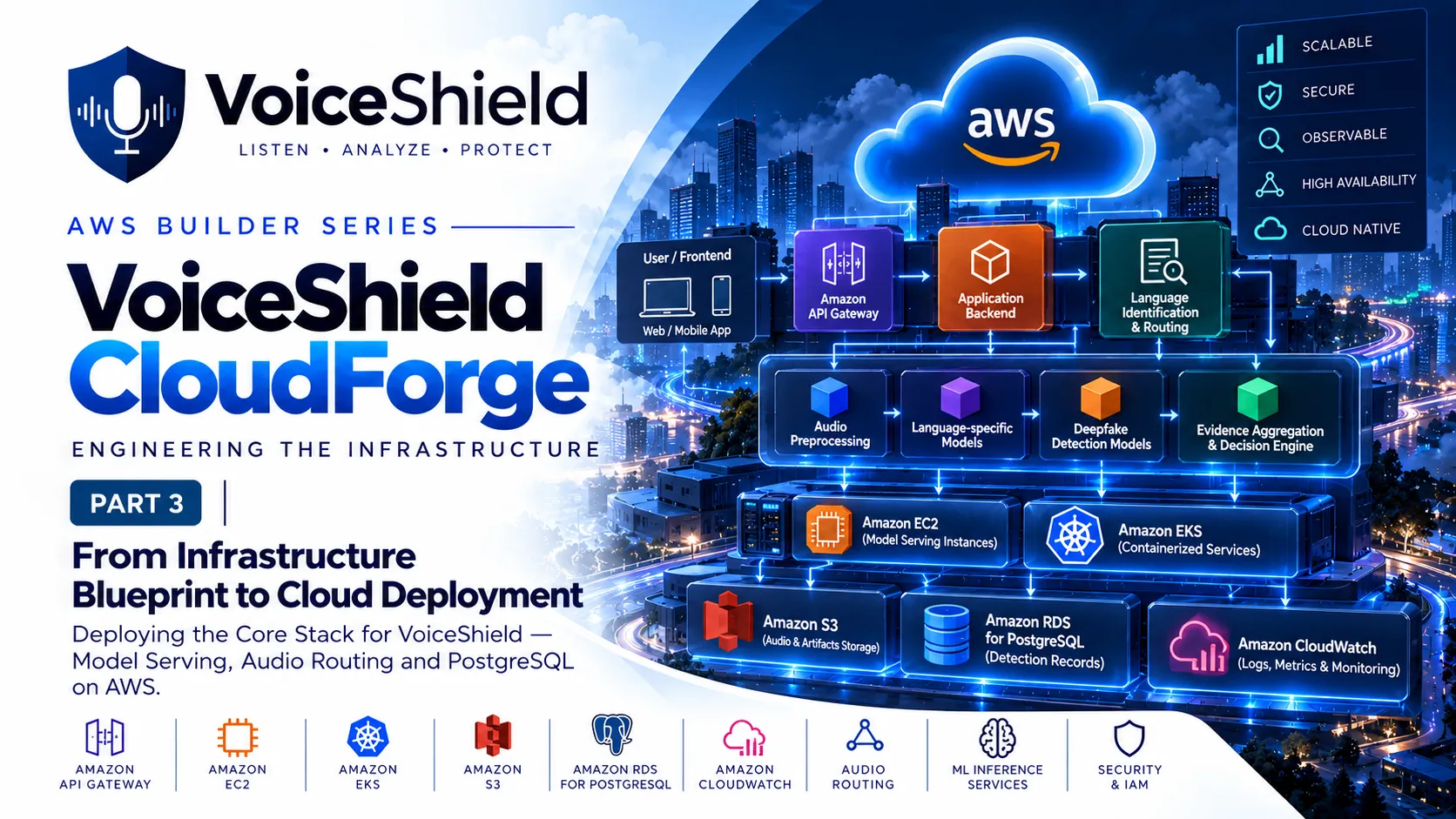
Our proposed infrastructure separates the application interface, API layer, model-serving workloads, and persistent data.
The high-level request flow is:
User Interface
↓
Amazon API Gateway
↓
Backend Application and Orchestration
↓
Language-Aware Cascading Audio Routing
↓
Specialized Audio Detection Models
↓
Evidence Aggregation and Decision Logic
↓
PostgreSQL Persistence
↓
Structured Detection Result
↓
Amazon API Gateway
↓
Backend Application and Orchestration
↓
Language-Aware Cascading Audio Routing
↓
Specialized Audio Detection Models
↓
Evidence Aggregation and Decision Logic
↓
PostgreSQL Persistence
↓
Structured Detection Result
This is our planned logical architecture, not a claim that every component is already deployed on AWS.
Amazon API Gateway — The Application Entry Point
Amazon API Gateway is planned as the managed API entry point for client requests.
It can provide a controlled interface between the frontend and backend, with integration points for authentication, request validation, throttling, and monitoring.
The backend will coordinate the detection workflow rather than exposing individual model endpoints directly to the user.
Amazon EC2 — Dedicated Model-Serving Infrastructure
For model workloads that require control over the runtime, dependencies, or inference environment, Amazon EC2 is a candidate for hosting model-serving services.
The deployment configuration will depend on the requirements of each model.
CPU-based instances may be suitable for lightweight inference, while GPU-capable instances may be necessary for computationally demanding models.
We will evaluate model latency, memory consumption, throughput, and cost before finalizing the instance strategy.
The key principle is to select compute based on measured workload requirements rather than assuming every detection model needs a GPU.
Amazon S3 — Audio and Artifact Storage
Amazon S3 is a candidate for storing audio objects, model artifacts, and other files that do not belong directly inside relational database records.
Where audio retention is required, we will need explicit retention policies, access controls, and encryption.
The application should avoid placing large audio payloads inside PostgreSQL when object storage is more appropriate.
Amazon CloudWatch — Observability
Amazon CloudWatch can provide centralized logs, metrics, dashboards, and alarms for the deployed components.
We will need visibility into API failures, model latency, resource utilization, and the behavior of the detection pipeline.
This will help us distinguish infrastructure failures from model-level uncertainty and application logic errors.
3. Language-Aware Cascading Audio Routing
One of the defining architectural components of VoiceShield is our Language-Aware Cascading Audio Routing Architecture.
Instead of treating every audio input identically, the system is designed to route audio through an appropriate sequence of detection stages.
The intended workflow is:
Audio Input → Preprocessing → Language Identification → Model Routing → Cascaded Detection → Evidence Aggregation → Final Decision
Stage 1: Audio Preprocessing
The system validates the incoming audio and prepares it for inference.
This stage can include format validation, sample-rate normalization, channel handling, and duration checks.
Consistent preprocessing is important because incompatible audio inputs can produce unreliable results or inference failures.
Stage 2: Language Identification
The routing layer identifies the language where supported and uses that information to select suitable downstream processing.
Language identification should not be treated as a perfect signal. Short clips, background noise, code-switching, and low-quality recordings may create uncertainty.
The architecture should therefore support a fallback path when language identification is inconclusive.
Stage 3: Cascaded Model Inference
The router selects the appropriate detection sequence according to the input characteristics and the capabilities of the available models.
Rather than invoking every model indiscriminately, the system can evaluate evidence progressively.
For example, a lightweight first-stage detector may process an input before a more computationally expensive detector is invoked when additional evidence is necessary.
The precise model sequence and escalation thresholds will be determined through evaluation.
Stage 4: Evidence Aggregation
The detection system combines relevant outputs from the selected stages.
A reliable implementation must account for differences in model confidence, calibration, language coverage, and failure behavior.
We should not assume that confidence scores from different models are directly comparable without validation.
The final decision layer will interpret the available evidence and return a structured result.
4. PostgreSQL: Building a Persistent Detection Record
VoiceShield also requires a persistent data layer for storing structured information about detection requests and their outcomes.
PostgreSQL is planned for this responsibility.
The database can maintain records such as:
- Detection request identifiers.
- Audio object references and metadata.
- Processing status and timestamps.
- Models invoked during inference.
- Relevant model outputs and calibrated scores.
- Aggregated decisions and uncertainty indicators.
- Error records and processing outcomes.
A simplified logical relationship could be represented as:
Detection Request → Model Evaluation Records → Aggregated Detection Result
This structure allows us to distinguish the original request from the multiple model evaluations performed during processing.
It also creates a foundation for auditing decisions, troubleshooting failed requests, and evaluating system performance.
Audio binaries should generally remain in object storage, with PostgreSQL retaining the relevant metadata and references.
For deployment, we will evaluate Amazon RDS for PostgreSQL or another suitable managed PostgreSQL configuration against our operational and cost requirements. The final selection will depend on networking, availability, backup, security, and access requirements.
5. Connecting Compute, Models, and Data
A major engineering challenge is ensuring that the individual components operate as one coherent system.
The API layer must communicate reliably with the orchestration layer. The orchestrator must invoke model services using well-defined interfaces. Model outputs must follow a consistent schema, and the persistence layer must record the results without compromising the request lifecycle.
We are therefore prioritizing clear service boundaries.
Each detection component should have a defined responsibility, input contract, output contract, timeout, and error-handling strategy.
For example, a model-serving component should return structured inference results rather than requiring the orchestration layer to interpret arbitrary console output or unstructured text.
This approach will make it easier to replace models, introduce new language-specific detection stages, and investigate failures independently.
6. Security Is Part of the Architecture
Audio analysis can involve sensitive user data. Security must therefore be considered before deployment, not added after the application is operational.
Our planned security considerations include:
Identity and access management: Use AWS IAM roles and least-privilege policies for services accessing AWS resources.
Network isolation: Keep database instances and internal model services off the public internet wherever possible, exposing only the interfaces that require external access.
Encryption: Use encryption in transit and at rest for supported data paths and storage services.
Credential management: Keep database credentials and other secrets out of source code and container images.
Data retention: Define how long uploaded audio, intermediate artifacts, and detection records should be retained.
Auditability: Record operational events and relevant detection metadata while avoiding unnecessary exposure of sensitive audio content in logs.
These measures will form part of the deployment requirements as the prototype matures.
7. Preparing for Reliable Deployment
A deployment is not complete merely because the application starts successfully.
Before considering the cloud implementation ready for broader testing, we need to validate:
- API connectivity and request validation.
- Successful audio preprocessing and model invocation.
- Correct language-aware routing and fallback behavior.
- Consistent model output schemas.
- Database persistence and recovery from failures.
- Timeouts, retries, and error handling.
- Resource utilization and inference latency.
- Access controls, logging, and operational monitoring.
We also need to measure the cost of processing an audio request.
The cost will depend on the selected compute resources, inference duration, storage usage, database configuration, and request volume.
Performance and cost measurements should guide subsequent optimization instead of relying on assumptions about the ideal infrastructure.
8. The Road Ahead: SIH Prototype v2.0
CloudForge is about turning architectural decisions into an engineering foundation that can support the next stage of VoiceShield.
Our priorities are to refine the service boundaries, validate the model-serving strategy, integrate PostgreSQL persistence, and prepare the infrastructure for repeatable deployment and testing.
The next iteration will focus on closing the gap between the planned architecture and a validated implementation.
We will need to verify which components can be deployed as managed services, which require dedicated compute, and where additional orchestration or asynchronous processing is justified.
The architecture should evolve in response to measured requirements, not simply the number of AWS services we can introduce.
Conclusion
Building an AI-powered security application requires more than a detection model and a cloud account.
It requires infrastructure that can coordinate inference, manage data, handle failures, protect sensitive inputs, and provide enough observability to understand the system's behavior.
Through CloudForge, we are working toward that foundation for VoiceShield.
Our focus is clear: move from an infrastructure blueprint toward a validated, secure, and deployment-ready architecture that supports the transition from Demonstrator v1.0 to SIH Prototype v2.0.
This is the next step in building VoiceShield as an engineering system—not just a model demonstration.
Note: The AWS services and deployment components described in this article represent the proposed architecture. Actual deployment status and final service selections should be documented as implementation progresses.
Up Next
In Part 4, we will explore how to turn the deployment plan into a repeatable engineering workflow, covering environment configuration, service integration, testing, and deployment validation.
#CloudForge #VoiceShield #AWS #CloudArchitecture #DeepfakeDetection #MLOps #PostgreSQL #SIH2026
Series: VoiceShield CloudForge: Engineering the Infrastructure (3 articles)
- 3VoiceShield CloudForge — Part 3: From Infrastructure Blueprint to Cloud Deployment This article
Enjoyed reading this content? Let the author know!
Your likes, comments, shares, and saves help creators reach more builders.

Loading recommendations
Loading article