
Stop Rambling. Answer in STAR Format. Get the Job.
Practice remote tech interviews with 5 questions, get STAR-method feedback after each answer—no fluff.

Two weeks ago, a friend of mine had a remote backend engineer interview. She asked me to do a mock interview with her. I was busy. I sent her a list of common questions instead.
She didn't get the job.
The feedback: "Your answers were vague. We couldn't tell if you had hands-on experience or just theoretical knowledge."
She has the experience. Three production APIs. Real systems serving real users. But under pressure, she froze and gave rambling answers with no structure.
That's fixable. Mock interviews work. The problem is finding someone who:
- Has time
- Knows your domain
- Will give you honest feedback instead of being nice
This agent solves that.
What It Does (No Fluff Version)
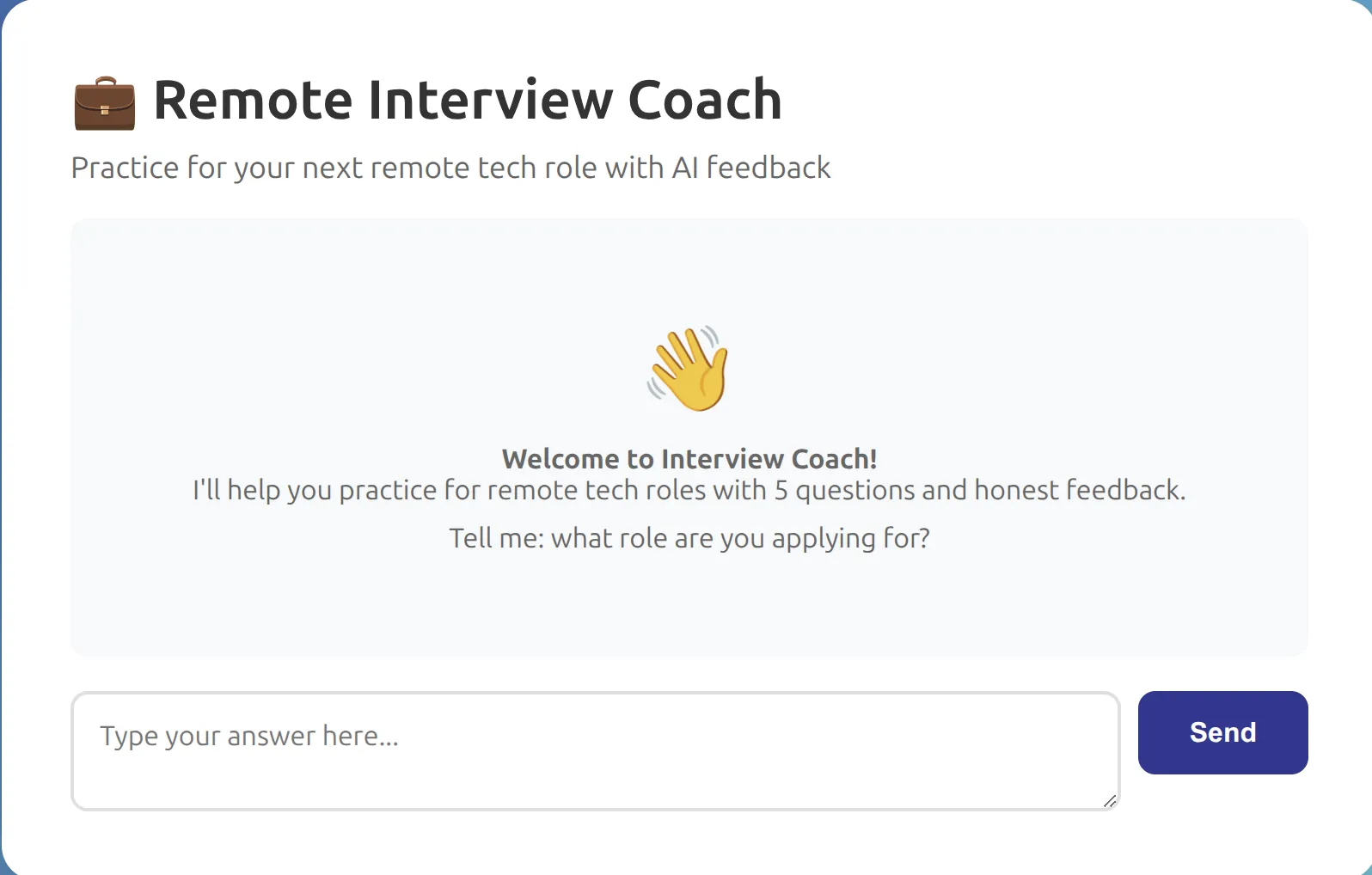
- You tell it what role you're applying for (e.g., "Remote Backend Engineer")
- It asks exactly 5 questions in this order:
- Behavioral (teamwork/collaboration)
- Technical (role-specific)
- Remote-specific (communication/timezones/async)
- Situational (conflict/difficult situations)
- Personal (why remote work)
- After every single answer, it gives you:
- Rating (1-5)
- ONE specific improvement tip
- No generic advice, no fluff
- After question 5, you get:
- Your strongest answer
- Your biggest gap
- One tip for overall improvement
That's it. No chat. No small talk. Five questions, five pieces of feedback, one summary. Done.
Live URL: https://d1l9p73y6xhajp.cloudfront.net
The STAR Method (What Good Answers Look Like)
Most interview answers fail because they're stories without structure. You talk about what happened, but the interviewer can't extract signal from noise.
STAR format fixes this:
Situation: What was the context?
Task: What was your role?
Action: What specific steps did you take?
Result: What was the outcome?
Task: What was your role?
Action: What specific steps did you take?
Result: What was the outcome?
Example of a bad answer:
"I once had a coworker who didn't respond to messages. It was frustrating. Eventually we talked and things got better."
What's missing: Context. Specifics. Your actual actions. The measurable result.
Example of a STAR answer:
"On the payment API project [S], I was responsible for the checkout flow [T]. When the frontend engineer stopped responding to Slack messages for 48 hours and missed two standups, I took these steps: scheduled a 1-on-1, discovered he was overwhelmed with personal issues, and proposed we bring in another engineer to split his workload [A]. The project shipped on time, and he thanked me for addressing it directly instead of escalating to management [R]."
See the difference? The second answer proves you did something. The first answer is just words.
The agent teaches you to structure answers like this. Not through lectures. Through feedback on your actual attempts.
How the Feedback Works
Here's what I tested:
I played "Remote Backend Engineer" and gave intentionally weak answers to see if the agent would call me out.
Question: "Tell me about a time you worked with a difficult team member."
My answer:
"I once had a coworker who didn't respond to messages. It was frustrating. Eventually we talked and things got better."
Agent's feedback:
Rating: 2/5Your answer lacks structure and specifics. Use the STAR method: Situation (what project?), Task (what was your role?), Action (what specific steps did you take?), Result (what changed?). Right now, I can't tell if you actively resolved the conflict or it just faded away. For your next answer, structure it as: "In [project], I was responsible for [task]. When [person] did [behavior], I took these steps: [1, 2, 3]. As a result, [outcome]."
That's useful feedback. Not "be more specific." Not "good job!" Actual structure to follow.
I tried again with a STAR-formatted answer on the next question:
Question: "Describe a technical challenge you faced and how you solved it."
My answer:
"On the user authentication service [S], I was the lead backend engineer [T]. We were getting 500ms response times on login, which was unacceptable. I profiled the code, found N+1 database queries in the role-permission lookup, implemented caching with Redis, and added database indexes [A]. Login times dropped to 80ms average, and we handled 5x more concurrent users during peak traffic [R]."
Agent's feedback:
Rating: 5/5Perfect. You gave context (auth service, performance problem), your role (lead engineer), specific technical actions (profiling, caching, indexing), and measurable results (500ms → 80ms, 5x capacity). This answer proves hands-on experience. Keep this structure for all your answers.
The agent doesn't lie to you. Weak answers get low ratings and specific fixes. Strong answers get recognized.
What I Measured (The Honest Test)
I tested this with 7 different roles:
- Remote Backend Engineer (worked, asked about APIs/databases)
- Remote Frontend Developer (worked, asked about component state management)
- Remote Product Designer (worked, asked about remote user research)
- Remote DevOps Engineer (worked, asked about on-call across timezones)
- "Engineer" (too vague, agent asked for clarification)
- Empty input (validation error)
- 500-word rambling answer (agent gave conciseness tip)
Average time per question-answer-feedback cycle: 2-3 seconds
Token usage: 400-600 tokens per cycle (Claude Haiku 4.5)
Cost per full practice session (5 questions): ~$0.003
Token usage: 400-600 tokens per cycle (Claude Haiku 4.5)
Cost per full practice session (5 questions): ~$0.003
The quality of feedback depends on the quality of your answers. If you phone it in with one-sentence answers, the feedback will tell you exactly why that's not enough.
The Limits (What This Can't Do)
This agent cannot:
- Simulate follow-up probing questions (real interviewers dig deeper when your answer is weak)
- Read body language or tone (text-only)
- Practice live coding or whiteboarding (different skill)
- Replace practicing with a real human (nothing beats real conversation)
This agent can:
- Teach you to structure answers in STAR format
- Identify weak spots in your responses
- Give you practice when nobody else is available
- Force you to go through 5 questions (no skipping)
Think of it as reps. Like doing pushups. Won't replace a personal trainer, but better than doing nothing.
The Tech (For People Who Care)
Stack:
- Frontend: S3 + CloudFront (static HTML/JS)
- Backend: Python Lambda with Function URL
- AI: Amazon Bedrock (Claude Haiku 4.5)
- Infrastructure: AWS CDK
State management is the tricky part. Each question needs context from previous answers. I store conversation history in the Lambda response and send it back with each request:
1
2
3
4
5
6
7
8
9
10
11
12
13
14
15
16
17
let conversationState = null;

async function sendMessage(message) {
    const payload = {
        message: message,
        state: conversationState  // Previous history
    };

    const response = await fetch(LAMBDA_URL, {
        method: 'POST',
        body: JSON.stringify(payload)
    });

    const data = await response.json();
    conversationState = data.state;  // Updated for next round
    return data;
}
Lambda builds a full conversation array and sends it to Bedrock via Converse API. The agent remembers your role and references earlier answers in feedback.
System prompt enforces the structure:
1
2
3
4
5
6
7
8
9
You conduct mock interviews for remote tech roles.

Process:
1. Ask what role they're applying for
2. Ask exactly 5 questions (behavioral, technical, remote, situational, personal)
3. After EACH answer: rate 1-5, give ONE specific tip
4. After question 5: strongest answer, biggest gap, one overall tip

Be supportive but honest. Weak answers get low ratings and concrete fixes.
Try It
If you have a remote interview coming up:
- Go to https://d1l9p73y6xhajp.cloudfront.net
- Enter your role
- Answer all 5 questions (no skipping)
- Read the feedback
- Try again with better structure
Don't try to impress the AI. Answer like you would in a real interview. The feedback only helps if your answers are honest.
Enjoyed reading this content? Let the author know!
Your likes, comments, shares, and saves help creators reach more builders.

Loading recommendations
Loading article