
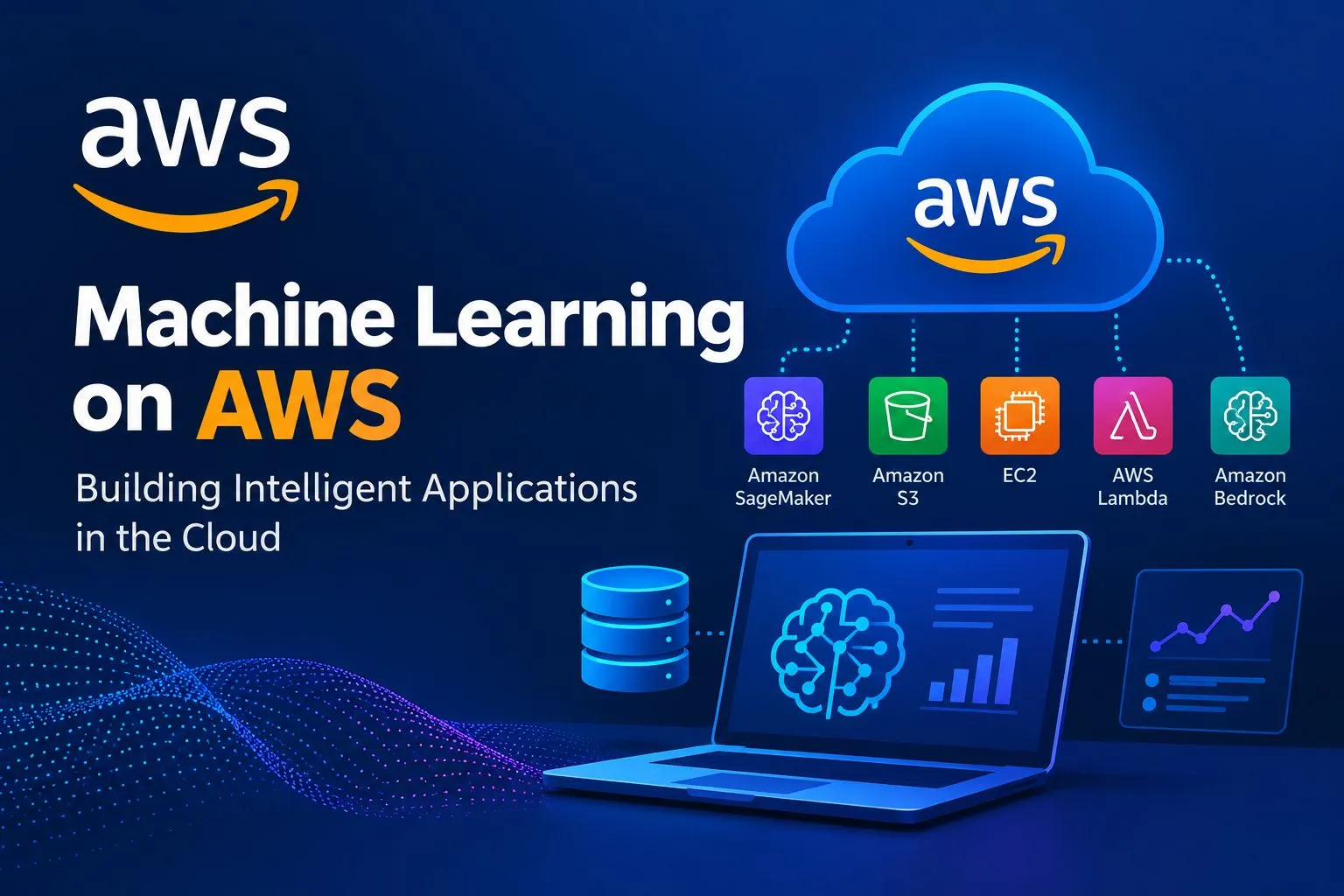
Machine Learning on AWS: Building Intelligent Applications in the Cloud
Explore how Amazon Web Services (AWS) simplifies machine learning through cloud-based tools and services. Learn about Amazon SageMaker, data storage, model training, deployment, and real-world applications of AI and machine learning.

Introduction
Machine Learning (ML) is transforming industries by enabling computers to learn from data, identify patterns, and make predictions. When combined with cloud computing, machine learning becomes more scalable, accessible, and efficient.
Amazon Web Services (AWS) provides a wide range of tools that help developers and data scientists build, train, deploy, and manage machine learning models without maintaining expensive computing infrastructure.
How AWS Supports Machine Learning
AWS offers cloud infrastructure and managed services that simplify the machine learning lifecycle, from collecting data to deploying trained models.
Some important AWS services for machine learning include:
1. Amazon SageMaker
Amazon SageMaker is a machine learning platform that helps developers and data scientists prepare data, build models, train algorithms, deploy models, and monitor their performance.
2. Amazon S3
Amazon Simple Storage Service (S3) provides scalable storage for datasets, training files, model artifacts, and machine learning outputs.
3. Amazon EC2
Amazon Elastic Compute Cloud (EC2) provides virtual computing resources for running machine learning experiments and training models that require additional processing power.
4. AWS Lambda
AWS Lambda can run serverless functions to process incoming data, trigger workflows, and connect machine learning predictions with other applications.
5. Amazon Bedrock
Amazon Bedrock provides access to foundation models for building generative AI applications, including chatbots, text summarization systems, and intelligent assistants.
Machine Learning Workflow on AWS
A typical machine learning project on AWS follows these steps:
- Data collection: Gather data from files, databases, or other sources.
- Data storage: Store datasets in Amazon S3.
- Data preprocessing: Clean and prepare the data for training.
- Model training: Train a machine learning algorithm using SageMaker or suitable EC2 resources.
- Model evaluation: Measure accuracy and other performance metrics.
- Model deployment: Make predictions available through an endpoint or application.
- Monitoring: Track model performance and update the model when necessary.
Real-World Applications
Machine learning on AWS can support many practical applications:
- Healthcare: Assist with medical image analysis and risk prediction.
- Finance: Identify potentially fraudulent transactions.
- E-commerce: Recommend products based on customer preferences.
- Transportation: Predict traffic patterns and estimate accident risk.
- Business analytics: Forecast sales and analyze customer behavior.
- Generative AI: Build intelligent assistants and document-processing applications.
Example Project: Student Performance Prediction
A beginner can build a student performance prediction model using Python and Scikit-learn.
The project could use student study hours, attendance, and previous academic results to predict performance categories.
Amazon S3 can store the dataset, while Amazon SageMaker can support model training and deployment. The resulting model could be connected to a simple web application to demonstrate predictions.
This project helps students understand both machine learning fundamentals and cloud deployment.
Benefits of Combining AWS and Machine Learning
- Scalability: Access computing resources according to workload requirements.
- Faster experimentation: Train and evaluate models using managed infrastructure.
- Flexible storage: Store and manage large datasets in the cloud.
- Deployment options: Integrate models into web applications and business systems.
- Cost management: Select suitable resources and manage usage according to budget.
Conclusion
The combination of AWS and machine learning creates opportunities to develop intelligent applications that can process data, recognize patterns, and generate predictions. Services such as Amazon SageMaker, Amazon S3, and Amazon EC2 provide a foundation for building practical ML solutions.
For students and aspiring machine learning engineers, learning AWS alongside Python, Scikit-learn, and fundamental ML algorithms is a valuable way to gain experience in both model development and cloud deployment.
The future of machine learning is not only about building accurate models, but also about deploying them reliably and making them useful in real-world applications.
Enjoyed reading this content? Let the author know!
Your likes, comments, shares, and saves help creators reach more builders.

Loading recommendations
Loading article