
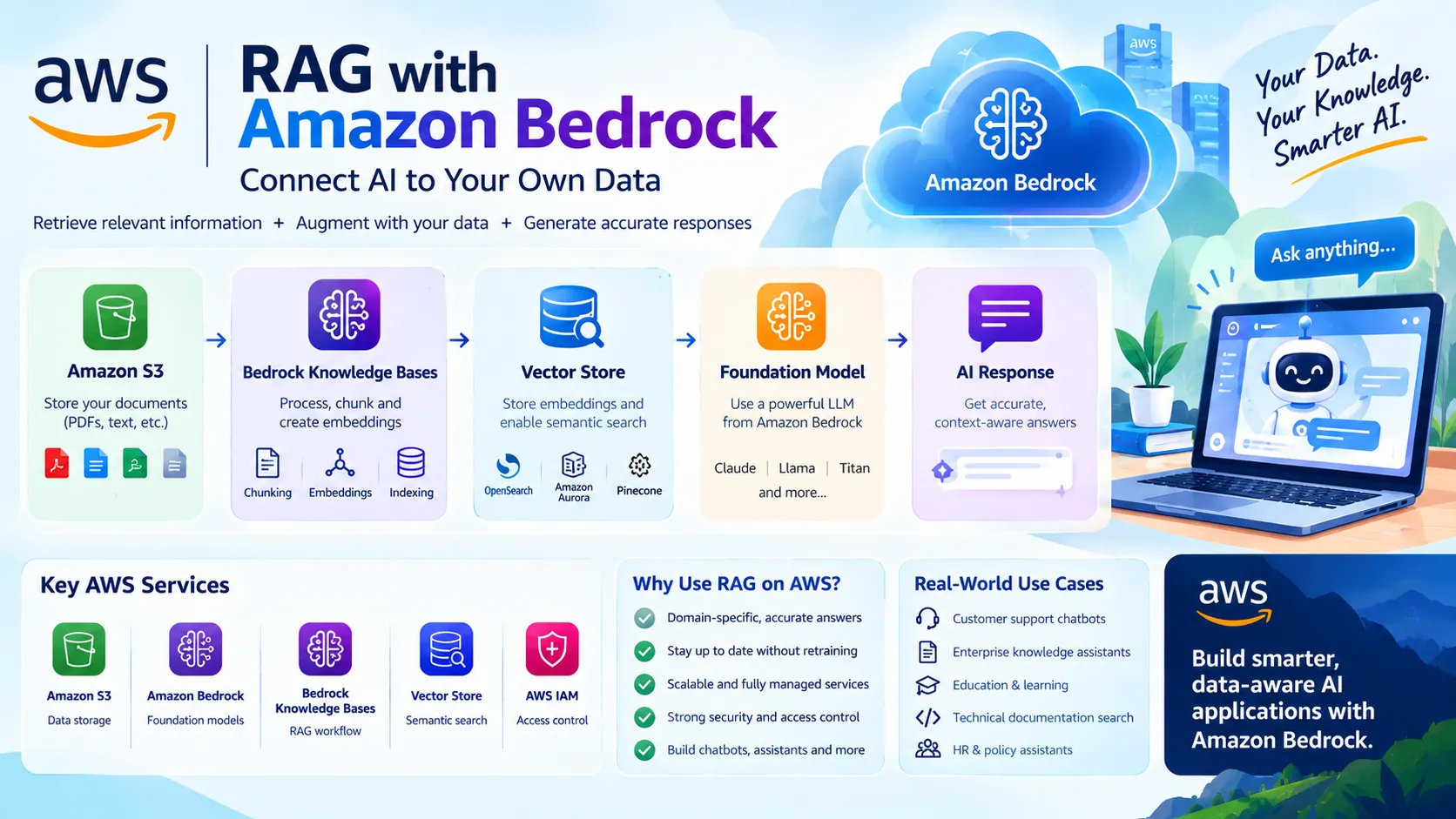
RAG with AWS Bedrock: Connecting AI to Your Own Data
RAG with Amazon Bedrock connects AI models to external or private data, helping them generate more relevant, context-aware answers.

Introduction
Artificial Intelligence (AI) and Large Language Models (LLMs) are transforming how applications understand and generate information. However, LLMs may not have access to an organization's latest, private, or specialized data. Retrieval-Augmented Generation (RAG) helps solve this problem by connecting AI models to relevant external information before generating a response.
Amazon Bedrock provides managed tools for building generative AI applications, including Knowledge Bases that help developers implement RAG workflows.
What Is RAG?
RAG is a technique that combines information retrieval with AI-generated responses. Instead of relying only on information learned during training, the system searches a knowledge source for relevant content and provides it to the language model as context.
For example, a college chatbot using RAG can retrieve information from college notices, course documents, and student guidelines to answer questions more accurately.
How RAG Works with Amazon Bedrock
A typical RAG workflow follows these steps:
- Upload data: Store documents, PDFs, and other knowledge sources in Amazon S3.
- Prepare the knowledge base: Amazon Bedrock Knowledge Bases processes the data, creates embeddings, and indexes the information for retrieval.
- Ask a question: A user submits a query through an application.
- Retrieve relevant information: The system searches the knowledge base for content related to the question.
- Generate a response: The retrieved content is provided to a foundation model, which generates a contextual answer.
This approach helps applications answer questions using information specific to their domain.
Key AWS Services Used
- Amazon Bedrock: Provides access to foundation models for generating responses.
- Amazon Bedrock Knowledge Bases: Helps manage document ingestion, retrieval, and RAG workflows.
- Amazon S3: Stores source documents and knowledge files.
- Vector store: Stores embeddings and supports semantic similarity searches.
- AWS IAM: Helps control access to AWS resources and data.
The exact architecture depends on the selected model, data source, and supported vector store.
Benefits of RAG on AWS
RAG with Amazon Bedrock offers several advantages:
- Domain-specific answers: Responses can use an organization's own documents.
- Updated information: Knowledge sources can be refreshed without retraining the foundation model.
- Scalability: AWS managed services help support growing application needs.
- Security controls: AWS identity and access management features help protect resources.
- Flexible development: Developers can build chatbots, knowledge assistants, and document question-answering systems.
RAG does not guarantee that every answer will be correct. Good document quality, relevant retrieval, appropriate permissions, and response evaluation are still important.
Real-World Applications
RAG using Amazon Bedrock can support customer-service chatbots, enterprise knowledge assistants, educational support systems, technical documentation search, and internal policy assistants.
For instance, a company can store product manuals in Amazon S3 and use a Bedrock Knowledge Base to help customers ask questions in natural language. The application retrieves relevant passages and uses them to generate a helpful response.
Conclusion
Retrieval-Augmented Generation makes AI applications more useful by connecting language models to relevant external data. With Amazon Bedrock, Bedrock Knowledge Bases, and Amazon S3, developers can build scalable, data-aware AI applications without needing to train a foundation model from scratch.
RAG is an important approach for building practical AI systems that combine the language capabilities of LLMs with an organization's own knowledge.
Enjoyed reading this content? Let the author know!
Your likes, comments, shares, and saves help creators reach more builders.

Loading recommendations
Loading article