
I Built Fuuud AI, a Gentle Agent That Helps You Find the Right Care
Fuuud AI is an agent built on Amazon Bedrock that helps people find the right doctor, hospital, or pharmacy, and knows when to point someone to emergency help instead of chatting.

What it is and who it's for
Finding a doctor can feel like a chore at the moment you have the least energy for one. You don't know which specialist you need, which hospital is closest, or where to begin. I built Fuuud, a health-care web app, around the idea that care should feel closer and calmer. Fuuud AI is the agent inside it. You tell it in plain words what kind of care you're looking for, and it guides you to the right doctor, hospital, or pharmacy.
It's made for everyday people who feel lost in the healthcare maze. Maybe someone knows "my skin has been bothering me" but not whether they need a dermatologist or a general practitioner. Maybe someone is new in town and needs a hospital. Fuuud AI does not diagnose and does not give treatment or medication advice. Its single job is helping people find care, and it is upfront that the listings in this demo are fictional.
You can try it here: https://fuuud-health.vercel.app/agent
How I built it
Fuuud is built with Next.js and deployed on Vercel. The agent's brain runs on Amazon Bedrock, using the Converse API.
The flow works like this:
- The chat page at
/agentsends the conversation to a server-side route in my app. - That route calls the Bedrock Converse API. I authenticate with a Bedrock API key stored as an environment variable in Vercel, so the key never reaches the browser.
- I gave the model tools, such as searching doctors by specialty and finding hospitals by area. When someone says "I need someone for my skin," the model decides to call the doctor-search tool, my server runs it against the app's data, and the results go back to the model. It then replies with real options from the app instead of guessing. That is what makes it an agent rather than a plain chatbot.
- A system prompt defines the personality and the safety rules: warm and short replies, one question at a time, no diagnosing, and honesty that the data is a demo.
I chose Bedrock because it let me skip hosting and managing a model entirely. One API call and one key were enough to go from a static interface to a working agent, which mattered a lot over a single weekend. Keeping the key server-side was the main security habit I wanted to get right, and when Vercel flagged my key for rotation, I revoked it, created a new one, and redeployed.
I also hit a real-world snag: the first model ID I tried had been retired, and Bedrock returned a 404. I switched to a current model from the Bedrock console, and the agent started responding. It was a good reminder that model IDs change, so it's worth checking the console first.
The delightful detail
The detail I cared about most is how the agent behaves when someone may be in danger.
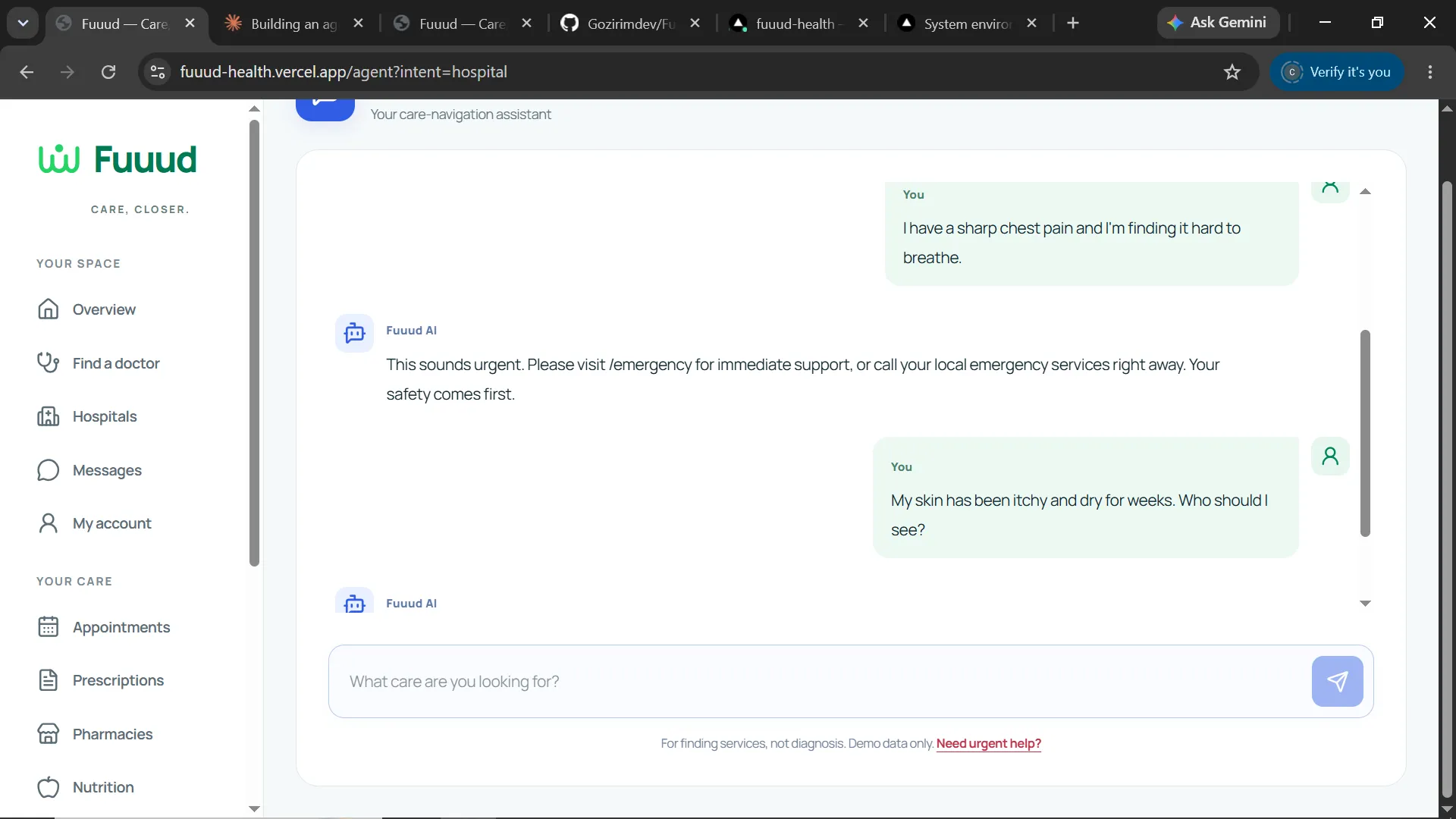
A health assistant that keeps cheerfully chatting while someone describes chest pain is worse than having no assistant. So I built emergency awareness into the experience. If a message mentions things like chest pain, trouble breathing, severe bleeding, or thoughts of self-harm, the agent drops the normal flow. It calmly says this sounds like it needs urgent attention, and points straight to the emergency page and local emergency services, with no further questions in the way.
Around that, I made everything else gentle:
- A friendly greeting on first open, so nobody has to figure out what to type.
- Tappable starters like "Find a doctor" and "Explore hospitals," so there is never a blank box to stare at.
- One clarifying question at a time, not a long form.
- Friendly errors. If something fails, the agent says it lost its train of thought and offers to try again, rather than showing a technical message.
I tested the agent myself with a mix of everyday requests and emergency-style messages. The ordinary requests led to relevant doctor or hospital suggestions, and the urgent ones switched immediately to the emergency guidance. For a health product, that last behavior was the real test of whether the experience felt trustworthy, and I'm happy with how it responds.
Proof it works
The agent is live and you can use it right now: https://fuuud-health.vercel.app/agent
Open it, tap a starter, and ask for a specialist or a hospital. Then try describing something urgent to see the emergency handling.
What I learned
Making an agent enjoyable is less about a smarter model and more about small decisions: what it says first, how it handles failure, and knowing when to stop talking and point someone toward real help. Amazon Bedrock took away the infrastructure work, so I could spend my time on exactly those decisions.
Next, I want to connect real provider data, let the agent help book appointments, and add more languages so more people can use it comfortably.
Enjoyed reading this content? Let the author know!
Your likes, comments, shares, and saves help creators reach more builders.

Loading recommendations
Loading article