
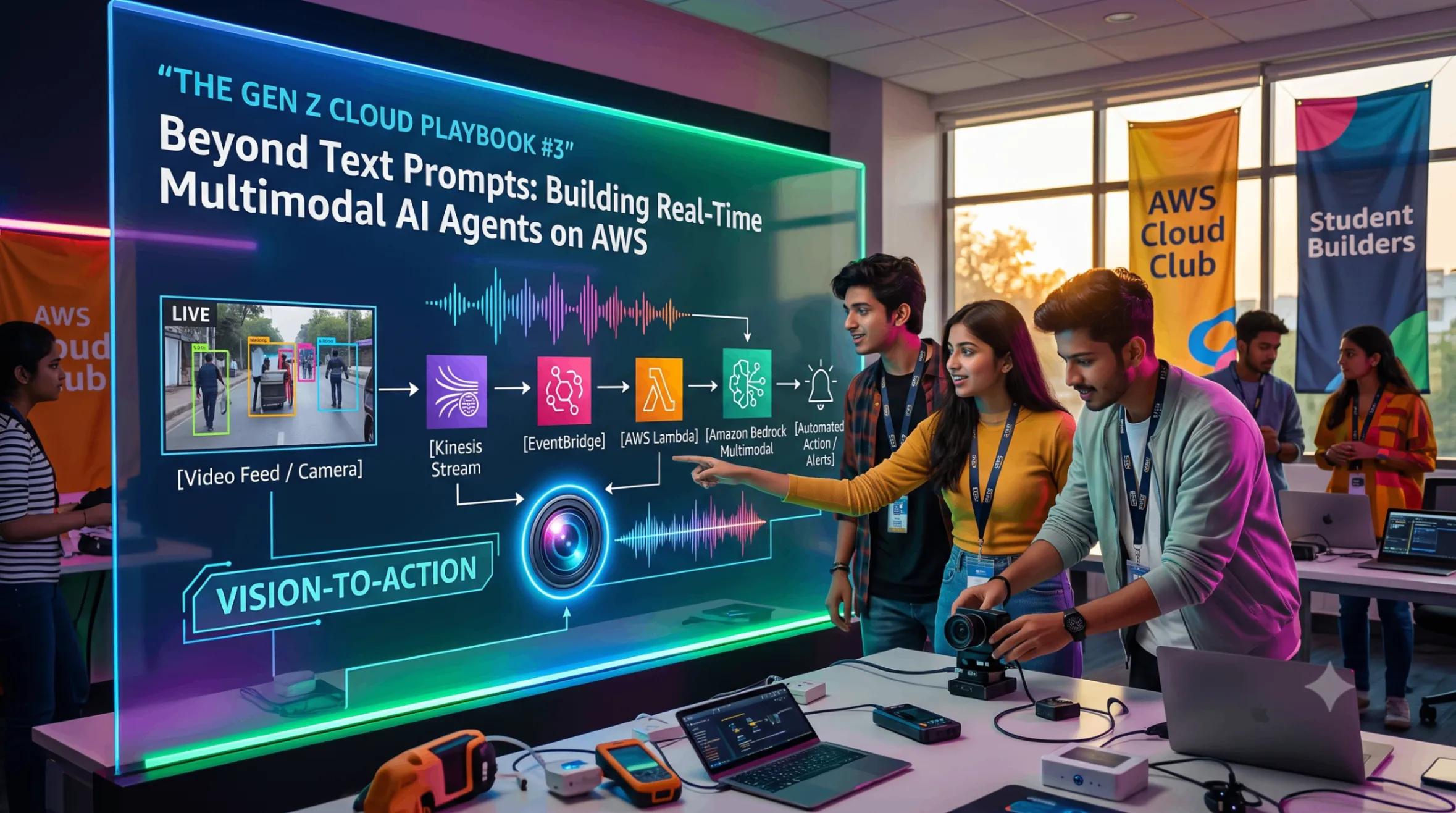
Beyond Text Prompts: Building Real-Time Multimodal AI Agents on AWS
Text-only prompts are so 2024. Learn how to build real-time multimodal agents that analyze vision, voice, and streaming data using Amazon Bedrock, AWS EventBridge, and Lambda.
Series: The Gen Z Cloud Playbook (4 articles)
- …
- 3Beyond Text Prompts: Building Real-Time Multimodal AI Agents on AWS This article

Let's be real: if your AI agent can only read plain text, you're building with one eye closed. In 2026, the real shift is happening in Multimodal Agentic Workflows—systems that can process images, video frames, audio streams, and unstructured real-world data to make split-second decisions.
From smart campus infrastructure to real-time security auditing, multimodal AI agents are bridging the gap between physical events and cloud execution. Here is how to build vision-and-action pipelines on AWS using Amazon Bedrock, AWS EventBridge, and AWS Lambda.
1. Vision-to-Action: Processing Real-World Inputs
Traditional workflows require converting everything into text before sending it to a model. Multimodal foundation models on Amazon Bedrock eliminate that friction by processing raw visual and spatial data alongside structured instructions.
When paired with automated tools, a visual agent can inspect a photo or video frame, detect anomalies (like equipment damage or waterlogging), and immediately trigger downstream remediation code.
Here is a snippet showing how to send visual frame payloads to Amazon Bedrock for instant multi-modal analysis:
1
2
3
4
5
6
7
8
9
10
11
12
13
14
15
16
17
18
19
20
21
22
23
24
25
import boto3

import base64


bedrock_runtime = boto3.client('bedrock-runtime')


def analyze_visual_stream(image_bytes, user_prompt):

    # Encode visual frame to base64

    encoded_image = base64.b64encode(image_bytes).decode('utf-8')


    # Send multimodal payload to Amazon Bedrock

    response = bedrock_runtime.invoke_model(

        modelId='anthropic.claude-3-5-sonnet-20241022-v2:0',

        body=f'''{{

            "anthropic_version": "bedrock-2023-05-31",

            "max_tokens": 500,

            "messages": [{{

                "role": "user",

                "content": [

                    {{"type": "image", "source": {{"type": "base64", "media_type": "image/jpeg", "data": "{encoded_image}"}}}},

                    {{"type": "text", "text": "{user_prompt}"}}

                ]

            }}]

        }}'''

    )

    return response['body'].read()
2. Event-Driven Multimodal Pipelines
Processing video streams or IoT sensor images manually doesn't scale. To make your agents ultra-responsive, you build event-driven architecture.
By routing visual events through Amazon EventBridge to AWS Lambda, your agents only run when something actually happens—keeping your serverless compute overhead low and cost-efficient.
1
[Video Feed / Camera] ➔ [Amazon Kinesis Stream] ➔ [AWS EventBridge] ➔ [AWS Lambda] ➔ [Amazon Bedrock Multimodal] ➔ [Automated SNS Alert / IoT Action]
This decoupled architecture allows your multi-agent system to react in sub-seconds without keeping expensive GPUs running 24/7.
3. Community-Led Innovation
The fastest way to master multimodal architecture isn't reading documentation in isolation—it's building real projects alongside your peers in your AWS Cloud Club or student community.
Whether you're hacking together automated campus navigation tools or building real-time environmental monitoring systems, building in public gives you instant feedback and connects you with fellow builders pushing the boundaries of AI.
The TL;DR
The era of text-only AI is over. The future belongs to multimodal agents that see, hear, and interact with the physical world in real time. Master Amazon Bedrock Multimodal, AWS EventBridge, and serverless event streams, and you'll be building architecture that defines 2026.
Are you currently building text-only pipelines, or have you started testing multimodal vision and audio agents on AWS? Drop your architecture ideas in the comments below! ☁️👁️✨
Series: The Gen Z Cloud Playbook (4 articles)
- …
- 3Beyond Text Prompts: Building Real-Time Multimodal AI Agents on AWS This article
Enjoyed reading this content? Let the author know!
Your likes, comments, shares, and saves help creators reach more builders.

Loading recommendations
Loading article