
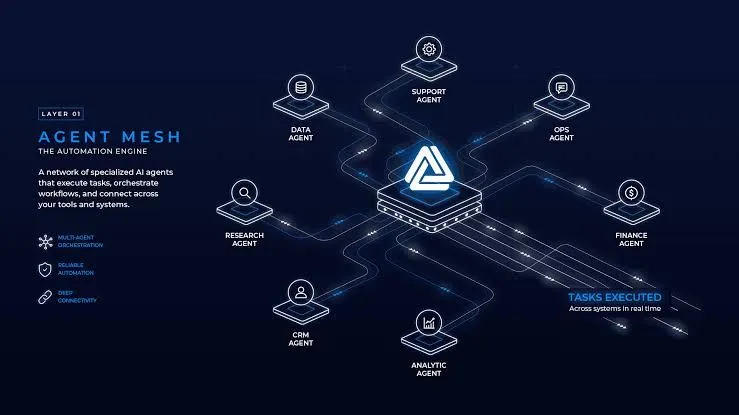
The Rise of the AI Agent Mesh: Redefining Cloud Architecture
The cloud computing landscape is undergoing a structural shift

The cloud computing landscape is undergoing a structural shift. For years, cloud strategy focused on migration, elastic compute, and hosting centralized generative models. Today, standard architectures are evolving beyond basic model deployments toward autonomous Agentic AI systems—a transformation enabled by the AI Agent Mesh.
What Is an AI Agent Mesh?
As enterprises deploy specialized AI agents across departments—from automated customer service and continuous code synthesis to real-time security remediation—managing these autonomous entities in isolation becomes impossible.
An AI Agent Mesh is a dedicated infrastructure layer that acts as the orchestration and communication backbone for autonomous agents. Similar to how microservices reliance gave birth to service meshes (like Istio or Linkerd), the AI Agent Mesh provides a unified control plane to route, govern, secure, and monitor inter-agent workflows across multi-cloud environments.
Why Is It Trending Now?
1. From Chatbots to Multi-Agent Workflows
Single-prompt LLM applications are being replaced by multi-agent collaboration. Complex tasks now involve several specialized agents working together—one retrieving context, another evaluating code, a third checking regulatory compliance, and a fourth executing the database action. Without a dedicated mesh, managing these dynamic dependencies leads to fragile custom scripts and hidden latency bottlenecks.
2. Pre-Emptive Security & Zero Trust
Autonomous agents require API keys, database access, and execution rights. Giving raw credentials to autonomous models introduces severe risks, including prompt injection or agent drift. The Agent Mesh applies Zero Trust principles at the orchestration layer, enforcing real-time identity checks, policy guardrails, and cryptographic provenance for every action an agent takes.
3. Cost Control & Token Optimization
Unchecked agent loops can consume thousands of tokens or trigger unexpected compute calls, driving cloud bills out of control. The Agent Mesh provides FinOps governance by intelligently caching responses, throttling redundant calls, and dynamically routing requests to the most cost-effective model or edge instance based on query complexity.
Key Pillars of a Modern Cloud Agent Mesh
| Capability | Function | Benefit |
|---|---|---|
| Agent Interoperability | Standardizes protocols for agents to discover and trigger each other across disparate cloud providers. | Prevents vendor lock-in and streamlines complex multi-cloud operations. |
| Observability & Traceability | Records full execution trails, contextual inputs, and decisions made by each agent. | Essential for compliance audits, debugging, and digital provenance. |
| Dynamic Traffic Routing | Balances load across foundation models, private fine-tuned endpoints, and localized edge servers. | Reduces latency and optimizes inference costs. |
What This Means for Developers and Cloud Architects
The emergence of the AI Agent Mesh signifies that compute is no longer just running code—it is mediating intent.
Cloud engineers are moving beyond simply provisioning Kubernetes clusters or serverless functions. Modern platform design now centers on constructing robust mesh topologies that let autonomous agents act safely, rapidly, and within strict cost and regulatory constraints.
Enjoyed reading this content? Let the author know!
Your likes, comments, shares, and saves help creators reach more builders.

Loading recommendations
Loading article