
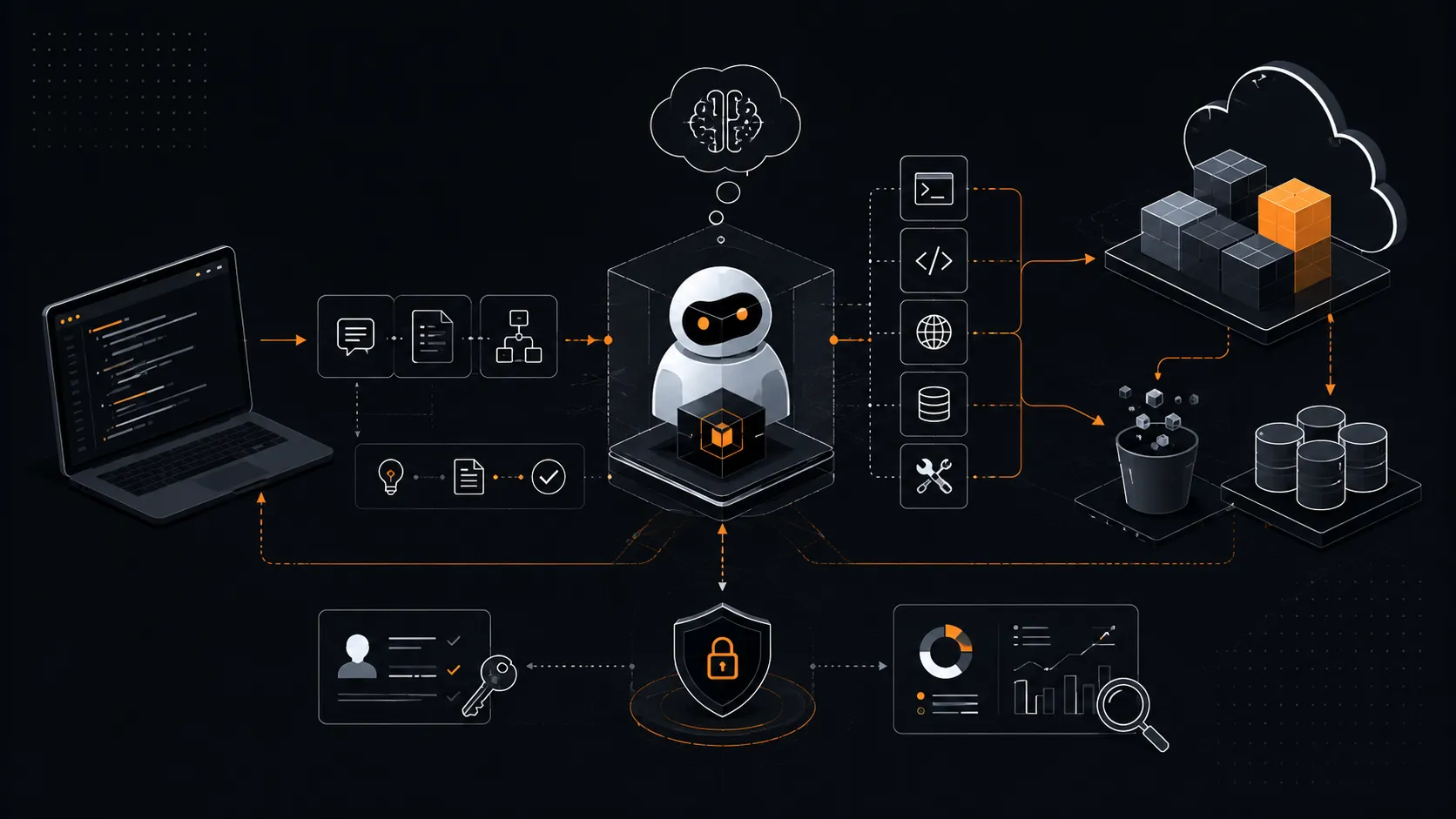
Beyond Chatbots: How Agentic AI Is Reshaping Software Development in 2026
Artificial intelligence is moving beyond generating answers. In 2026, AI agents are beginning to reason, use tools, interact with software systems, and complete multi-step tasks. This article explores the shift from generative AI to agentic AI, its impact on software development, and how cloud platforms such as AWS are enabling secure, scalable AI agents.

Beyond Chatbots: How Agentic AI Is Reshaping Software Development in 2026
Artificial intelligence has evolved rapidly in just a few years. We moved from machine learning models that made predictions, to generative AI systems that could create text and images, and then to conversational assistants capable of answering increasingly complex questions.
Now, another transition is taking place.
AI is moving from generating responses to taking actions.
This emerging shift toward agentic AI is one of the defining technology developments of 2026. Instead of simply responding to a prompt, AI agents can be designed to understand a goal, plan a sequence of actions, use tools, interact with external systems, and evaluate the results.
The result is a fundamental change in how software can be designed.
From Generative AI to Agentic AI
Traditional software generally follows predefined instructions:
Input → Logic → Output
Generative AI introduced a more flexible interaction:
Prompt → AI Model → Response
Agentic AI extends this model:
Goal → Reason → Plan → Use Tools → Execute → Evaluate → Continue
This distinction is important.
A chatbot might explain how to create an AWS Lambda function. An AI agent could potentially determine what needs to be built, generate the required code, interact with development tools, test the result, identify an error, and continue working toward the requested outcome.
The AI is no longer only producing information. It is participating in a workflow.
Why 2026 Is Becoming the Agentic AI Era
The movement toward agentic systems is no longer purely experimental.
McKinsey's 2026 technology research identifies agentic software development as one of the emerging technology trends and describes a broader shift toward AI systems capable of completing end-to-end digital tasks.
Its 2026 AI research also reports that 40% of respondents from large organizations say their organizations are scaling AI agents, compared with 27% the previous year. Software engineering is among the areas where organizations are increasingly deploying these systems.
This suggests that the next stage of AI adoption is not simply about giving employees better chat interfaces.
It is about redesigning workflows around AI systems that can perform parts of those workflows.
What Makes an AI Agent Different?
An AI agent typically combines several capabilities.
1. Reasoning
The agent interprets a goal and determines what needs to happen.
2. Planning
Instead of producing one response, it can break a larger objective into multiple steps.
3. Tool Use
Agents can interact with APIs, databases, applications, code execution environments, and other tools.
4. Memory and Context
An agent can maintain relevant information throughout a task and, depending on the architecture, across multiple interactions.
5. Execution
The agent can perform actions rather than simply describing what a human should do.
6. Evaluation
The system can inspect the result of an action and determine whether another step is necessary.
Together, these capabilities create a fundamentally different type of software application.
The Developer's Role Is Changing
The rise of agentic AI does not mean that software developers become unnecessary.
Instead, the developer's role is expanding.
Developers increasingly need to think about questions such as:
- What tools should an agent be allowed to access?
- What permissions should it have?
- How should actions be validated?
- What happens when the agent makes a wrong decision?
- How can agent activity be monitored?
- How can sensitive information be protected?
- How can the cost of agent execution be controlled?
Building an AI agent is therefore not only a model problem.
It is a systems engineering problem.
The model may provide intelligence, but the surrounding infrastructure determines what that intelligence is allowed to do.
The Cloud Becomes the Agent's Operating Environment
This is where cloud platforms become increasingly important.
An AI agent may need to interact with:
- APIs
- databases
- storage
- compute resources
- authentication systems
- monitoring platforms
- internal business applications
- external services
Managing these connections manually can become complex very quickly.
AWS is building infrastructure specifically around this challenge.
Amazon Bedrock AgentCore provides capabilities for building, deploying, and operating AI agents securely at scale. It is designed to work with different models and agent frameworks while providing capabilities for identity, access control, tool interaction, observability, and production operation.
This represents an important shift in cloud architecture.
Instead of treating AI as a standalone model endpoint, developers can treat an AI agent as a complete software workload that requires infrastructure, security, monitoring, and governance.
A Simple Agentic Architecture on AWS
A simplified architecture could look like this:
User
↓
AI Agent
↓
Foundation Model
↓
Agent Planning and Reasoning
↓
Tools / APIs / AWS Services
↓
Lambda | S3 | Databases | External APIs
↓
Result
↓
Monitoring and Evaluation
AWS services can provide different parts of this architecture.
For example, Amazon Bedrock can provide access to foundation models, while AgentCore can provide capabilities for running and governing agents. AWS Lambda can provide serverless tools that an agent can invoke, Amazon S3 can provide storage, and AWS IAM can control which resources an agent is allowed to access.
This creates an important principle:
An intelligent agent still needs disciplined infrastructure.
Security Becomes More Important Than Ever
Giving an AI system the ability to take actions creates a new security challenge.
A chatbot that generates an incorrect answer is one problem.
An agent that incorrectly calls an API, modifies data, deletes a resource, or sends a message creates a much larger problem.
Therefore, agentic applications need strong boundaries around what an agent can do.
Identity and access management become particularly important.
Instead of giving an agent unrestricted access, developers can design systems around the principle of least privilege:
Agent → Identity → Permission → Tool → Action
Every tool call should have a clearly defined purpose and authorization boundary.
AWS describes AgentCore as providing authentication and access-control capabilities for agent tool calls, helping developers control which tools agents can access and what actions they can perform.
This is likely to become one of the most important engineering disciplines in the agentic era.
AI Agents and Software Development
One of the most interesting applications of agentic AI is software development itself.
Instead of using AI only to autocomplete code, developers can increasingly use agentic systems for larger development workflows.
For example:
Requirement
↓
Generate implementation
↓
Create or modify files
↓
Run tests
↓
Analyze failures
↓
Fix implementation
↓
Run tests again
↓
Prepare final result
This changes the developer's workflow from writing every individual instruction to supervising an intelligent system working through a larger objective.
AWS has also highlighted agentic software development and frontier AI-native development as important areas of current innovation.
The Infrastructure Challenge
The AI revolution also creates a less visible challenge: infrastructure.
More capable AI systems require more compute, storage, networking, and energy.
As AI applications become agentic, the number of model interactions can also increase because an agent may perform several reasoning and tool-use steps during a single task.
That means developers need to think about more than model accuracy.
They also need to consider:
- Latency
- Compute utilization
- Token consumption
- Model selection
- Storage
- Network communication
- Monitoring
- Reliability
- Security
- Cost
The 2026 technology landscape increasingly connects AI innovation with advances in chips, data centers, energy infrastructure, and cloud computing.
The future of AI therefore depends not only on better models, but also on better infrastructure.
The Future: Humans and Agents Working Together
The most useful way to think about agentic AI is not necessarily as a replacement for humans.
Instead, it can become another layer of software between humans and complex digital systems.
A human can define the objective.
An AI agent can determine the steps.
Cloud infrastructure can provide the tools.
Security systems can enforce boundaries.
Monitoring systems can observe execution.
And the human can remain responsible for important decisions.
This creates a new software model:
Human Intent + AI Reasoning + Tools + Cloud Infrastructure + Governance
The quality of this system will depend on how well all of these components work together.
What Developers Should Learn Next
For developers entering this new era, learning only how to call an AI model API may not be enough.
A stronger skill set includes:
- Foundation models and generative AI
- Prompt and context engineering
- AI agents and tool calling
- APIs and distributed systems
- Cloud computing
- Identity and access management
- Databases and storage
- Observability
- AI security and governance
- Cost-aware architecture
This combination brings AI engineering closer to traditional software engineering and cloud architecture.
The developers who understand both sides will be better positioned to build reliable AI applications rather than simple AI demos.
Conclusion
The AI revolution is entering a new phase.
The first major wave focused on teaching machines to understand and generate information.
The next wave is about giving software the ability to reason, interact, and act.
Agentic AI has the potential to change software development, enterprise workflows, cloud operations, customer support, research, and many other areas.
But the transition also introduces new engineering challenges.
An agent that can act needs identity.
An agent that can use tools needs permissions.
An agent that operates in production needs monitoring.
And an agent that scales needs reliable cloud infrastructure.
This is why the future of AI is not only about building smarter models.
It is about building smarter systems around those models.
In the agentic era, the key question is no longer simply:
"What can AI generate?"
It is becoming:
"What can AI safely accomplish?"
That question may define the next chapter of cloud computing and software development.
Enjoyed reading this content? Let the author know!
Your likes, comments, shares, and saves help creators reach more builders.

Loading recommendations
Loading article