
What If Your AWS Services Could Talk to Each Other?
Modern applications often need different services to react to events without being tightly connected. Learn how AWS EventBridge, Lambda, SQS, and Step Functions can work together to build flexible event-driven applications.

What If Your AWS Services Could Talk to Each Other?
Imagine you place an order on an online shopping website.
You click Buy.
But what happens next?
The application may need to:
- Save the order
- Process the payment
- Send a confirmation
- Update inventory
- Notify the delivery system
- Start another workflow
One application could try to handle everything itself.
But there is another approach:
Let services react to events.
This is the basic idea behind event-driven architecture.
What Is an Event?
An event is simply something that happened.
For example:
Order Created
Payment Completed
File Uploaded
User Registered
Delivery Completed
Instead of asking every service directly what to do, an application can publish an event.
Other services can then decide whether they need to react to it.
A Simple AWS Example
Imagine an online shopping application.
The user places an order.
The application produces:
OrderCreated
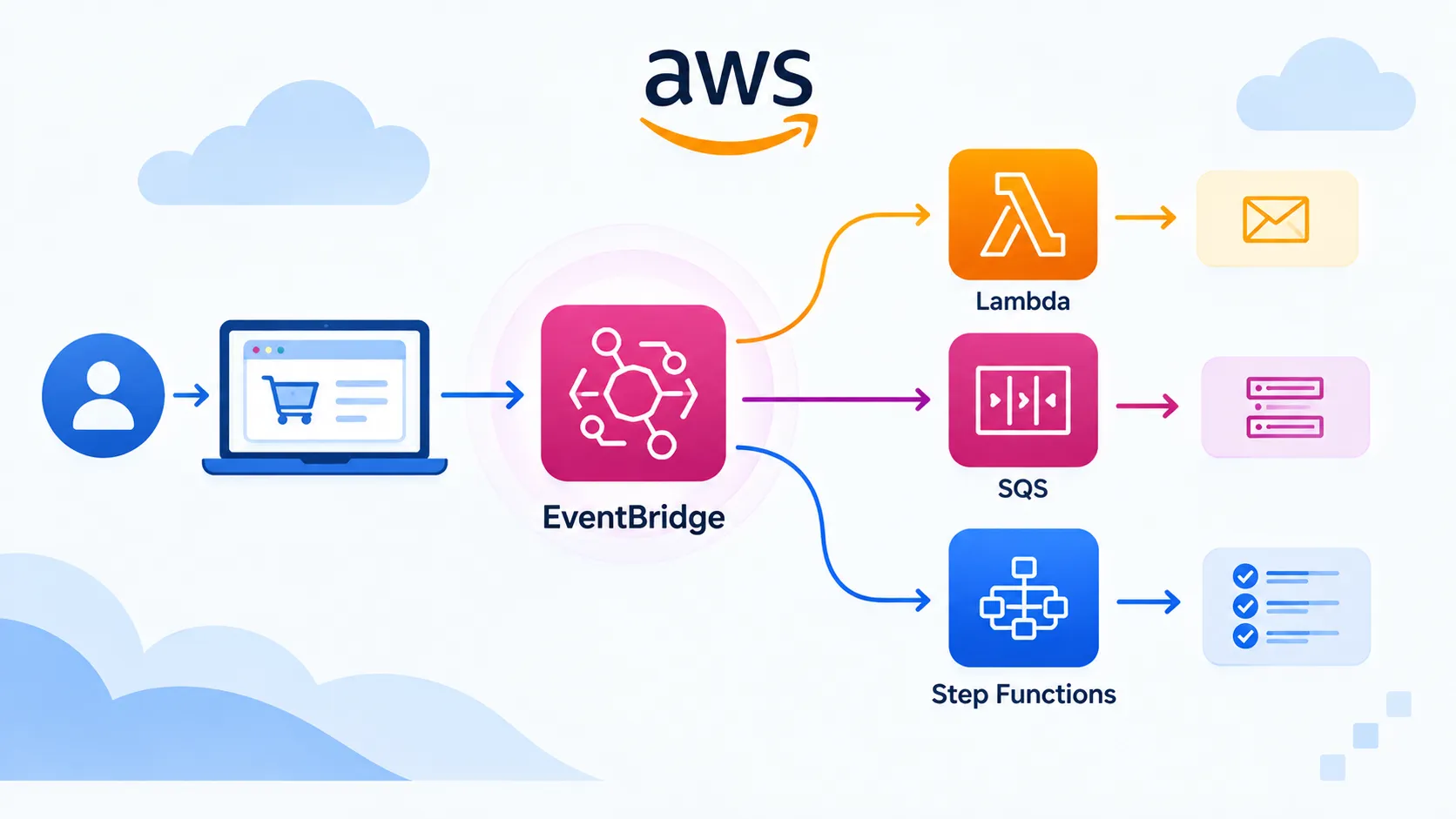
That event can be sent to Amazon EventBridge.
EventBridge can then route the event to different targets.
For example:
OrderCreated
↓
EventBridge
↓
Lambda → Send Email
SQS → Order Processing
Step Functions → Start Workflow
Now one event can trigger multiple actions.
Why Is This Useful?
Imagine adding a new notification service.
In a tightly connected application, you might need to modify the existing order-processing code.
With an event-driven approach, the new service can simply listen for the event it needs.
The original order service doesn't necessarily need to know about the new service.
This creates a more flexible architecture.
Where Does Lambda Fit?
AWS Lambda can execute code when an event arrives.
For example:
OrderCreated → Lambda → Send confirmation
The developer doesn't need to keep a server running just to wait for an event.
Lambda runs the function when it is needed.
Where Does SQS Fit?
Sometimes a service should not process an event immediately.
This is where Amazon SQS can help.
For example:
OrderCreated → SQS → Order Processing Service
Messages can wait in the queue until the processing service is ready.
This can help applications handle sudden increases in workload.
Where Do Step Functions Fit?
Some tasks require multiple steps.
For example:
Order Created
↓
Check Payment
↓
Update Inventory
↓
Prepare Delivery
↓
Send Confirmation
Instead of putting all of this logic inside one large function, AWS Step Functions can coordinate the workflow.
This makes the individual steps easier to understand and manage.
The Bigger Picture
A simple event-driven architecture could look like this:
User
↓
Application
↓
EventBridge
↓
Lambda
SQS
Step Functions
Each service has a specific responsibility.
That means the application can be built from smaller components instead of one large block of code.
A Real-World Example
Think about a food delivery application.
When an order is placed:
OrderCreated
The event could trigger:
Restaurant Service → Prepare the food
Payment Service → Process payment
Notification Service → Send confirmation
Delivery Service → Find a delivery partner
All of these actions can happen because of the same event.
The services don't necessarily need to be directly connected to each other.
Why Should Developers Learn This?
As applications grow, direct connections between every service can become difficult to manage.
Event-driven architecture provides another way to design applications:
Produce an event → Route the event → React to the event
This can make systems more flexible and easier to extend.
It is also useful for applications involving automation, notifications, data processing, workflows, and AI-powered systems.
Start Small
You don't need a huge application to learn event-driven architecture.
Try building something simple:
S3 File Upload
↓
EventBridge
↓
Lambda
↓
Process File
Then expand it:
EventBridge → SQS → Lambda → Step Functions
Each new service teaches you a different part of modern cloud architecture.
Final Thought
Cloud applications are increasingly becoming collections of services that communicate through events.
Instead of asking:
"Which AWS service should I learn next?"
Try asking:
"How can these services work together to solve a real problem?"
That shift in thinking can take you from simply learning AWS services to actually designing cloud applications.
One event. Multiple services. One scalable architecture.
Enjoyed reading this content? Let the author know!
Your likes, comments, shares, and saves help creators reach more builders.

Loading recommendations
Loading article