
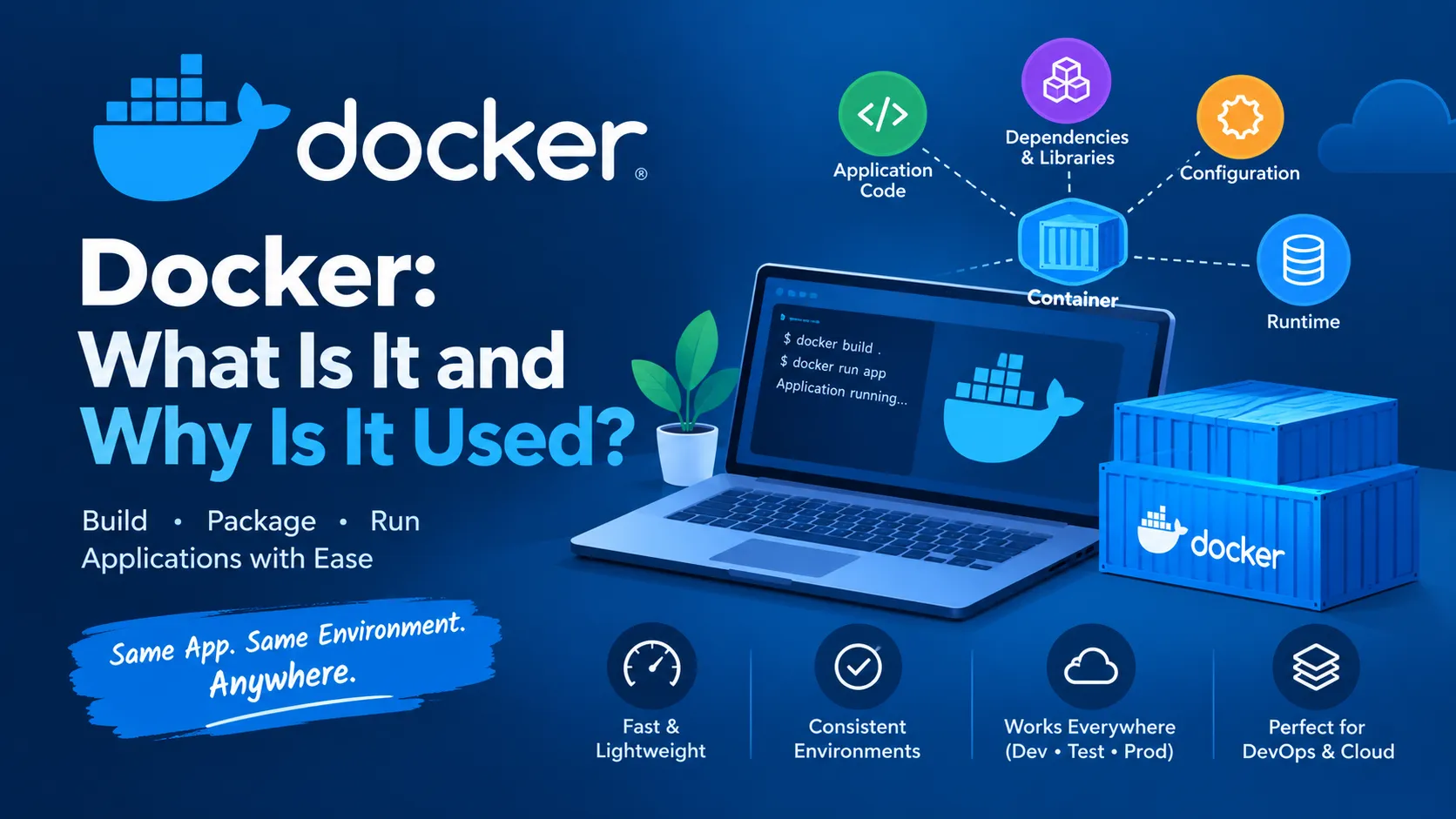
Docker: What Is It and Why Is It Used?
Docker is a popular platform used to build, package, and run applications in a consistent environment. It helps developers avoid the common problem of “It works on my machine” by allowing applications and their dependencies to run inside isolated containers.

What is Docker?
Docker is a platform that allows developers to package an application along with everything it needs to run, such as libraries, dependencies, configuration, and runtime, into a lightweight unit called a container.
In simple words, Docker creates a controlled environment where an application can run in the same way on different computers and servers.
For example, imagine a developer creates a web application on their computer. The application works perfectly on their machine, but when another developer runs it, they may get errors because they have a different version of Python, Node.js, or another dependency.
Docker helps solve this problem by putting the application and its required environment inside a container.
Why is Docker Used?
Docker is mainly used to make application development, testing, deployment, and management easier.
One of its biggest advantages is consistency. The same Docker container can run on a developer's computer, a testing environment, a server, or a cloud platform.
Docker is also useful because containers are lightweight and usually start much faster than traditional virtual machines.
Docker Containers
A container is an isolated environment in which an application runs.
For example, a developer can create a container for a Node.js application that contains:
- Application code
- Node.js
- Required packages
- Configuration
- Other dependencies
This allows the application to run consistently without depending heavily on the host computer's configuration.
Docker Image
A Docker Image is a template used to create containers.
You can think of an image as a blueprint and a container as the running version of that blueprint.
For example:
Docker Image → Creates → Docker Container
Images can contain the application code, runtime, libraries, and other requirements needed by the application.
Docker and Virtual Machines
Docker containers are different from traditional virtual machines.
A virtual machine usually includes a complete guest operating system, while containers share the host operating system's kernel. Because of this, containers are generally more lightweight and can start quickly.
Docker in Software Development
Docker is useful throughout the software development lifecycle.
Developers can use Docker to create the same environment for all team members. QA engineers can use containers to create consistent testing environments, while DevOps engineers can use Docker as part of automated deployment and CI/CD pipelines.
For example:
Developer → Docker Container → Testing → CI/CD → Production
This makes the process more consistent and reduces environment-related problems.
Docker and Cloud
Docker is also widely used with cloud platforms such as AWS.
Applications can be packaged into Docker containers and deployed to cloud services. This makes Docker an important technology for people who want to work in Cloud and DevOps.
Conclusion
Docker simplifies the process of developing, testing, and deploying applications by providing a consistent environment through containers.
For beginners, the most important concepts to understand are:
Docker → Image → Container → Run Application
Learning Docker is a valuable step for anyone interested in Software Development, SQA, Cloud Computing, or DevOps.
Enjoyed reading this content? Let the author know!
Your likes, comments, shares, and saves help creators reach more builders.

Loading recommendations
Loading article