
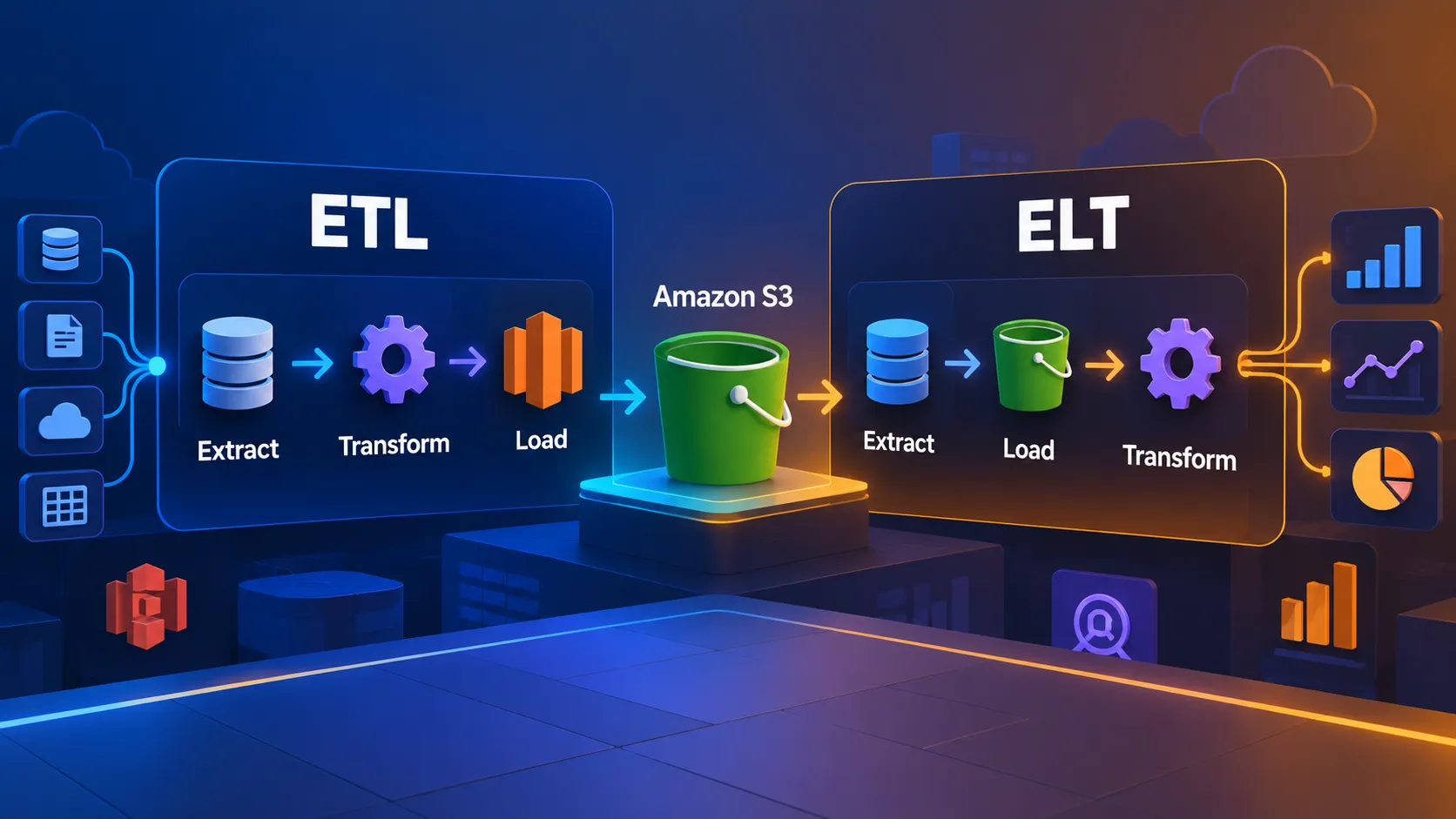
ETL vs ELT: Understanding Modern Data Pipelines
What’s the difference between ETL and ELT? Explore how these two data pipeline approaches work, their trade-offs, and why ELT has become increasingly popular in modern cloud data architectures.

When building a data pipeline, one of the first architectural decisions is how and where data should be transformed.
Two approaches appear frequently in modern data engineering: ETL (Extract, Transform, Load) and ELT (Extract, Load, Transform).
Although the difference seems simple, the choice can have a significant impact on scalability, cost, performance, and the overall architecture of a data platform.
What is ETL?
ETL stands for:
Extract → Transform → Load
In a traditional ETL pipeline, data is extracted from one or more sources, transformed before reaching the destination, and then loaded into the target system.
For example:
1
2
3
4
5
6
7
8
9
Source Systems
     ↓
   Extract
     ↓
   Transform
     ↓
    Load
     ↓
Data Warehouse
Imagine a company receiving customer data from several applications.
The pipeline could:
- Extract the raw data from the source systems.
- Clean invalid records.
- Standardize dates and formats.
- Remove duplicates.
- Apply business rules.
- Load the processed data into a warehouse.
The destination receives data that is already transformed and ready for consumption.
Why use ETL?
ETL can be useful when:
- Data needs to be heavily processed before storage.
- The target system has limited processing capabilities.
- Sensitive information needs to be removed before loading.
- Transformation logic is relatively stable.
- Only curated data should reach the destination.
However, ETL can also introduce an important limitation: the raw data may not be preserved in the target platform.
That can make it harder to reproduce transformations or apply new business rules later.
What is ELT?
ELT changes the order:
Extract → Load → Transform
Instead of transforming data before loading it, the pipeline first loads the data into a storage or analytics platform.
1
2
3
4
5
6
7
8
9
10
11
Source Systems
     ↓
   Extract
     ↓
    Load
     ↓
Data Lake / Warehouse
     ↓
  Transform
     ↓
Curated Data
This approach became increasingly popular with cloud data platforms because modern storage and compute systems can handle large volumes of data efficiently.
A common architecture might look like:
1
2
3
4
5
6
7
8
9
10
11
12
13
Applications
     ↓
   Ingestion
     ↓
     S3
     ↓
Raw Data
     ↓
Transformation
     ↓
Curated Data
     ↓
Analytics / BI / ML
For example, data can initially be stored in Amazon S3 in its raw form.
Transformation jobs can then process that data and create optimized datasets for analytics.
This separation between raw data and transformed data provides more flexibility.
ETL vs ELT
The biggest difference is where the transformation happens in relation to the loading step.
| ETL | ELT |
|---|---|
| Extract → Transform → Load | Extract → Load → Transform |
| Data is transformed before loading | Raw data is loaded first |
| Usually requires dedicated transformation infrastructure | Uses the destination's compute capabilities |
| Raw data may not be preserved | Raw data can be retained |
| Common in traditional architectures | Common in modern cloud architectures |
The important point is that ELT does not replace ETL in every scenario.
The right approach depends on the data, requirements, infrastructure, and processing model.
Why ELT Fits Well With Data Lakes
One of the reasons ELT became popular in cloud environments is the rise of data lakes.
Object storage services such as Amazon S3 can store large amounts of data at relatively low cost.
Instead of forcing every dataset into a predefined structure before storage, organizations can keep the original data and transform it later.
For example:
1
2
3
4
5
6
7
8
9
10
11
12
13
14
15
                Amazon S3
                   │
          ┌────────┴────────┐
          ↓                 ↓
       Raw Data        Historical Data
          │
          ↓
    Transformation
          │
          ↓
   Curated Datasets
          │
      ┌───┴────┐
      ↓        ↓
     BI       ML
This architecture provides an important capability:
You can keep the raw data and change the transformation logic later.
That can be extremely valuable when business requirements change.
ETL Is Not Dead
It's tempting to think that modern data engineering means replacing ETL with ELT.
That's not really the case.
ETL is still useful when transformation needs to happen before data reaches the destination.
For example, imagine a pipeline processing sensitive customer information.
The organization might need to remove or anonymize certain fields before storing the data in another system.
In this scenario, transforming the data before loading it can make sense.
Another example is when the destination system is not designed to perform large-scale transformations.
The architecture should therefore be driven by requirements rather than trends.
A Practical AWS Example
Consider an e-commerce company generating:
- Orders
- Customers
- Payments
- Website events
- Product information
A possible modern architecture could be:
1
2
3
4
5
6
7
8
9
10
11
12
13
14
15
16
17
18
19
20
Applications
     │
     ↓
 Data Ingestion
     │
     ↓
 Amazon S3
     │
     ├── Raw
     │
     ├── Processed
     │
     └── Curated
             │
             ↓
       Analytics Layer
             │
        ┌────┴────┐
        ↓         ↓
       BI         ML
The raw data can be preserved in S3 while transformation processes create optimized datasets for downstream workloads.
AWS services such as Amazon S3, AWS Glue, Amazon Athena, and Amazon Redshift can be combined depending on the architecture and requirements.
The important part isn't simply choosing a service.
It's understanding where data enters the platform, where it is stored, where transformations occur, and how downstream consumers access it.
So, Which One Should You Use?
There isn't a universal answer.
A simple rule of thumb is:
Consider ETL when:
- Data must be transformed before storage.
- Sensitive information must be filtered early.
- The destination has limited compute capabilities.
- Transformation logic is tightly coupled to ingestion.
Consider ELT when:
- You want to preserve raw data.
- Your destination has strong compute capabilities.
- You need flexibility to transform data multiple ways.
- You're building a cloud-based data lake or modern analytics platform.
- Data volumes are expected to grow significantly.
In many modern cloud architectures, ELT is a natural fit, but ETL remains an important pattern.
The Bigger Picture
ETL vs ELT is ultimately not just about the order of three letters.
It is about data architecture.
When designing a pipeline, questions such as these are often more important:
- Where does the data originate?
- How frequently does it arrive?
- Should raw data be preserved?
- Where should transformations happen?
- How much data will the system process?
- Who will consume the data?
- How should failures be handled?
- How will the pipeline be monitored?
Understanding these questions is what turns a simple data pipeline into a scalable data engineering architecture.
Conclusion
ETL and ELT are both valid approaches to building data pipelines.
ETL transforms data before loading it, while ELT loads the data first and transforms it afterward.
Modern cloud platforms have made ELT increasingly attractive because scalable storage and compute allow organizations to retain raw data and transform it when needed.
But the most important lesson is not to blindly choose one approach.
Choose the architecture that fits the data, the workload, and the business requirements.
That mindset is at the heart of modern data engineering.
Enjoyed reading this content? Let the author know!
Your likes, comments, shares, and saves help creators reach more builders.

Loading recommendations
Loading article