
What Cloud Computing Actually Does for Engineering Work (and Where It Still Falls Short)
An analysis of the possible use of AI and Cloud computing in Engineering

Terrence Sibanda, engineering consultant. More about my work at www.terrylaws.com .
I work in data center commissioning, and lately a lot of that work involves liquid cooling. If you've followed the industry at all, you know why. AI workloads are pushing rack densities past what air can handle, and suddenly every project has coolant distribution units, leak detection systems, and BMS integrations that didn't exist on this scale five years ago.
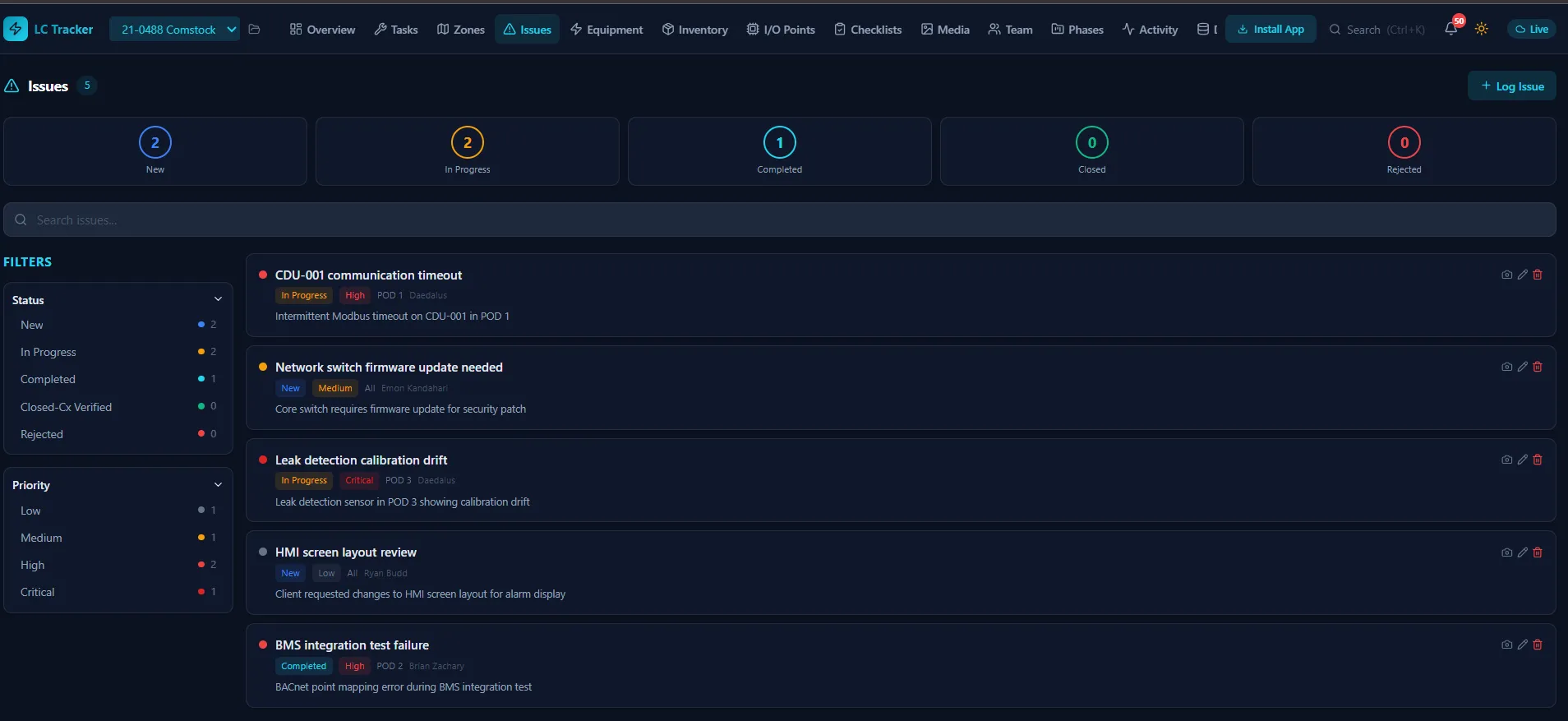
Commissioning this equipment is messy. A typical project generates hundreds of issues like these, pulled from my own tracker on a live project: a CDU with intermittent Modbus timeouts, a leak detection sensor drifting out of calibration, a BACnet point mapping error that fails a BMS integration test. Each one needs an owner, a priority, a location, and a paper trail. This is where cloud tools earn their keep, and where I've been spending my evenings building one.
Where AWS genuinely helps
The biggest win is replacing scattered spreadsheets with one source of truth. With RDS holding issue and task data and S3 storing photos and test records, everyone from the technician in the POD to the client three time zones away sees the same live picture. No more arguing over whose spreadsheet is current.
A few other things with real value, not buzzword value:
- Report generation. Lambda can turn field data into formatted client reports without anyone staying late to copy and paste.
- Sensor data. IoT Core can ingest readings from cooling equipment during testing, and anomaly detection can flag a drifting sensor before it becomes a flooded floor. For liquid cooling, that last part is not theoretical.
- Access control. Clients, contractors, and vendors all need different visibility, and cloud permission models handle this far better than emailing PDFs.
- Cost. A one-person consultancy can now run infrastructure that only large firms could afford ten years ago.
The honest limitations
Here's what the brochures skip.
Connectivity is the big one. Data halls under construction often have no reliable network, which is exactly where commissioning happens. If your tool assumes a connection, it fails where the work happens. Offline-first design is not optional in this industry.
Control systems are another. Cloud can monitor and analyze, but PLCs and cooling controls need millisecond response and must keep running if the network dies. Anything safety-critical stays on premises, and it should.
Then there's the people side. Some clients forbid cloud storage of facility data, reasonably so. Site teams won't adopt tools that add steps to their day. And cloud bills creep if nobody watches them.
Where this is going
I think the future is hybrid. Edge computing handles site-level work, the cloud handles aggregation, analysis, and reporting. Digital twins will move from conference slides to actual commissioning practice, especially as liquid cooling makes thermal performance harder to eyeball. And AI-assisted defect detection from photos and test data is closer than most people in my industry realize.
The firms that win won't adopt every service. They'll pick the two or three that solve real field problems, and respect the constraints of the physical world they work in.
I'm building my own tool in this space, LC Tracker, born from exactly the issues described above. You can see an early version and more about my engineering work at www.terrylaws.com .
Enjoyed reading this content? Let the author know!
Your likes, comments, shares, and saves help creators reach more builders.

Loading recommendations
Loading article