
Understanding AWS Serverless: Building Scalable Applications with AWS Lambda and Amazon EventBridge
Discover how serverless architecture eliminates infrastructure management, scales automatically with traffic, and reduces costs using AWS Lambda and EventBridge.

Modern application development focuses on moving fast without the burden of managing servers, operating system updates, or complex scaling policies. Serverless architecture allows developers to focus purely on business logic while AWS handles provisioning, maintenance, and auto-scaling behind the scenes.
Why Go Serverless?
Traditional server setups require predicting traffic spikes, paying for idle capacity during low usage, and maintaining infrastructure security. A serverless approach shifts these responsibilities to the cloud provider, delivering key advantages:
- No Server Management: No need to provision, patch, or maintain virtual machines or containers manually.
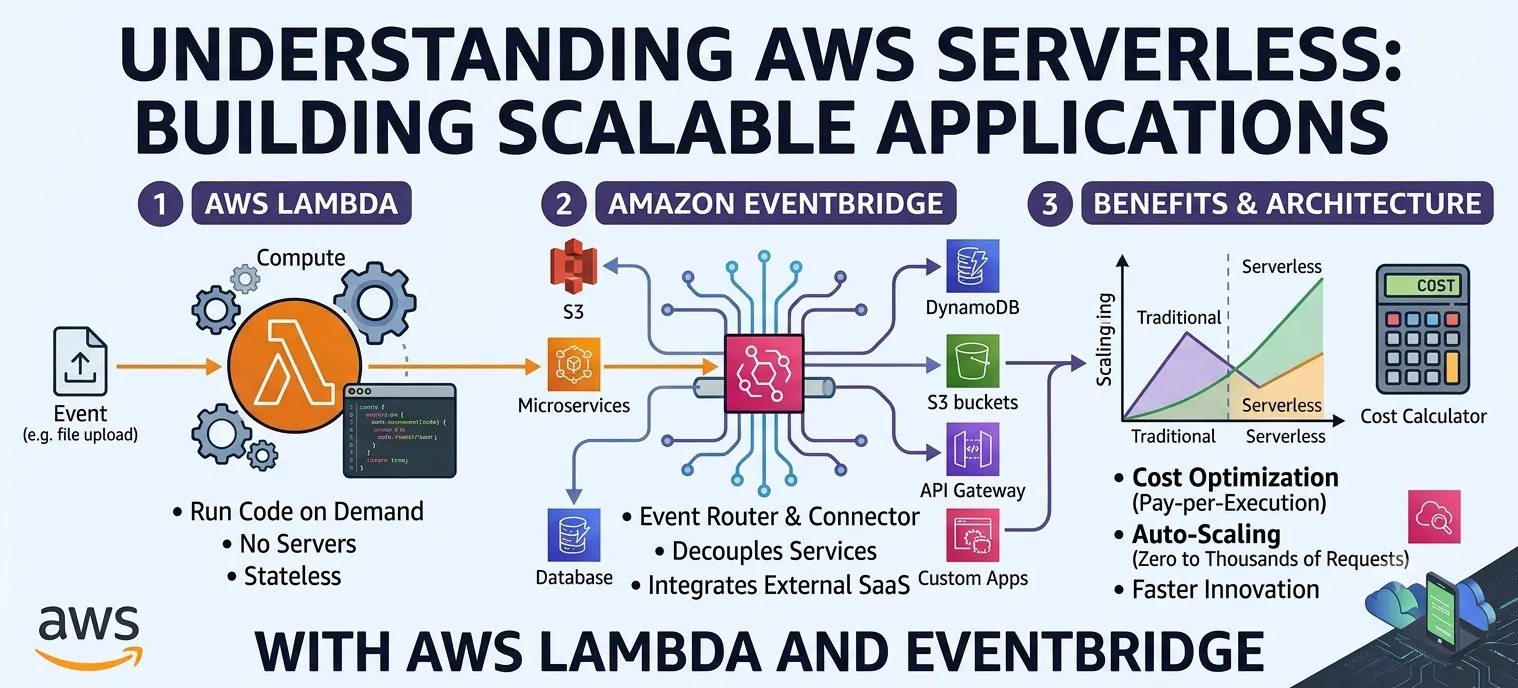
- Automatic Scaling: AWS automatically scales your application from a few requests per day to thousands per second.
- Pay-per-Use Pricing: You only pay for the execution time and resources consumed while your code runs.
Core Building Blocks
A. AWS Lambda
AWS Lambda is the cornerstone of serverless execution. It allows you to run code in response to events (such as HTTP requests, database changes, or file uploads) without managing servers.
- Triggers: Events from Amazon S3, DynamoDB, API Gateway, or EventBridge invoke Lambda functions automatically.
- Stateless Design: Lambda functions execute independently, making horizontal scaling seamless.
B. Amazon EventBridge
Amazon EventBridge acts as the event bus connecting serverless components. It decouples services by routing real-time data streams across microservices and external SaaS applications.
Amazon EventBridge acts as the event bus connecting serverless components. It decouples services by routing real-time data streams across microservices and external SaaS applications.
- Best Practices for Serverless Applications
Keep Functions Granular: Design single-purpose functions (Microservices pattern) rather than monolithic code blocks. - Optimize Cold Starts: Use lightweight runtime dependencies and configure appropriate memory sizes to keep execution fast.
- Manage Secrets Securely: Use AWS Secrets Manager or AWS Systems Manager Parameter Store instead of hardcoding credentials in your Lambda code.
- Implement Robust Logging: Leverage Amazon CloudWatch to capture logs, track latency, and set alerts for error rates.
Conclusion
Adopting a serverless mindset with AWS Lambda and EventBridge empowers teams to deliver features faster, reduce operational overhead, and optimize infrastructure costs. Start by migrating non-critical background jobs or event-driven tasks to build confidence before moving core services.
Adopting a serverless mindset with AWS Lambda and EventBridge empowers teams to deliver features faster, reduce operational overhead, and optimize infrastructure costs. Start by migrating non-critical background jobs or event-driven tasks to build confidence before moving core services.
Enjoyed reading this content? Let the author know!
Your likes, comments, shares, and saves help creators reach more builders.

Loading recommendations
Loading article