
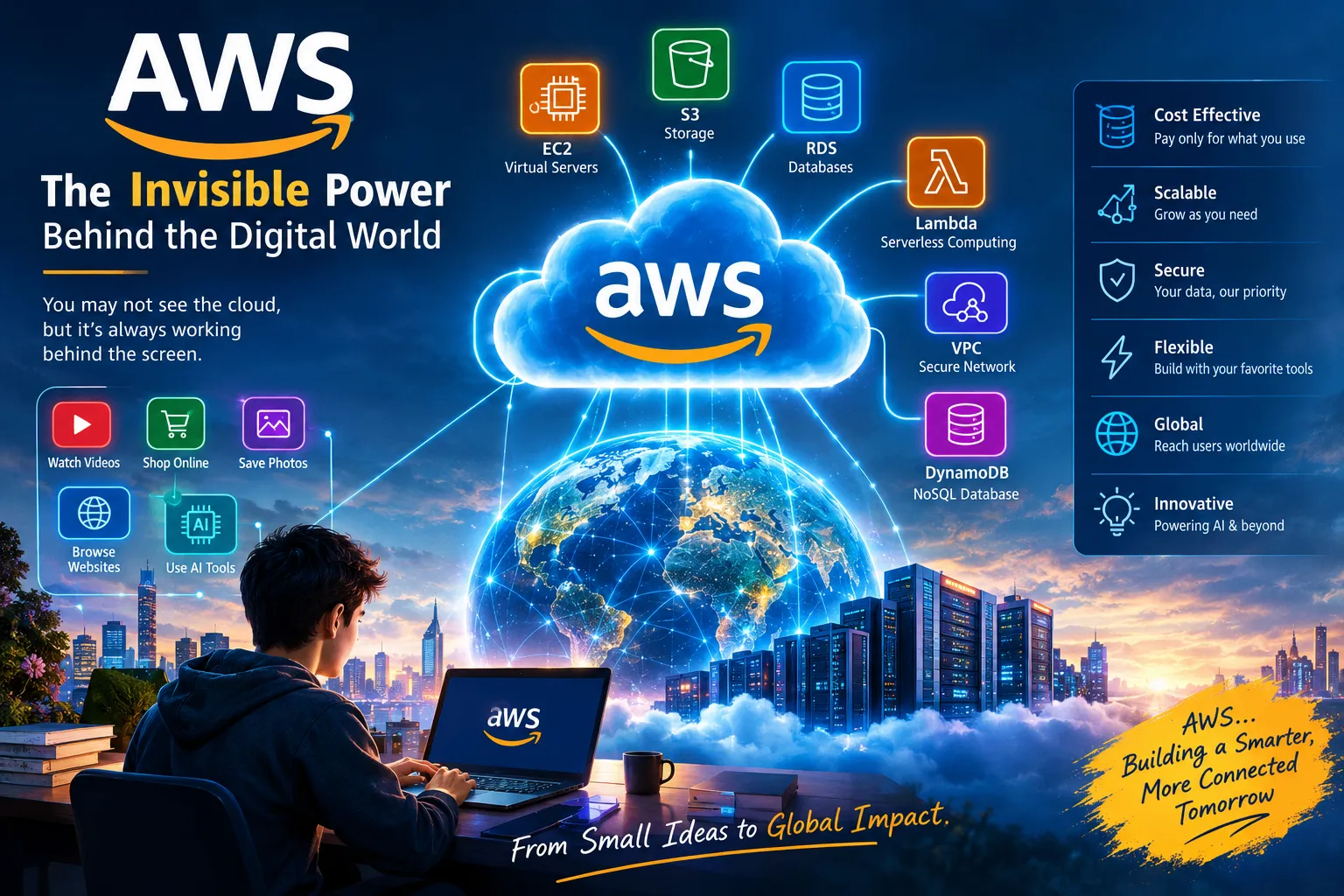
AWS: The Invisible Power Behind the Digital World
Every time we watch a video, order something online, save a photo, use an AI tool, or open a website, powerful technology is working silently behind the screen. One of the biggest forces driving this digital world is Amazon Web Services (AWS).

☁️ A World We Cannot See
Imagine opening your favorite mobile application. You see a colorful screen, buttons, images, and information. Everything looks simple. But the moment you tap a button, your request travels through networks to powerful computers somewhere in the world.
Those computers process your request, communicate with databases, find the required information, and send the result back to your device.
All of this can happen in just a few seconds.
This hidden infrastructure is one reason the modern digital world feels so fast and connected. Cloud platforms such as AWS provide the technology that makes much of this possible.
🌐 What Exactly Is AWS?
Amazon Web Services, commonly called AWS, is a cloud computing platform provided by Amazon. It gives users access to computing resources through the internet instead of requiring them to purchase and maintain their own physical infrastructure.
In the past, if a company wanted to create an online service, it might have needed to purchase servers, build a data center, install networking equipment, and employ people to maintain everything. This could require a huge amount of money and time.
With AWS, many of these resources can be accessed on demand.
A developer can create a server, store data, connect a database, and deploy an application without building an entire data center from scratch.
💻 From a Small Idea to a Global Application
One of the most interesting things about cloud computing is scalability.
Imagine a student creates a small application. At first, only ten people use it. Later, the application becomes popular and thousands or even millions of people start using it.
The computing requirements suddenly become much larger.
Cloud services can help applications scale their resources according to demand. This allows developers to focus more on improving their ideas instead of constantly worrying about physical hardware.
This flexibility has helped cloud computing become an important part of modern software development.
📦 The Digital Warehouse – Amazon S3
Every digital application needs a place to store information. Photos, videos, documents, backups, and other files can occupy enormous amounts of storage.
Amazon S3, or Simple Storage Service, is an AWS service designed for storing data.
Think of S3 as a gigantic digital warehouse. Instead of shelves filled with physical boxes, it stores digital objects that applications can access when needed.
For example, an application might use cloud storage to keep user-uploaded images, videos, documents, or backup files.
🖥️ Virtual Computers in the Cloud
Computers normally have physical processors, memory, and storage. But cloud computing allows users to create virtual servers.
Amazon EC2 provides virtual computing capacity that developers can use to run applications.
A developer can select the required computing resources and use them without purchasing a physical machine.
This is one of the reasons cloud computing has changed software development. Computing power can be requested when it is needed instead of being permanently purchased.
🧠 AWS and Artificial Intelligence
The rise of Artificial Intelligence has created an enormous demand for computing power.
Training and running AI models can require large amounts of processing power and data. Cloud platforms can provide the infrastructure required for these workloads.
AWS offers services and tools for Artificial Intelligence and Machine Learning, helping developers build intelligent applications.
AI systems can be used for tasks such as image analysis, language processing, prediction, recommendation systems, and data analysis.
The combination of cloud computing and AI is creating new possibilities for businesses, researchers, and students.
⚡ The Server That You Don't Have to Manage
Imagine writing a small piece of code and wanting it to run only when something happens. Normally, you might need to keep a server running continuously.
AWS Lambda provides a different approach.
It allows developers to run code in response to events without managing traditional servers directly. This is known as serverless computing.
For example, an event such as uploading a file can trigger a piece of code automatically.
This can make application development simpler and more flexible.
🔐 Security in the Cloud
When large amounts of important information are stored online, security becomes extremely important.
AWS provides various security services and features that help organizations control access, protect data, monitor activity, and secure their cloud infrastructure.
However, cloud security is not simply the responsibility of the cloud provider. Organizations must also configure their applications and access permissions correctly.
This shared approach to security is an important part of using cloud technology responsibly.
🌍 A Global Network
The internet has no single physical location. Information can travel across countries and continents in seconds.
AWS operates a global infrastructure consisting of regions and availability zones. This allows organizations to deploy applications closer to their users and design systems that can continue operating even when individual components experience problems.
For a user, this complexity is usually invisible.
They simply open an application and expect it to work.
💡 AWS for Startups and Students
Cloud computing is not only for large companies.
Startups can use cloud services to experiment with new ideas without spending huge amounts of money on physical infrastructure. They can build a prototype, test it with users, and increase resources as the project grows.
Students can also use cloud technology to learn about servers, databases, networking, artificial intelligence, data analytics, and application development.
A small project created in a classroom can therefore use the same type of cloud technology used in much larger digital systems.
🚀 How AWS Is Changing Businesses
Businesses today generate enormous amounts of data. They need systems that can process information quickly and support customers from different locations.
Cloud computing allows businesses to move from traditional infrastructure toward flexible digital systems.
E-commerce platforms can handle large numbers of customers. Streaming services can deliver content. Financial applications can process transactions. Educational platforms can provide online learning. Businesses can analyze data and build intelligent systems.
Behind many of these digital experiences, cloud infrastructure plays an important role.
🔮 The Future of AWS and Cloud Computing
Technology is moving rapidly toward a world where cloud computing, artificial intelligence, automation, robotics, and connected devices work together.
Future applications may require enormous computing power and the ability to process information instantly.
Cloud platforms can provide the foundation for these technologies.
As more businesses and developers move their applications to the cloud, knowledge of cloud computing is also becoming an important technical skill.
🌟 The Invisible Revolution
The most fascinating thing about AWS is that most people never realize when they are using it.
We do not see the servers.
We do not see the databases.
We do not see the networks carrying our information.
We simply experience the result.
A video starts playing. A website loads. A photo appears. An application responds. An AI system produces an answer.
Behind these simple experiences can be a complex network of computing resources working together.
Enjoyed reading this content? Let the author know!
Your likes, comments, shares, and saves help creators reach more builders.

Loading recommendations
Loading article