
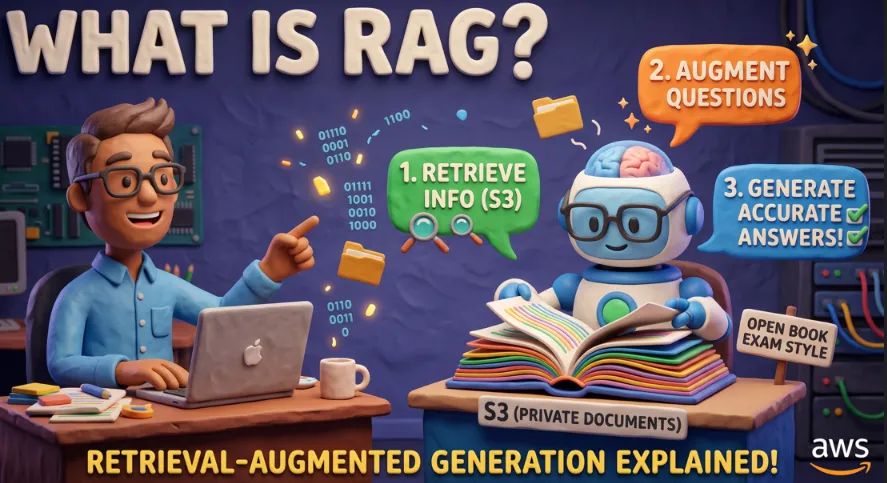
What is RAG? (Retrieval-Augmented Generation Explained for Beginners)
If you have been following AI news or building on AWS, you have likely heard the acronym RAG. It sounds super complex, but it is actually one of the most practical and useful patterns in modern AI.

What is RAG? (Retrieval-Augmented Generation Explained for Beginners)
If you have been following AI news or building on AWS, you have likely heard the acronym RAG. It sounds super complex, but it is actually one of the most practical and useful patterns in modern AI.
Here is a quick, beginner-friendly guide to what RAG is, why we need it, and how it works on AWS.
The Problem: LLMs Don't Know Your Private Data
Large Language Models (LLMs) like ChatGPT or Claude are trained on massive public datasets. They know world history, coding syntax, and general facts.
However, they suffer from two major limitations:
- They don't know your private data: They cannot read your company’s internal PDFs, your private database, or your personal notes stored in Amazon S3.
- They hallucinate: When asked about specific internal details they don't know, LLMs often make up plausible-sounding but completely incorrect facts.
The Analogy: Closed-Book vs. Open-Book Exam
Think of standard AI generation as taking a closed-book exam. The model has to rely entirely on its memory. If you ask a hyper-specific question about your company's policy, it might guess wrong.
RAG turns the AI into an open-book exam student:
- Retrieval: First, the system searches through your private documents (your "textbook") to find the exact pages related to the user's question.
- Augmented Generation: Next, it hands those exact pages to the AI model alongside the user's question, asking it to write an answer using only that retrieved reference material.
How RAG Works on AWS in 3 Steps
AWS makes building a RAG pipeline simple using services like Amazon Bedrock Knowledge Bases and Amazon S3:
1
[ User Question ] ──> [ Search S3 Docs ] ──> [ Send Question + Relevant Text to Bedrock ] ──> [ Accurate Answer ]
- Store Your Documents in Amazon S3: You upload your PDFs, text files, or documentation to an S3 bucket.
- Retrieve Relevant Context: When a user asks a question, AWS searches your S3 files (using vector embeddings or semantic search) to grab the top 2-3 most relevant paragraphs.
- Generate the Answer: AWS passes the user's question plus those relevant paragraphs to a Bedrock Foundation Model (like Claude). The model reads the snippet and generates a precise, truthful answer.
Why RAG is a Game-Changer for Beginners
- Zero Fine-Tuning Required: You don't need to spend thousands of dollars training or fine-tuning a custom AI model. You just update your text files in S3.
- Up-to-Date Answers: Whenever your policies or data change, you simply overwrite the file in S3, and your AI automatically uses the new information.
- Fewer Hallucinations: Because the AI is forced to cite its context, answers are grounded in real facts.
Summary
Retrieval-Augmented Generation (RAG) simply means searching your private files first, then letting AI write the response based on what it found. It is the easiest way to turn a general AI into a smart, accurate assistant for your own apps!
Enjoyed reading this content? Let the author know!
Your likes, comments, shares, and saves help creators reach more builders.

Loading recommendations
Loading article