
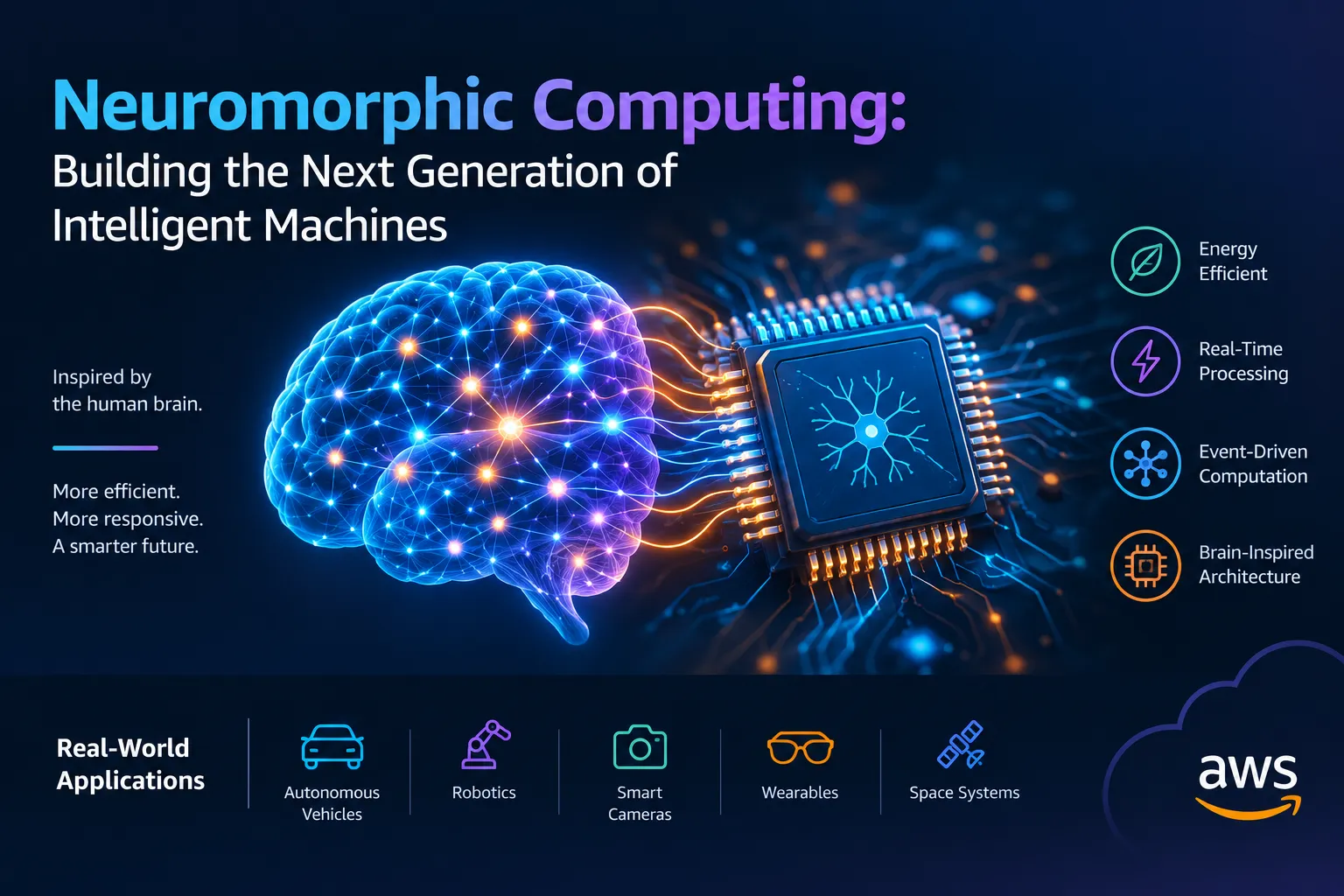
Neuromorphic Computing: Building the Next Generation of Intelligent Machines
Neuromorphic computing is an emerging approach to building intelligent systems inspired by the human brain. By using artificial neurons, synapses, spike-based communication, and event-driven processing, it aims to make AI more energy-efficient and responsive. This article explores how neuromorphic computing works, its importance, applications, challenges, and potential role in the future of AI and computing.

Introduction
Modern AI depends heavily on powerful CPUs, GPUs and specialized accelerators. As AI moves into robots, autonomous vehicles, IoT devices and wearable technology, running intelligent systems with limited power becomes increasingly important.
The human brain provides an interesting model. It performs complex tasks using highly parallel and event-driven processing while consuming relatively little energy.
Neuromorphic computing takes inspiration from these principles to develop a new generation of computing systems designed specifically for efficient intelligent processing.
What Is Neuromorphic Computing?
Neuromorphic computing is an approach to computer architecture inspired by the structure and functionality of biological neural systems.
Instead of treating computing and memory as completely separate processes, neuromorphic systems can combine computation, memory and communication in architectures that resemble neural networks.
A simplified flow is:
Input → Artificial Neurons → Synaptic Connections → Spikes → Output
Many neuromorphic systems use Spiking Neural Networks (SNNs), where information is represented through discrete events called spikes.
How Does Neuromorphic Computing Work?
1. Artificial Neurons
Artificial neurons imitate some behavior of biological neurons.
They receive input signals and generate an output when the accumulated signal reaches a particular threshold.
Input Signals → Neuron → Threshold → Spike
2. Artificial Synapses
Synapses connect biological neurons and influence how signals are transmitted.
Neuromorphic systems use artificial synapses to represent the strength of connections between artificial neurons.
Neuron A → Synaptic Weight → Neuron B
3. Spike-Based Communication
Instead of continuously processing every numerical value, spiking systems communicate through events.
Event → Spike → Processing
The timing and frequency of these spikes can carry information.
4. Parallel Processing
Large numbers of artificial neurons can operate simultaneously. This enables highly parallel processing and makes neuromorphic architectures suitable for real-time AI applications.
5. Event-Driven Processing
The system can perform computation mainly when meaningful events occur.
For example:
Object Movement → Sensor Event → Spike → AI Processing → Response
This approach can reduce unnecessary computation and energy usage.
Why Is It Important?
Energy-Efficient AI
The growth of AI is increasing the computational and energy requirements of modern systems. Neuromorphic architectures aim to perform certain AI workloads with much lower energy.
Real-Time Intelligence
Event-driven processing makes neuromorphic systems particularly interesting for applications that continuously interact with the physical world.
Edge AI
Instead of sending all sensor data to a cloud environment, processing can happen directly on the device.
Sensor → Neuromorphic Processor → Local AI → Decision
This can reduce latency, bandwidth requirements and dependence on continuous cloud connectivity.
Future AI Infrastructure
Neuromorphic computing could become another specialized computing architecture alongside CPUs, GPUs and AI accelerators, particularly for low-power intelligent systems.
Real-World Applications
Autonomous Systems
Autonomous vehicles, drones and robots need to continuously process information from their surroundings. Neuromorphic systems could help process sensor information quickly and efficiently.
Robotics
Robots could use neuromorphic processors for real-time perception, environmental understanding and movement.
Sensing → Perception → Decision → Action
Smart Cameras
Event-based sensors can detect changes in a scene instead of continuously processing complete images, potentially reducing data and energy requirements.
Wearable Devices
Smart glasses, hearing devices and other wearable technologies could benefit from low-power, always-on AI processing.
Space Technology
Satellites and spacecraft operate under strict power and communication constraints. Local neuromorphic processing could allow them to analyze sensor information before transmitting important results.
Neuromorphic Computing vs Traditional AI Hardware
| Feature | Traditional AI Hardware | Neuromorphic Computing |
|---|---|---|
| Processing | Clock-driven | Event-driven |
| Information | Numerical values | Often spike-based |
| Architecture | CPU/GPU/accelerator based | Brain-inspired |
| Parallelism | High | Highly parallel |
| Energy efficiency | Varies by workload | Potentially very high |
| Main focus | General and large-scale AI | Efficient real-time intelligence |
Neuromorphic computing is therefore not simply a replacement for GPUs. It represents a different architectural approach for specific types of intelligent workloads.
Challenges
Neuromorphic computing is still developing and faces several challenges.
Programming: New programming models are required to effectively use neuromorphic hardware.
Training: Training Spiking Neural Networks can be more difficult than conventional deep-learning models.
Hardware: Designing large, reliable and scalable neuromorphic systems remains challenging.
Ecosystem: The neuromorphic software and hardware ecosystem is still much smaller than the established CPU and GPU ecosystem.
The Future of Neuromorphic Computing
The future could combine neuromorphic hardware with AI, robotics, IoT, edge computing and advanced sensors.
A possible architecture could look like:
Real-World Environment
↓
Event-Based Sensors
↓
Neuromorphic Processor
↓
AI Model
↓
Real-Time Decision
↓
Physical Action
↓
Event-Based Sensors
↓
Neuromorphic Processor
↓
AI Model
↓
Real-Time Decision
↓
Physical Action
This could enable machines that continuously perceive and respond to their environment while operating within strict energy constraints.
Conclusion
Neuromorphic computing represents a different way of thinking about intelligent computing. By drawing inspiration from neurons, synapses, spikes and biological parallelism, it aims to make AI systems more efficient and responsive.
As intelligence moves from cloud data centers toward robots, autonomous vehicles, IoT devices and wearable systems, energy-efficient edge intelligence will become increasingly important.
The future of AI may not depend only on bigger models and faster processors, but also on fundamentally different ways of computing.
Enjoyed reading this content? Let the author know!
Your likes, comments, shares, and saves help creators reach more builders.

Loading recommendations
Loading article