
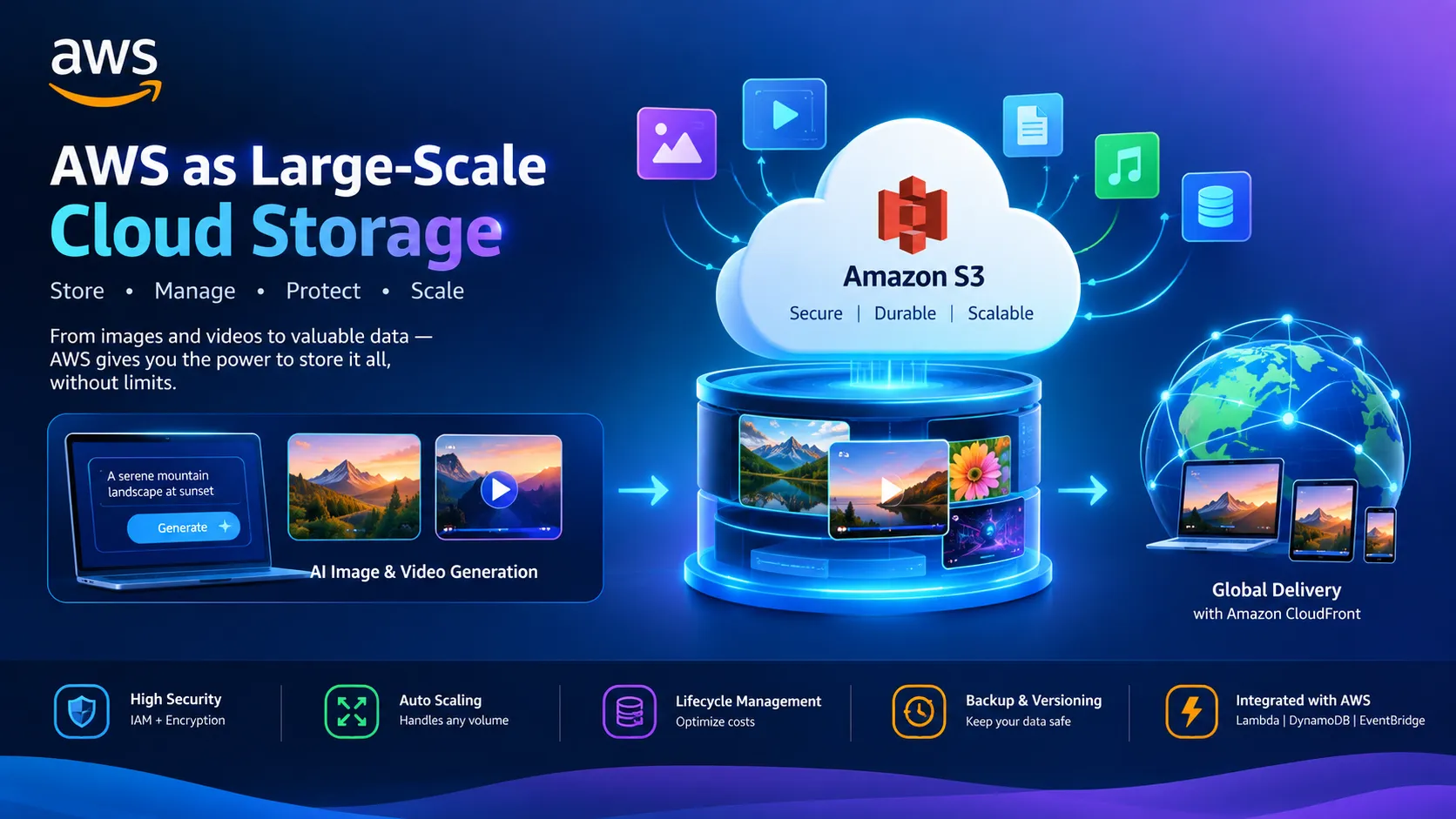
AWS as Large-Scale Cloud Storage
AWS provides scalable, secure, and reliable cloud storage for handling massive amounts of data such as images, videos, documents, and AI-generated content. Using services like Amazon S3 and CloudFront, applications can efficiently store, manage, protect, and deliver digital content as their storage requirements grow.

As the amount of digital data continues to grow, organizations need storage systems that are scalable, secure, reliable, and easy to manage. Amazon Web Services (AWS) provides a wide range of cloud storage solutions that allow businesses and applications to store huge amounts of data without maintaining physical servers or storage devices. AWS can support everything from small personal applications to large-scale enterprise platforms handling millions of files.
One of the most important AWS storage services is Amazon S3 (Simple Storage Service). S3 is an object storage service designed to store and retrieve virtually any amount of data. Images, videos, documents, databases, backups, logs, datasets, and AI-generated content can all be stored in S3. Since storage capacity can grow according to demand, applications do not need to purchase additional hardware whenever their data increases.
For an AI image and video generation platform, AWS can serve as the central storage layer. When a user generates an image or video, the application can automatically upload the generated file to an S3 bucket. Each file can be organized using folders, object names, metadata, and unique identifiers. Users can then access their previous generations whenever required. This makes S3 particularly useful for applications that continuously generate and store large multimedia files.
AWS also provides different S3 storage classes based on how frequently data is accessed. Frequently used files can be stored in a standard storage class, while older or rarely accessed files can be moved to lower-cost storage classes. With S3 Lifecycle policies, this process can be automated—for example, frequently accessed videos can remain in standard storage initially and later be moved to cheaper archival storage when they are no longer regularly used.
Security is another important advantage of AWS storage. S3 provides access-control mechanisms that allow developers to determine who can upload, download, or modify files. AWS Identity and Access Management (IAM) can be used to control permissions, while encryption can protect data both during storage and transmission. This is particularly important when applications store private user files, business documents, or sensitive datasets.
For applications serving users across different locations, Amazon CloudFront can be combined with S3 to deliver stored content efficiently. CloudFront acts as a content delivery network (CDN), caching frequently requested files closer to users. This can reduce loading times and improve the experience when users access large images, videos, or other media.
AWS storage can also be integrated with other AWS services. AWS Lambda can automatically process files when they are uploaded to S3, while Amazon DynamoDB can store information such as user accounts, file names, generation history, prompts, timestamps, and file locations. Amazon EventBridge or AWS Step Functions can be used to automate more complex workflows.
Another major benefit is scalability. Traditional storage requires organizations to predict how much hardware they will need in the future. With AWS, storage can expand as the application's data grows. This is especially valuable for AI applications because generated images and videos can consume significant amounts of storage over time.
AWS also supports backup, versioning, replication, and lifecycle management, helping organizations protect important data and manage storage costs. For example, an AI platform could retain high-resolution original videos in one storage tier while keeping smaller preview versions for everyday use.
Overall, AWS provides a flexible foundation for building large-scale storage systems. By combining Amazon S3, CloudFront, IAM, Lambda, DynamoDB, and other AWS services, developers can create applications capable of securely storing and managing massive amounts of digital content. For AI-powered image and video generation, AWS storage makes it possible to build a platform that can grow from a small prototype into a large-scale production system without requiring physical storage infrastructure.
Enjoyed reading this content? Let the author know!
Your likes, comments, shares, and saves help creators reach more builders.

Loading recommendations
Loading article