
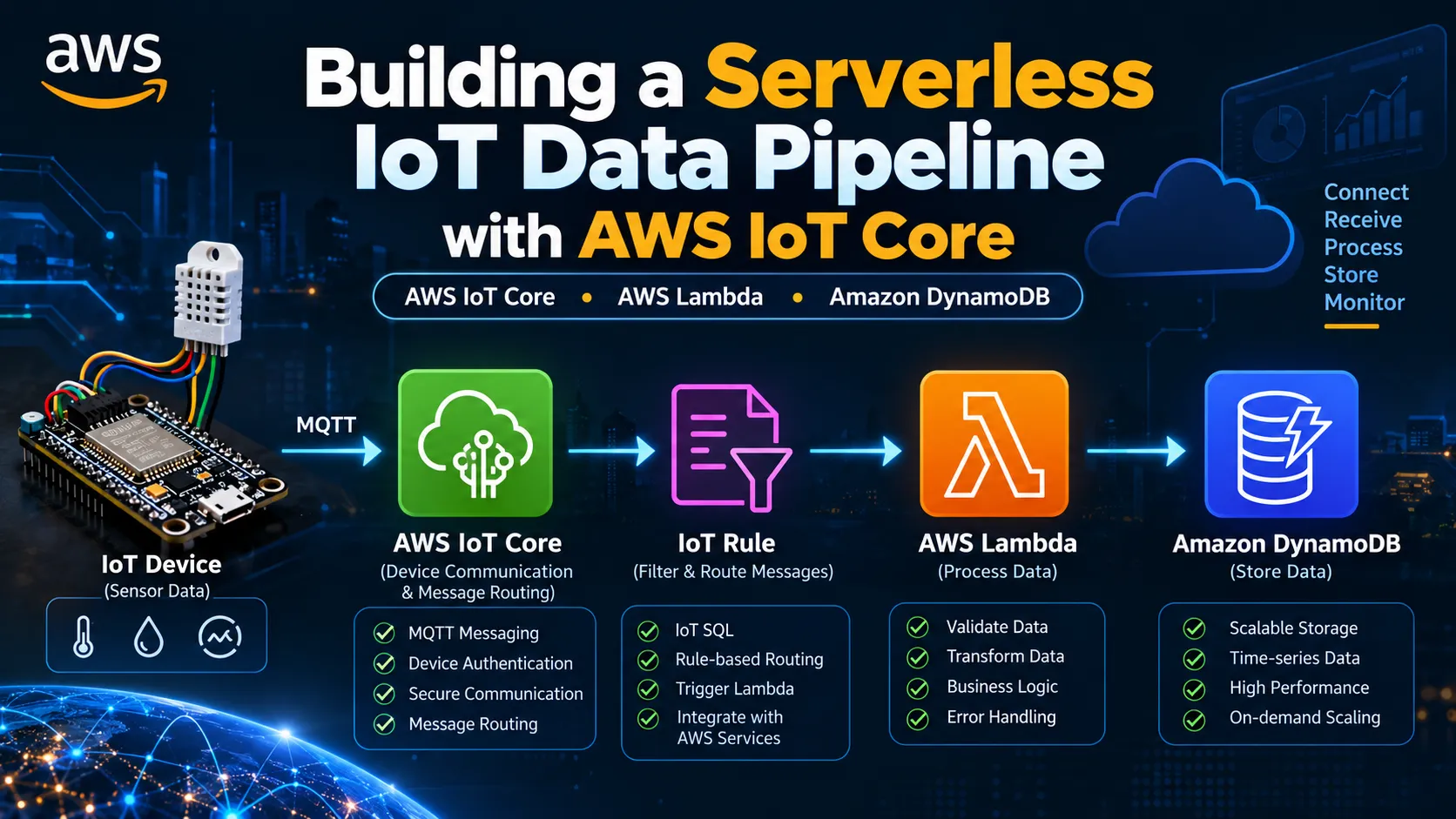
Building a Serverless IoT Data Pipeline with AWS IoT Core
Learn how to build a scalable serverless IoT data pipeline using AWS IoT Core, AWS Lambda, and Amazon DynamoDB. This article explains device communication, MQTT messaging, rule-based processing, data storage, and basic security practices.

TITLE:
Building a Serverless IoT Data Pipeline with AWS IoT Core
Building a Serverless IoT Data Pipeline with AWS IoT Core
DESCRIPTION:
Learn how to build a scalable serverless IoT data pipeline using AWS IoT Core, AWS Lambda, and Amazon DynamoDB. This article explains MQTT communication, device data processing, secure architecture, data storage, monitoring, and scalability.
Learn how to build a scalable serverless IoT data pipeline using AWS IoT Core, AWS Lambda, and Amazon DynamoDB. This article explains MQTT communication, device data processing, secure architecture, data storage, monitoring, and scalability.
BODY:
# Building a Serverless IoT Data Pipeline with AWS IoT Core
IoT devices continuously generate data such as temperature, humidity, motion, voltage, and device status. A scalable cloud architecture is required to collect, process, and store this data efficiently.
A practical serverless architecture can be designed as:
IoT Device → AWS IoT Core → IoT Rule → AWS Lambda → Amazon DynamoDB
The IoT device publishes sensor data using the MQTT protocol. AWS IoT Core receives the message and uses an IoT Rule to route the data. AWS Lambda can validate and process the message before storing the final data in DynamoDB.
## MQTT Communication
MQTT is a lightweight publish-subscribe protocol commonly used in IoT applications.
For example, a device can publish sensor readings to:
sensors/device01/data
A sample payload could be:
{
"deviceId": "device01",
"temperature": 28.6,
"humidity": 64
}
"deviceId": "device01",
"temperature": 28.6,
"humidity": 64
}
## AWS IoT Core
AWS IoT Core provides secure communication between connected devices and AWS services. It supports MQTT messaging, device authentication, message routing, and integration with other AWS services.
Devices should use secure authentication and TLS-based communication when connecting to AWS IoT Core.
## IoT Rules
AWS IoT Rules can inspect incoming MQTT messages and route them to other AWS services such as AWS Lambda.
A simple IoT SQL statement could be:
SELECT deviceId, temperature, humidity
FROM 'sensors/+/data'
FROM 'sensors/+/data'
This allows sensor data to be processed automatically whenever a device publishes a new message.
## Processing Data with AWS Lambda
AWS Lambda can be used to validate and transform incoming sensor data.
A simplified Python example is:
def lambda_handler(event, context):
device_id = event.get("deviceId")
temperature = event.get("temperature")
device_id = event.get("deviceId")
temperature = event.get("temperature")
if device_id is None or temperature is None:
return {
"statusCode": 400,
"body": "Invalid sensor data"
}
return {
"statusCode": 400,
"body": "Invalid sensor data"
}
print(f"Device: {device_id}, Temperature: {temperature}")
return {
"statusCode": 200,
"body": "Sensor data processed successfully"
}
"statusCode": 200,
"body": "Sensor data processed successfully"
}
In a production system, additional validation, error handling, logging, and database operations should be implemented.
## Storing Data in Amazon DynamoDB
Amazon DynamoDB can be used to store processed sensor readings.
A possible data structure is:
deviceId
timestamp
temperature
humidity
timestamp
temperature
humidity
For example:
{
"deviceId": "device01",
"timestamp": "2026-10-07T10:30:00Z",
"temperature": 28.6,
"humidity": 64
}
"deviceId": "device01",
"timestamp": "2026-10-07T10:30:00Z",
"temperature": 28.6,
"humidity": 64
}
The database design should consider access patterns, partition keys, scalability, and data retention requirements.
## Security Considerations
Security is critical in IoT systems because compromised devices can become an entry point into cloud infrastructure.
Important security practices include:
- Use unique identities or certificates for devices.
- Use TLS for secure communication.
- Follow the principle of least privilege.
- Avoid hard-coded AWS credentials.
- Validate incoming sensor data.
- Monitor device activity and application logs.
- Rotate credentials when appropriate.
- Use TLS for secure communication.
- Follow the principle of least privilege.
- Avoid hard-coded AWS credentials.
- Validate incoming sensor data.
- Monitor device activity and application logs.
- Rotate credentials when appropriate.
## Monitoring and Reliability
Real-world IoT networks can experience connectivity problems, delayed messages, or malformed data.
A reliable system should consider:
- Input validation
- Error handling
- Logging
- Monitoring
- Retry mechanisms
- Device reconnection strategies
- Error handling
- Logging
- Monitoring
- Retry mechanisms
- Device reconnection strategies
Amazon CloudWatch can be used to monitor Lambda execution and application logs.
## Why Serverless?
Using AWS IoT Core, AWS Lambda, and DynamoDB reduces the need to manage traditional servers.
The architecture is event-driven and can scale according to workload while keeping the individual components loosely coupled.
The overall workflow is:
Connect → Receive → Process → Store → Monitor
## Applications
This architecture can be applied to:
- Smart agriculture
- Environmental monitoring
- Industrial monitoring
- Smart homes
- Healthcare monitoring devices
- Connected vehicles
- Industrial IoT systems
- Environmental monitoring
- Industrial monitoring
- Smart homes
- Healthcare monitoring devices
- Connected vehicles
- Industrial IoT systems
## Conclusion
AWS IoT Core, AWS Lambda, and Amazon DynamoDB provide a practical foundation for building scalable serverless IoT applications.
By combining MQTT communication, event-driven processing, managed database storage, and cloud monitoring, developers can build IoT systems that are secure, scalable, and easier to maintain.
The key concept is simple:
Connect → Receive → Process → Store → Monitor
TAGS:
AWS IoT
AWS Lambda
Internet of Things
Serverless
Cloud Computing
AWS IoT
AWS Lambda
Internet of Things
Serverless
Cloud Computing
Enjoyed reading this content? Let the author know!
Your likes, comments, shares, and saves help creators reach more builders.

Loading recommendations
Loading article