

Why Metal Snaps (And How the Cloud Fixes It)
An invisible element is making our strongest alloys snap under pressure. Learn how engineers are moving beyond the limits of traditional supercomputers to simulate atomic-scale material flaws using Amazon Braket and the AWS cloud ecosystem.
Series: Applied Quantum Computing (1 article)
- 1Why Metal Snaps (And How the Cloud Fixes It) This article

Consider all the metal in your kitchen, your knives, your spoons, your pans, whatever has metal in it. Now guess what? That seemingly indestructible metal in your utensils can actually break without much of an effort. Picture your metal fork snapping in two halfway through breakfast. Wouldn't it be surprising? It'd probably make you wonder how solid metal can just fail. The answer turns out to be hidden at the microscopic level. So to understand it, you have to look at the metal's internal structure. Think of this structure like a perfectly stacked pile of apples at a supermarket. If you draw a point in the center of every apple and then connect them, you get a repeating geometric pattern recognized as a crystal lattice.
But metals in the real world are rarely perfect. Imagine trying to jam different stacks of fruit together, apples, oranges, and bananas. They absolutely won't sit flush. There will be awkward gaps, crushed edges, and misalignments. In a metal, the fruits are atoms, and the messy borders where these mismatched crystal stacks smash together are called grain boundaries, which are full of misalignments, structural defects, and awkward gaps.

In the case of a breakfast fork, these microscopic mismatches might simply give way under regular wear and tear, snapping the utensil in two. A snapping fork is just an annoyance. But what happens when these same microscopic gaps exist in an airplane's landing gear, or the structural bolts of a suspension bridge? Suddenly, those tiny imperfections become a devastating threat, especially when an invisible element like hydrogen finds its way inside.
Because hydrogen is the smallest atom on the periodic table, it can effortlessly slip (diffuse) right into those grain boundaries and awkward gaps. Once trapped inside, it acts like a microscopic wedge. When the metal is put under stress, the trapped hydrogen weakens the metallic bonds holding the atoms together, turning a tough, flexible alloy into something that snaps without warning. This, is hydrogen embrittlement.
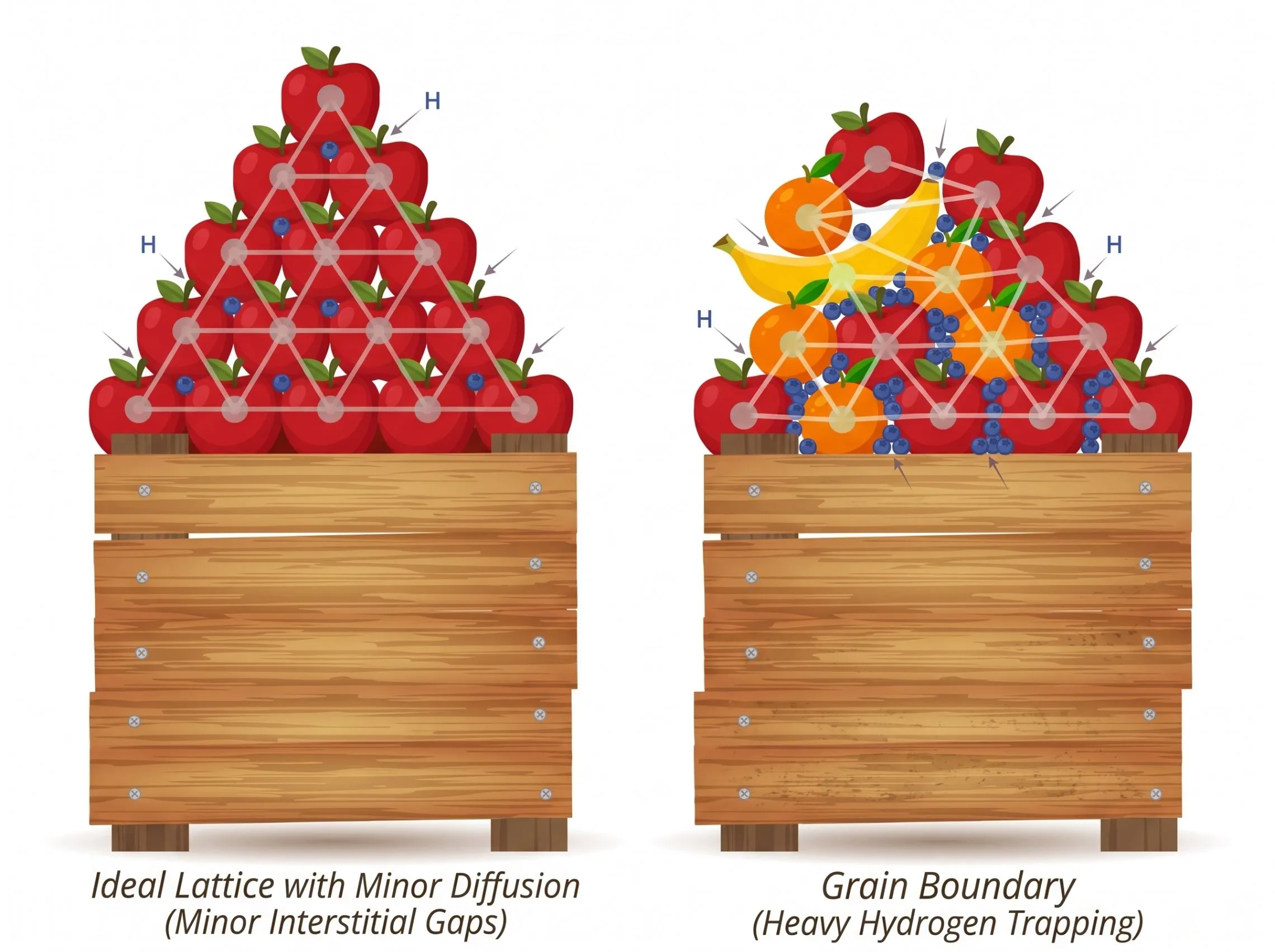
And it happens to be quite the roadblock. When engines, turbines, or sub hulls operate under pressure, a sudden, brittle snap is catastrophic. Yet you can't exactly slice open a cracked bolt during a flight to see how the atoms move. To grasp how hydrogen attacks the metal, engineers must simulate the behavior of every individual atom on a computer.
Nevertheless, that is where traditional computing meets its threshold. To predict how hydrogen weakens those atomic bonds, scientists rely on a method named Density Functional Theory, or DFT. Such a method can be thought of as a calculator that estimates how electrons behave to hold atoms together. For an average, uniform piece of metal, DFT works flawlessly. The only issue is that those grain boundaries require too much data. Since the atoms in those gaps are jammed together uncomfortably, their electrons constantly shove one another (a.k.a. strong electron correlation).
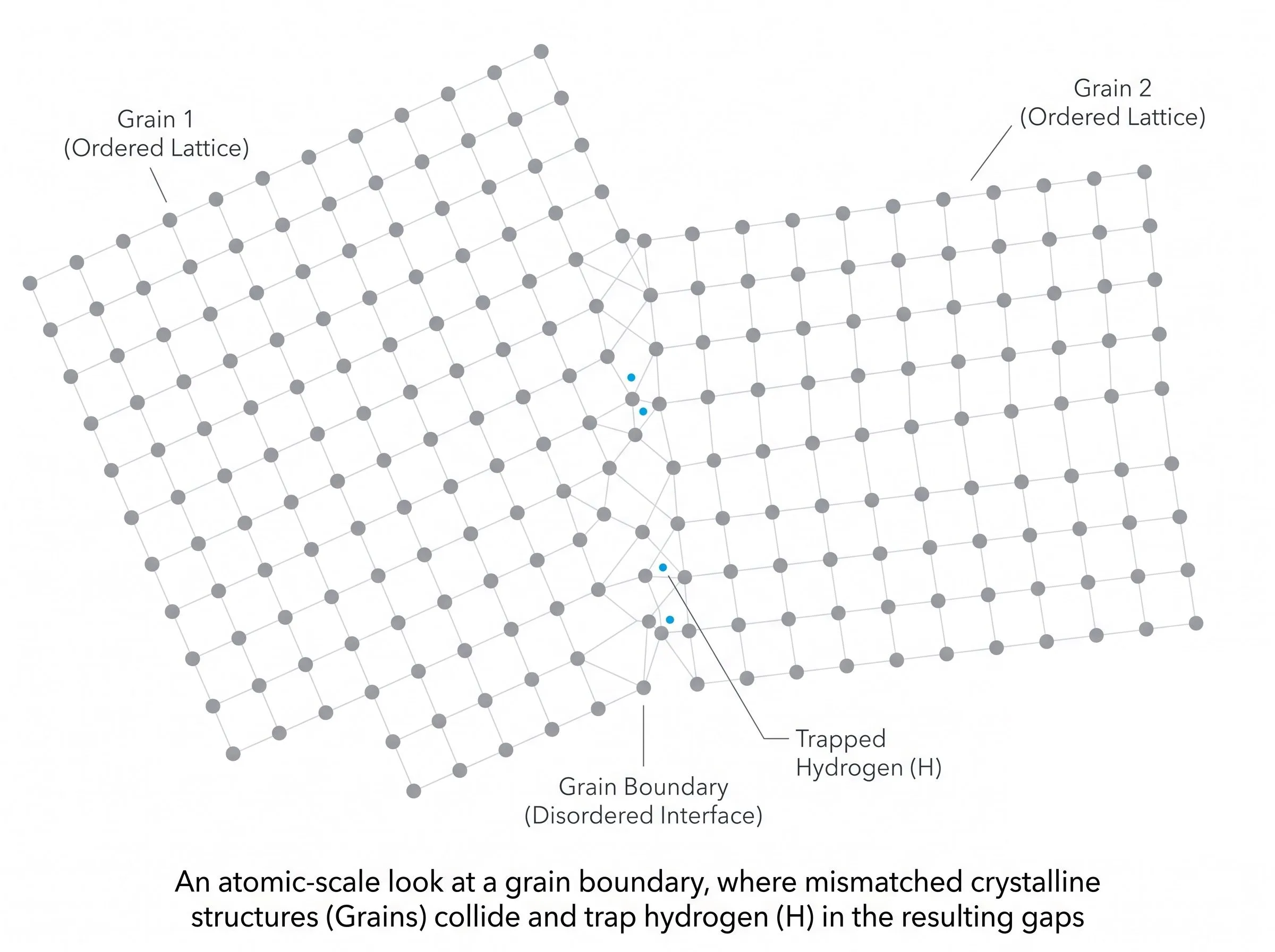
As visualized at the atomic level, the colliding patterns (Grain 1 and Grain 2) create a chaotic boundary seam where irregular spacing leaves empty pockets, allowing tiny hydrogen atoms to trap themselves inside the gaps.
Hence modeling this accurately implies a traditional computer calculating the relationship between every single electron simultaneously, which would require computing power multiplied with every atom you add. Meaning a standard supercomputer naturally has neither the memory nor the speed to finish the calculation.
Now instead of buying and maintaining an expensive local supercomputer, researchers can use services like AWS ParallelCluster to instantly spin up hundreds of compute-optimized EC2 instances. This fleet of traditional processors easily handles DFT calculations for the uniform, predictable parts of the metal. For those chaotic grain boundaries, however, quantum power can be paired with cloud clusters. Thus in place of trying to simulate everything classically, a hybrid quantum-classical approach splits the workload. Benchmark cloud servers manage the bulk of the metal, while a specialized quantum algorithm zooms in to calculate the highly correlated electron behavior inside the active boundary gaps.

Accessing this technology does not require building a multi-million-dollar quantum lab either. Through Amazon Braket, researchers get a managed gateway to test these hybrid algorithms on advanced simulators or route the heaviest math directly to physical quantum computers. Solving hydrogen embrittlement is turning away from slow, destructive trial-and-error in a physical workshop. By offloading the scale to cloud clusters as well as the complex electron physics to quantum processors, the future of material design is being simulated and perfected entirely in the cloud.
References & Further Reading
- Accelerating molecule discovery with computational chemistry and Promethium on AWS (AWS HPC Blog)
- Accelerate hybrid quantum-classical algorithms on Amazon Braket using embedded simulators (AWS Quantum Technologies Blog)
- Hydrogen Embrittlement at Cleavage Planes and Grain Boundaries in Bcc Iron (PMC7766328)
- Towards practical molecular electronic structure simulations on NISQ devices with Amazon Braket and Kvantify's FAST-VQE algorithm (AWS Quantum Technologies Blog)
- Classiq and AWS Power Quantum-Classical Chemistry Innovation in Singapore with Hatch (AWS Quantum Technologies Blog)
Series: Applied Quantum Computing (1 article)
- 1Why Metal Snaps (And How the Cloud Fixes It) This article
Enjoyed reading this content? Let the author know!
Your likes, comments, shares, and saves help creators reach more builders.

Loading recommendations
Loading article