
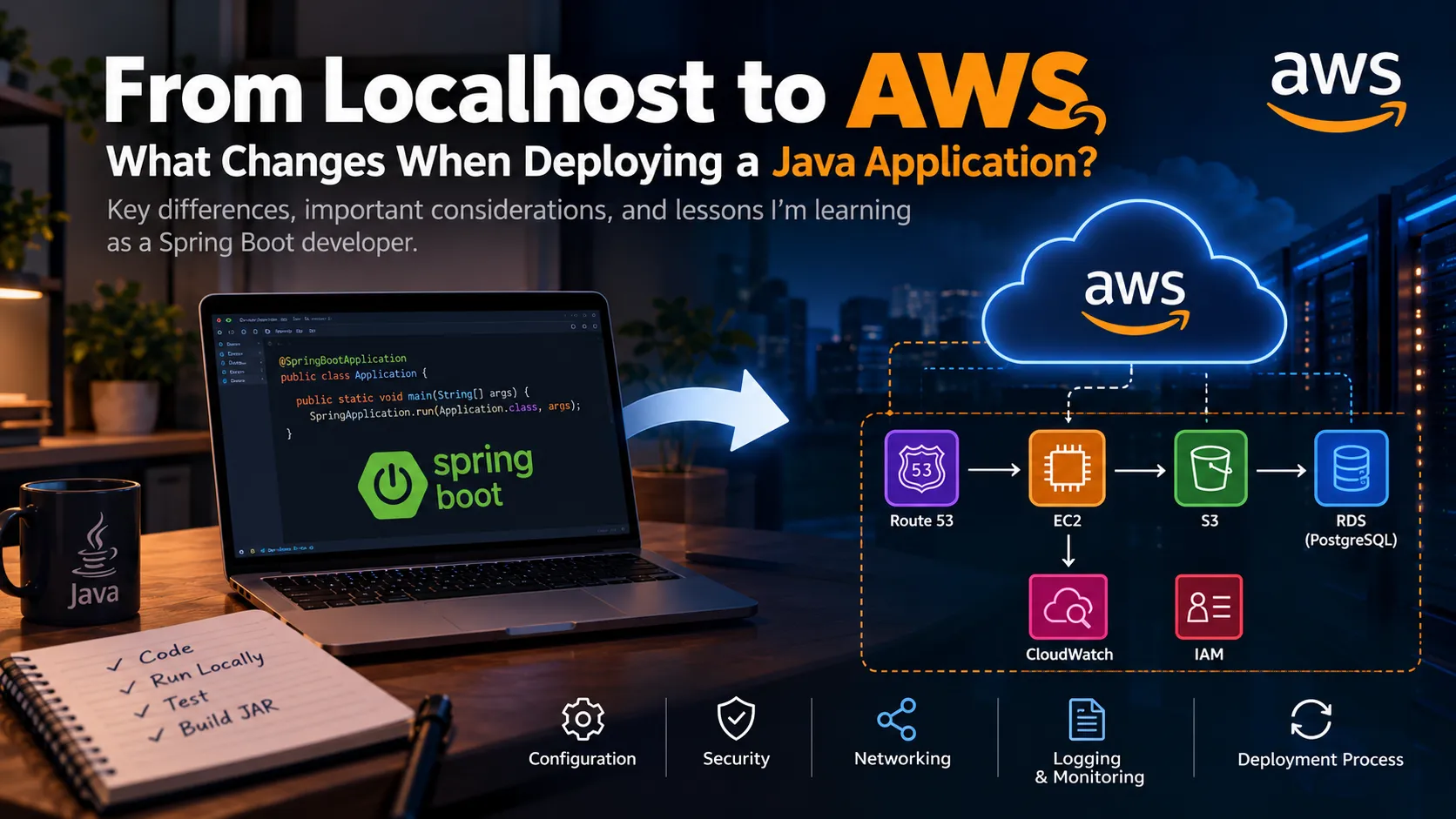
From Localhost to AWS: What Changes When Deploying a Java Application?
Moving a Spring Boot application from localhost to AWS involves more than deployment. This article explores the key changes in configuration, networking, security, monitoring, and deployment.

Moving a Spring Boot application from localhost to AWS is more than uploading a JAR file. The application may stay the same, but the way we think about configuration, networking, security, monitoring, and deployment changes significantly.
💻 It Works on My Machine — But What Happens Next?
During development, my application might look like this:
1
2
3
4
5
Spring Boot Application
        ↓
PostgreSQL
        ↓
localhost
Everything is available on my own machine, so testing is straightforward.
But when I move the application to AWS, the architecture starts looking more like:
1
2
3
4
5
6
7
8
9
User
  ↓
Internet
  ↓
AWS
  ↓
Application
  ↓
Database
Now I need to think about how each component communicates with the others.
1. Configuration Changes
Locally, I might have configuration such as:
1
localhost:5432
But in AWS, the database may be running somewhere completely different.
This means application configuration should be separated from the application code.
Things such as:
- Database URLs
- Database credentials
- API keys
- Environment-specific settings
should not simply be hardcoded into the source code.
This is where environment variables and proper secret-management practices become important.
2. Networking Becomes Important
On localhost, networking is almost invisible.
In AWS, it becomes a major part of deployment.
I need to understand concepts such as:
- VPCs
- Subnets
- Security groups
- Ports
- Public and private access
- Inbound and outbound traffic
For example, my Spring Boot application may need to communicate with a PostgreSQL database without exposing that database directly to the public internet.
That means deployment isn't just about starting the application — I also need to design how the components communicate securely.
3. Security Is Different
A locally running application isn't exposed to the same environment as a production application.
Once an application is accessible over the internet, security becomes much more important.
I need to think about:
- Who can access the application?
- Which ports should be open?
- Where are credentials stored?
- Which AWS resources have permission to access each other?
- Is the database publicly accessible?
AWS IAM also introduces another important concept: least privilege.
Instead of giving every user or service unnecessary permissions, access should be limited to what is actually required.
4. The Database Is No Longer Just localhost
During local development, connecting to PostgreSQL might be as simple as:
1
localhost:5432
In AWS, I need to consider:
1
2
3
4
5
Application
     ↓
Network
     ↓
Database
The database needs to be reachable from the application while remaining appropriately protected.
This is one reason services such as Amazon RDS are useful: AWS handles much of the underlying database infrastructure while developers focus more on the application.
5. Logs Become More Important
When my application runs locally, I can simply look at the terminal:
1
Spring Boot started successfully
But when the application is running remotely, I can't rely on staring at a terminal.
I need proper logging and monitoring to understand:
- Is the application running?
- Are requests failing?
- Are there exceptions?
- Is the application consuming too many resources?
- When did a problem start?
This is where monitoring and logging services such as Amazon CloudWatch become important.
6. Deployment Is More Than Uploading a JAR
Initially, deployment can look simple:
1
2
3
4
5
6
7
8
9
Code
 ↓
Build
 ↓
JAR
 ↓
Server
 ↓
Run
But a production-oriented workflow is closer to:
1
2
3
4
5
6
7
8
9
10
11
12
13
14
15
Code
 ↓
Build
 ↓
Test
 ↓
Package
 ↓
Deploy
 ↓
Configure
 ↓
Monitor
 ↓
Update
And eventually, this leads to bigger topics such as:
- Docker
- CI/CD
- Infrastructure as Code
- Load balancing
- Auto scaling
- Automated deployments
These are areas I want to explore further.
Enjoyed reading this content? Let the author know!
Your likes, comments, shares, and saves help creators reach more builders.

Loading recommendations
Loading article