
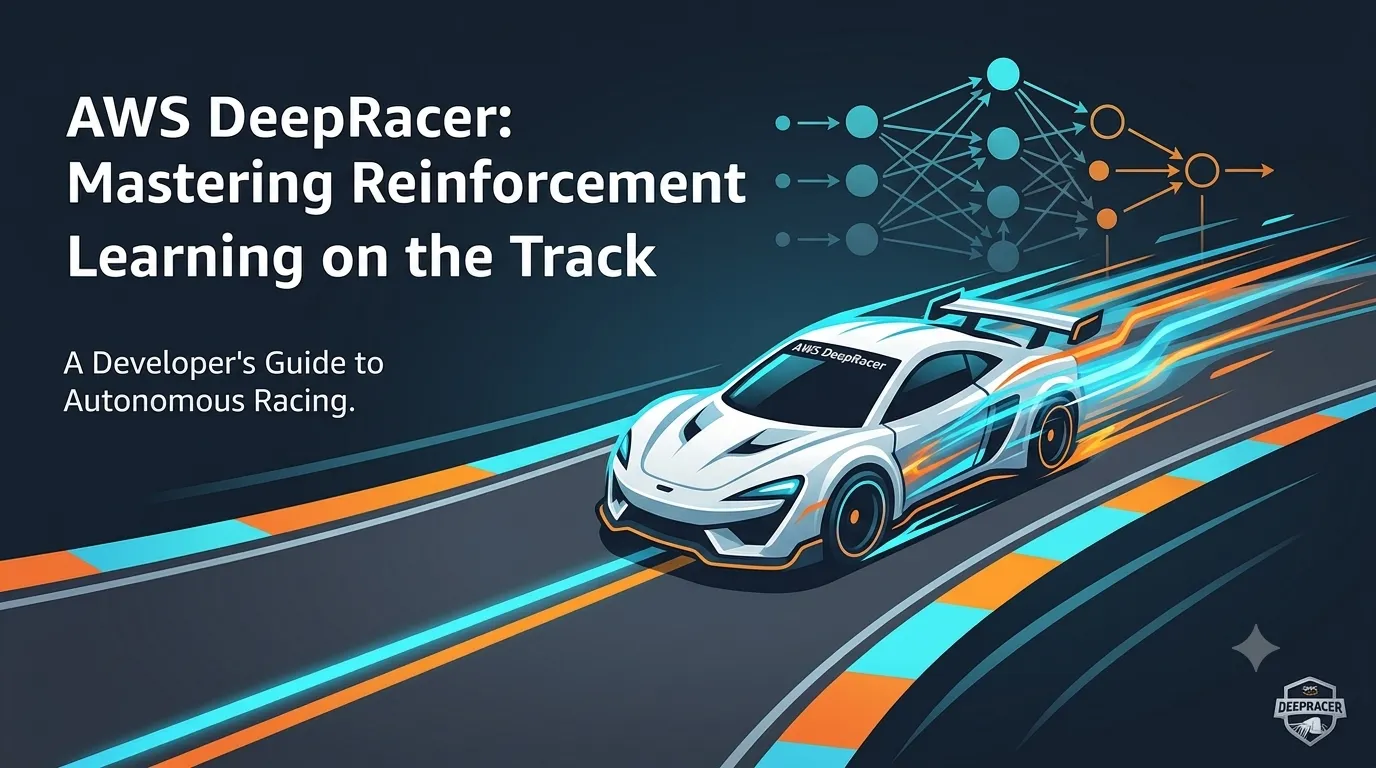
Understanding AWS DeepRacer: How Reinforcement Learning Drives Autonomous Racing
Discover how AWS DeepRacer simplifies Machine Learning by bringing Reinforcement Learning to life through 1/18th scale autonomous racing cars and virtual league competitions.

Demystifying Reinforcement Learning with AWS DeepRacer
Artificial Intelligence and Machine Learning (AI/ML) often feel intimidating, filled with dense mathematical equations and complex neural network architectures. However, AWS DeepRacer turns these abstract concepts into an engaging, hands-on experience by applying Reinforcement Learning (RL) to 1/18th scale autonomous racing cars.
What is AWS DeepRacer?
AWS DeepRacer is an interactive platform designed to help developers of all skill levels learn and experiment with Reinforcement Learning. It consists of three core components:
- A Physical 1/18th Scale Vehicle: Equipped with cameras, an Intel Atom processor, and Wi-Fi capabilities.
- A 3D Cloud-Based Simulator: Integrated within the AWS Management Console to train and evaluate models safely.
- The AWS DeepRacer League: The world's first global autonomous racing league where developers compete for prizes and glory.
The Core Concept: How Reinforcement Learning Works
Unlike Supervised Learning (which uses labeled data) or Unsupervised Learning (which looks for hidden patterns), Reinforcement Learning learns through trial and error.
An autonomous agent (the car) takes actions in an environment (the track) to maximize a reward.
Key Terminology:
- State ($S$): The visual input from the car's camera at any given frame.
- Action ($A$): The steering angle and throttle speed chosen by the model.
- Reward ($R$): A numerical score granted to the car based on how well it executed the action.
Writing a Reward Function in Python
The heart of an AWS DeepRacer model is its Reward Function. Written in Python, this function evaluates the car's state and returns a score.
Here is an example of a reward function that encourages the car to stay close to the center line and avoid sharp zig-zags:
1
2
3
4
5
6
7
8
9
10
11
12
13
14
15
16
17
18
19
20
21
22
23
24
25
26
27
28
29
30
31
32
33
34
35
36
37
38
39
40
41
def reward_function(params):
    '''
    Example AWS DeepRacer reward function: Staying close to the center line
    '''

    # Read input parameters
    track_width = params['track_width']
    distance_from_center = params['distance_from_center']
    all_wheels_on_track = params['all_wheels_on_track']

    # Calculate markers at varying distances from the center line
    marker_1 = 0.1 * track_width
    marker_2 = 0.25 * track_width
    marker_3 = 0.5 * track_width

    # Give high reward if the car is close to the center line
    if distance_from_center <= marker_1:
        reward = 1.0
    elif distance_from_center <= marker_2:
        reward = 0.5
    elif distance_from_center <= marker_3:
        reward = 0.1
    else:
        reward = 1e-3  # Likely off track

    # Penalize if the car goes off track
    if not all_wheels_on_track:
        reward = 1e-3

    return float(reward)
Tips for Optimizing Model Performance
To build a competitive model for the AWS DeepRacer League, consider these best practices:

Smooth Steering Penalties: Add logic to penalize excessive steering changes to prevent wobbling along straight paths.

Speed Allocation: Reward higher speed settings on straightaways and lower speeds when approaching sharp turns.

Hyperparameter Tuning: Adjust parameters like Learning Rate, Batch Size, and Epochs in the AWS Console to optimize model convergence.

Conclusion
AWS DeepRacer makes complex machine learning concepts accessible, visual, and fun. By experimenting with reward functions and track geometry, developers gain practical experience in Reinforcement Learning that applies to real-world autonomous systems and robotics.Enjoyed reading this content? Let the author know!
Your likes, comments, shares, and saves help creators reach more builders.

Loading recommendations
Loading article