
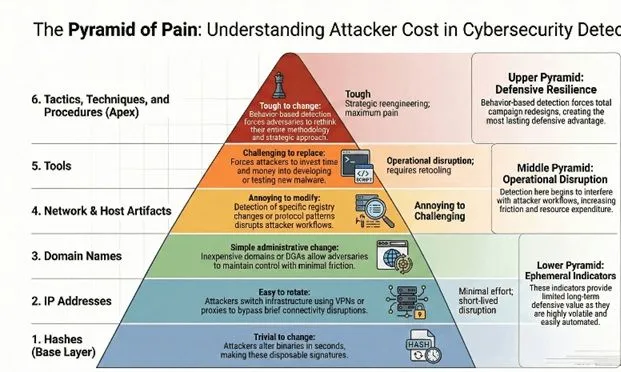
Understanding the Pyramid of Pain
This article explains how to shift a cloud security posture from reactive to resilient by mapping the Pyramid of Pain framework to native AWS security services. It breaks down all six layers of the framework and provides actionable blueprints for automating defenses and engineering behavioral detection using AWS tools.

The Pyramid of Pain is a conceptual framework designed by cybersecurity expert David Bianco in 2013 to measure the effectiveness of Cyber Threat Intelligence (CTI) and incident response operations.
In the context of AWS, understanding and applying this framework allows cloud builders, security engineers, and DevOps teams to shift from reactive firefighting to proactive, resilient threat detection.
Here is a comprehensive guide to understanding the Pyramid of Pain and implementing it natively within the AWS ecosystem.
Understanding the Pyramid of Pain
The pyramid is structured into six layers of indicators of compromise (IoCs). The core premise is simple: the higher you climb the pyramid, the more pain, cost, and disruption you inflict on an adversary when you detect and deny them that specific indicator. Conversely, it also reflects the difficulty your own team faces in collecting and implementing those detections.
/\ TTPs (Tough)
/_\ Tools (Challenging)
/__\ Network/Host Artifacts (Annoying)
/____\ Domain Names (Simple)
/______\ IP Addresses (Easy)
/________\ Hash Values (Trivial)
Here is how each layer breaks down and how AWS builders can address them:
/_\ Tools (Challenging)
/__\ Network/Host Artifacts (Annoying)
/____\ Domain Names (Simple)
/______\ IP Addresses (Easy)
/________\ Hash Values (Trivial)
Here is how each layer breaks down and how AWS builders can address them:
- Hash Values (Trivial)
• What it is: SHA-1, MD5, or SHA-256 signatures of malicious files.
• The Adversary's Pain: Trivial. Changing a single bit in a file changes its hash completely. Attackers automate this effortlessly.
• AWS Implementation: Use AWS Systems Manager (SSM) Inventory or Amazon GuardDuty to monitor EC2 instances for known malicious software hashes. However, do not rely on hashes as your primary line of defense. - IP Addresses (Easy)
• What it is: The network addresses used by attackers to launch attacks or host Command and Control (C2) servers.
• The Adversary's Pain: Easy. Attackers can easily spin up new proxy servers, use VPNs, or lease new cloud infrastructure to get a fresh IP.
• AWS Implementation: Leverage AWS WAF (Web Application Firewall) with managed threat intel lists to automatically block bad IPs. You can also ingest custom threat feeds into Amazon GuardDuty via Threat Intel Sets to trigger alerts when your resources communicate with known malicious IPs. - Domain Names (Simple)
• What it is: The domain names registered by adversaries (e.g., typosquatting or phishing domains) used for C2 or hosting malware.
• The Adversary's Pain: Simple. Registering a new domain takes minutes and costs very little, though it requires slightly more effort than changing an IP.
• AWS Implementation: Enable Route 53 Resolver DNS Firewall. This allows you to filter and block outbound DNS queries from your VPCs to known malicious domains, effectively breaking the attacker's ability to communicate out of your environment. - Network and Host Artifacts (Annoying)
• What it is: Traces left behind by an attacker on your systems or network, such as unique User-Agent strings, specific registry changes, URI patterns, or unusual directory creations.
• The Adversary's Pain: Annoying. Fixing this requires the attacker to rewrite parts of their scripts, compile new configurations, or change their deployment methods.
• AWS Implementation: Dig deep into your logs. Use Amazon VPC Flow Logs to analyze bytes transferred and port usage. Use Amazon CloudWatch Application Signals and AWS CloudTrail to detect anomalous API activity (like unexpected AssumeRole calls or modification of IAM policies). - Tools (Challenging)
• What it is: The software, utilities, or scripts the adversary uses to achieve their goals (e.g., Mimikatz, Cobalt Strike, or custom mass-scanning scripts).
• The Adversary's Pain: Challenging. If you can successfully detect and signatures their specific toolsets, the attacker must invest significant time finding, building, or learning a completely new tool.
• AWS Implementation: Implement Amazon GuardDuty Runtime Monitoring for Amazon ECS, EKS, and EC2. This capability looks at operating system-level behavior to identify when common attack tools are executing code in memory or attempting privilege escalation. - TTPs (Tough)
• What it is: Tactics, Techniques, and Procedures. This is how the attacker operates from start to finish—their behavioral methodology (e.g., spear-phishing -> credential dumping -> cloud data exfiltration via S3 replication).
• The Adversary's Pain: Tough. TTPs represent the attacker's habits and core skills. Forcing an attacker to change their TTPs means forcing them to completely reinvent how they operate.
• AWS Implementation: This requires a behavioral approach rather than signature matching. Use Amazon Detective to visualize and investigate root causes of complex security findings. Establish solid baseline behaviors using AWS Identity and Access Management (IAM) Access Analyzer to enforce least privilege, ensuring that even if an attacker attempts their usual lateral movement techniques, the infrastructure naturally denies them.
Action Plan for AWS Builders
To move up the Pyramid of Pain effectively in AWS, builders should prioritize architecture and automation over static blocklists: - Automate the Bottom Layers: Do not spend manual engineering time blocking IPs and hashes. Let AWS WAF and Amazon GuardDuty handle these dynamically via automated managed rules.
- Focus Engineering on the Top Layers: Spend your development cycles building robust IAM policies, locking down VPC boundaries, and using AWS Config to ensure your infrastructure maintains a secure, unalterable baseline.
- Centralize for Context: Feed your AWS security data into an Amazon Security Lake or a centralized SIEM using AWS Security Hub. This gives you the high-level behavioral visibility needed to spot structural TTPs rather than isolated alerts.
By designing your cloud infrastructure to target the top tiers of the Pyramid of Pain, you create an inherently hostile environment for adversaries, making it too costly and time-consuming for them to succeed.
Enjoyed reading this content? Let the author know!
Your likes, comments, shares, and saves help creators reach more builders.

Loading recommendations
Loading article