
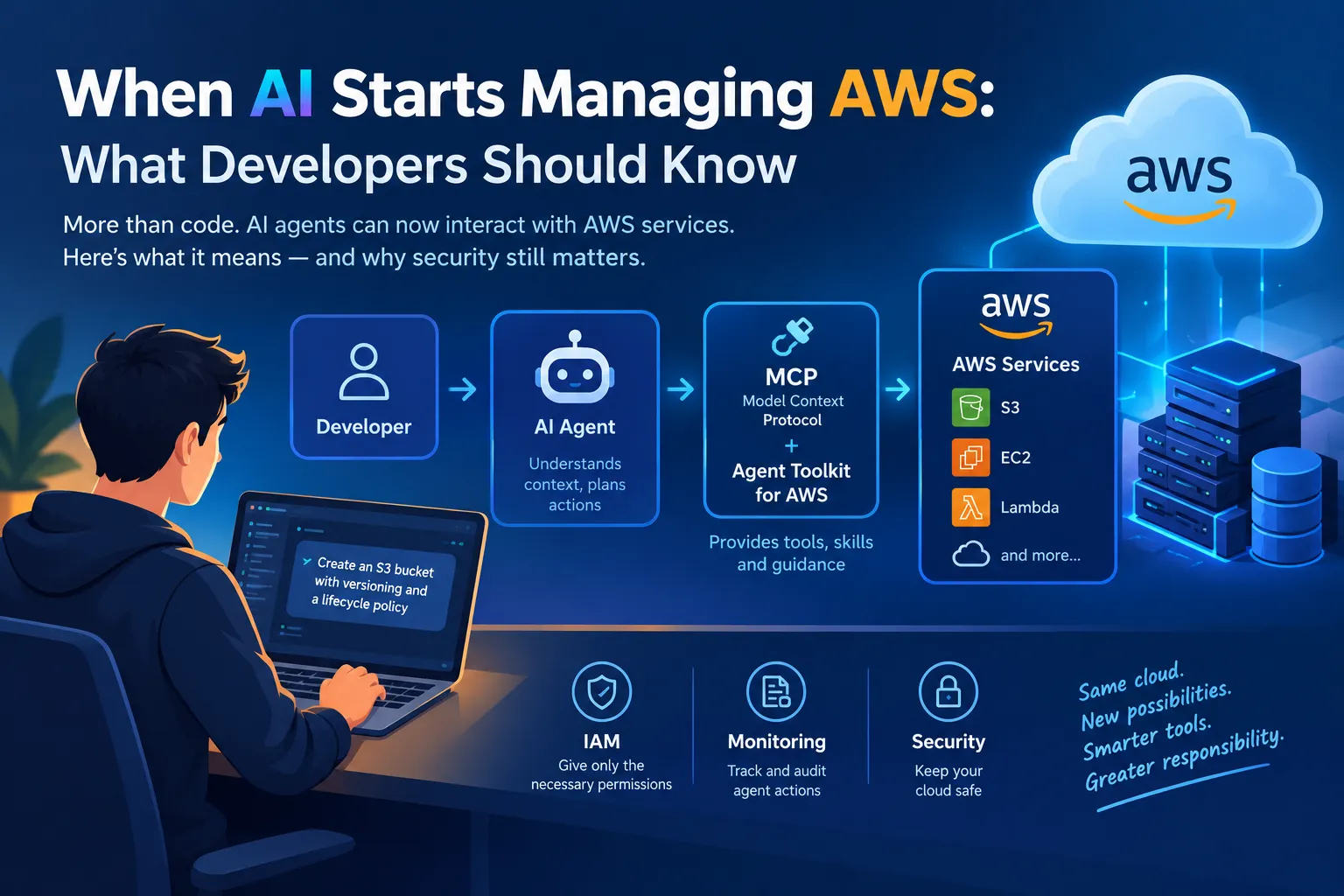
When AI Starts Managing AWS: What Developers Should Know
AI coding agents are moving beyond code generation and starting to interact with cloud services. Explore how AWS MCP Server and Agent Toolkit enable AI-assisted cloud development, and why IAM, permissions, and security still matter.

When AI Starts Managing AWS: What Developers Should Know
AI coding tools have evolved beyond generating code. Today, some AI agents can interact with cloud services, inspect resources, use documentation, and help developers build and troubleshoot applications.
AWS is moving in this direction with tools such as the AWS MCP Server and Agent Toolkit for AWS, which allow compatible AI coding agents to work with AWS services through controlled tools and workflows.
But this creates an important question:
What happens when AI is given access to your cloud environment?
From Writing Code to Taking Action
Traditionally, a developer might ask an AI:
“Write the AWS CLI command to create an S3 bucket.”
The AI provides the command, and the developer runs it.
With an AI agent connected to AWS, the workflow can become:
Developer → AI Agent → AWS Tools → AWS Services
Instead of only explaining what to do, the agent can potentially perform authorized operations, investigate errors, and assist with deployment and troubleshooting.
This is where MCP (Model Context Protocol) becomes useful.
What Is MCP?
MCP provides a standardized way for AI applications to interact with external tools and services.
AWS provides an AWS MCP Server that gives compatible AI agents access to AWS capabilities. The Agent Toolkit for AWS combines the MCP server with additional skills, plugins, and guidance designed to help AI coding agents work with AWS.
For example, an agent could help investigate why a deployment failed or assist with configuring an AWS resource instead of simply explaining the steps.
This can make cloud development much more conversational.
The Security Question
The ability to take action is also the biggest reason to be careful.
An AI agent should not automatically receive unrestricted access to an AWS account.
Consider the difference between allowing an agent to:
- Read information about an application
- Create a development resource
- Modify production infrastructure
- Change IAM permissions
- Delete resources
These actions have very different levels of risk.
This is why AWS IAM remains important even when AI is involved.
The principle of least privilege means giving an identity only the permissions it actually needs. AWS also provides monitoring and auditing capabilities such as CloudTrail to help track activity.
AI may be able to perform an action, but permissions determine whether it should be allowed to perform that action.
Why This Matters for Beginners
For someone learning AWS, this shift changes what it means to understand the cloud.
You do not necessarily need to memorize every command.
You need to understand:
Which service should I use?
What permissions are required?
What could go wrong?
How can I verify what the AI has done?
AI can assist with implementation, but understanding the underlying AWS services is still essential.
The Bigger Change
Cloud development has already moved through several stages:
Console → Code → Infrastructure as Code → AI-assisted development
The next step is AI agents that can interact directly with cloud environments.
AWS's continued investment in MCP and the Agent Toolkit shows that this is becoming part of the modern developer workflow. AWS expanded AWS MCP Server availability to additional regions in October 2026, further extending its reach.
The important lesson is not that AI should control everything.
It is that AI should have the right access, for the right task, with the right controls.
As AI becomes more capable of operating cloud infrastructure, understanding permissions, monitoring, and security will become just as important as knowing how to build with AWS.
The future of cloud development may not be humans versus AI.
It may be humans working with AI — with AWS permissions keeping both on the right path.
Enjoyed reading this content? Let the author know!
Your likes, comments, shares, and saves help creators reach more builders.

Loading recommendations
Loading article