
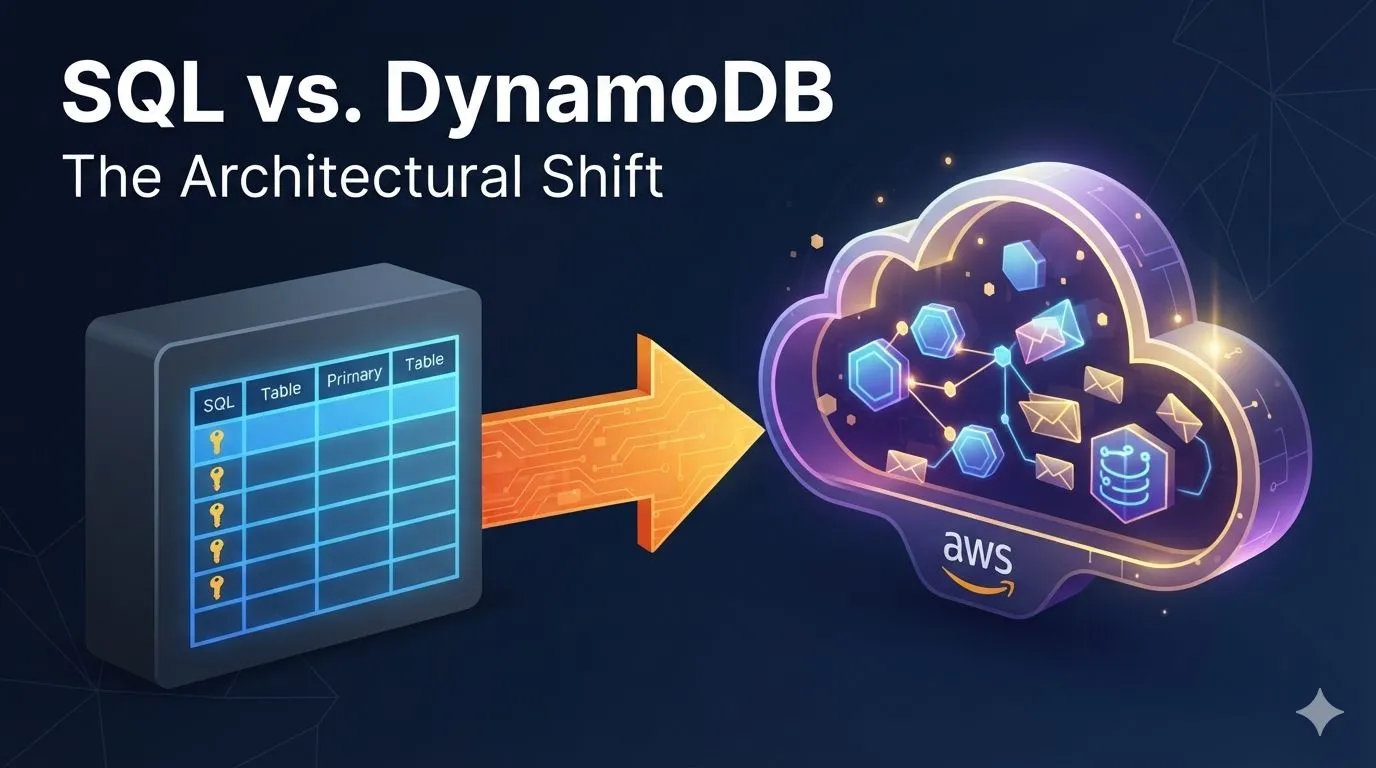
The Relational Dilemma: Transitioning from Traditional SQL to Amazon DynamoDB
An MCA student’s breakdown of mapping relational SQL logic into a high-performance NoSQL mindset when deploying backend services to AWS.

### The Crossroads: Local SQL vs. Cloud NoSQL
During my academic studies, relational databases have been the standard foundation for everything we build. Writing complex queries, handling tabular schemas, and setting up foreign keys in local **SQL** instances becomes second nature. It is an amazing structure for data integrity.
However, when you start designing architectures meant to run at a massive cloud scale, you quickly hit a crossroads. Traditional relational structures can face performance challenges when scaling horizontally to handle millions of concurrent global requests. That is where a cloud-native NoSQL solution like **Amazon DynamoDB** changes the architectural game.
Transitioning from a relational mindset to a NoSQL model is not just a change in syntax—it requires a complete shift in how you think about your data.
### Shifting the Mindset: Key Architectural Differences
For any developer or student making this jump, these are the major conceptual shifts that stand out right away:
* **Schema Flexibility:** Relational databases require strict column structures defined well in advance. Amazon DynamoDB is schema-less, meaning each item can possess unique attributes, allowing your data models to evolve dynamically alongside your application.
* **Scaling Strategy:** Traditional databases typically scale vertically (requiring more compute power on a single instance). DynamoDB scales horizontally, distributing data across partitions to deliver consistent single-digit millisecond latency regardless of whether your database is handling hundreds or millions of requests.
* **Join Queries vs. Single-Table Design:** In standard SQL, we rely heavily on `JOIN` operations to stitch relational tables together. DynamoDB doesn't support joins. Instead, it encourages single-table design principles, where you structure your item collections specifically around your application's access patterns from day one.
### My Goal: Testing the Boundaries
As I continue preparing for my **AWS Certified Cloud Practitioner** milestone, my next step is building a hybrid hands-on project. I want to map out how a standard Java backend service interacts when migrating its data layer from a structured SQL architecture over to a high-capacity DynamoDB table. Learning to design optimal primary keys and partition keys is proving to be a rewarding technical challenge.
**What about you?** When you deploy backend services to AWS, do you lean toward relational options like Amazon RDS, or do you prefer the managed simplicity of DynamoDB? Let’s connect, debate, and share your favorite database strategies in the comments below!
Enjoyed reading this content? Let the author know!
Your likes, comments, shares, and saves help creators reach more builders.

Loading recommendations
Loading article