
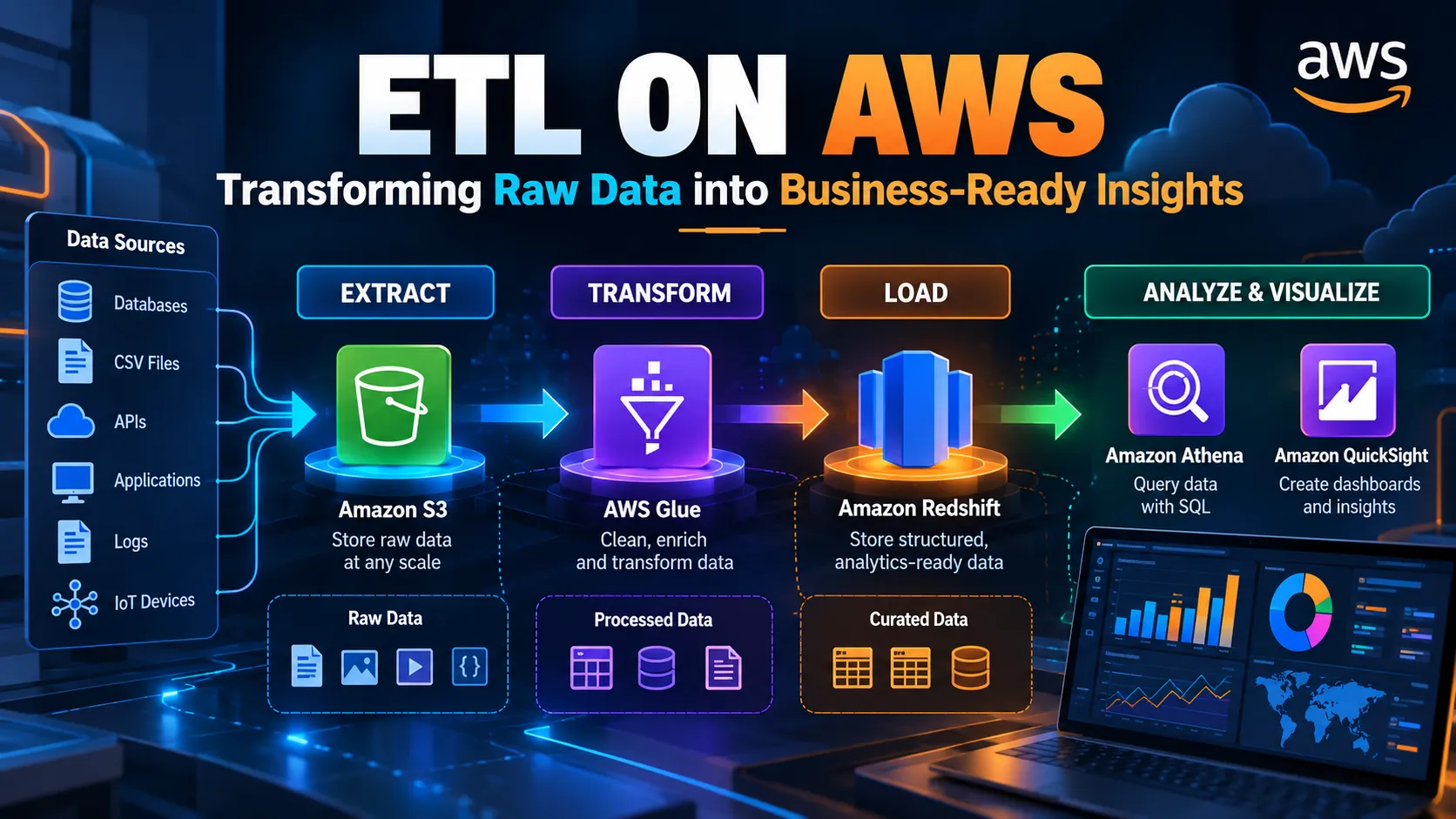
ETL on AWS: Transforming Raw Data into Business-Ready Insights
Learn how ETL works on AWS and how services such as Amazon S3, AWS Glue, Amazon Athena, and Amazon Redshift can transform raw data into clean, structured, and analytics-ready information for business decision-making.

ETL on AWS: Transforming Raw Data into Business-Ready Insights
Modern organizations generate data from many different sources, including applications, databases, websites, APIs, sales systems, and customer platforms. However, raw data is rarely ready for analysis.
It may contain missing values, duplicate records, inconsistent formats, or information spread across multiple systems.
This is where ETL (Extract, Transform, Load) becomes important.
ETL is a data integration process that collects data from different sources, transforms it into a clean and consistent format, and loads it into a destination where it can be analyzed.
AWS provides several services that can be combined to build scalable and reliable ETL pipelines.
What Is ETL?
ETL consists of three main stages:
Extract → Transform → Load
Extract
The first stage involves collecting data from different sources.
Common data sources include:
- Relational databases
- CSV and JSON files
- APIs
- Application logs
- Customer transactions
- Websites
- IoT devices
The goal is to bring data from different sources into a centralized environment for further processing.
Transform
Raw data usually needs to be cleaned and standardized before it can be analyzed.
Transformation can include:
- Removing duplicate records
- Handling missing values
- Changing data types
- Standardizing date and time formats
- Filtering unnecessary records
- Joining multiple datasets
- Creating calculated fields
- Aggregating data
For example, an organization may receive sales data from different systems where dates are stored in different formats. The transformation stage can convert them into a consistent format.
Load
After transformation, the processed data is loaded into a destination system.
Depending on the architecture, this could be:
- A data lake
- A data warehouse
- A database
- An analytics platform
On AWS, Amazon S3 can be used for scalable storage, while Amazon Redshift can be used for data warehousing and analytics.
Building an ETL Pipeline on AWS
A simple AWS ETL architecture can look like:
Data Sources → Amazon S3 → AWS Glue → Amazon S3 / Amazon Redshift → Amazon Athena / Amazon QuickSight
Each service can perform a specific role in this workflow.
Amazon S3: Storing Raw Data
Amazon Simple Storage Service (Amazon S3) can be used as the storage layer for raw and processed datasets.
Organizations can organize their data into different layers such as:
- Raw data
- Processed data
- Curated data
The raw layer contains the original data, while the processed and curated layers contain transformed and analytics-ready datasets.
Separating these layers makes the pipeline easier to manage, troubleshoot, and maintain.
AWS Glue: Transforming Data
AWS Glue is a serverless data integration service that can help discover, prepare, transform, and move data.
A typical AWS Glue workflow can:
- Discover datasets
- Create metadata
- Clean and transform data
- Combine multiple data sources
- Prepare data for analytics
- Write processed data to a destination
For example, customer data and sales data can be combined and transformed into a single dataset that is ready for analysis.
AWS Glue Data Catalog
The AWS Glue Data Catalog stores metadata about datasets.
It can contain information such as:
- Table names
- Column names
- Data types
- Data locations
- Table structures
This metadata helps analytics services understand the structure and location of datasets.
Amazon Athena: Querying Data with SQL
Once data is stored in Amazon S3 and cataloged, Amazon Athena can be used to query the data using standard SQL.
For example, a business could analyze sales by region to identify its highest-performing markets.
One advantage of Amazon Athena is that it can query data stored in Amazon S3 without requiring organizations to manage traditional database servers.
Amazon Redshift: Analytics at Scale
For organizations that need a dedicated data warehouse, Amazon Redshift can be used to store structured, analytics-ready data.
A common architecture is:
Raw Data → Amazon S3 → AWS Glue → Amazon Redshift → BI Dashboard
This approach can be useful for:
- Business intelligence
- Recurring reports
- KPI dashboards
- Historical analysis
- Complex analytical queries
From ETL to Business Insights
The purpose of an ETL pipeline is not simply to move data from one location to another.
The real objective is to transform data into information that can support better business decisions.
For example:
Raw Sales Data
↓
Clean and Transform
↓
Calculate Revenue and Profit
↓
Store Analytics-Ready Data
↓
Create Dashboard
↓
Business Decision
A business team can use the resulting analytics to identify:
- Best-performing products
- Highest-revenue regions
- Monthly sales trends
- Customer purchasing patterns
- Underperforming product categories
This is where ETL creates real business value.
Real-World Example: E-Commerce Analytics
Consider an e-commerce company that collects data from three different systems.
Customer Data
Customer information may include:
- Customer ID
- Customer location
- Registration date
Sales Data
Sales information may include:
- Order ID
- Customer ID
- Product ID
- Order value
- Order date
Product Data
Product information may include:
- Product ID
- Product category
- Product price
The company wants to understand customer purchasing behavior.
An AWS ETL pipeline could process this information through the following flow:
Customer + Sales + Product Data → Amazon S3 → AWS Glue → Amazon Redshift → Amazon QuickSight
The final dashboard could provide insights into:
- Revenue by product category
- Revenue by region
- Average order value
- Top customers
- Monthly sales
- Product performance
Instead of manually combining multiple datasets, the organization can build a repeatable pipeline that processes data systematically.
ETL vs. ELT
Another important concept in modern data engineering is ELT (Extract, Load, Transform).
The main difference is the order of operations.
ETL: Extract → Transform → Load
Data is transformed before being loaded into the destination.
ELT: Extract → Load → Transform
Data is first loaded into a storage or analytics environment and transformed afterward.
Cloud platforms make ELT practical because organizations can store large amounts of data and perform transformations using scalable cloud services.
The choice between ETL and ELT depends on factors such as:
- Data volume
- Processing requirements
- Analytics architecture
- Security requirements
- Cost
- Business use case
Why Use AWS for ETL?
AWS provides several advantages for building data pipelines.
Scalability
AWS services can support workloads ranging from small datasets to large-scale analytics environments.
Serverless Options
Services such as AWS Glue and Amazon Athena reduce the need to manage underlying infrastructure for many workloads.
Integration
AWS analytics services can work together to create end-to-end data pipelines.
Flexibility
Organizations can work with different types of data and choose services based on their specific analytics requirements.
Cost Management
Cloud-based services can help organizations reduce the need for dedicated infrastructure while aligning costs with actual workloads.
Best Practices for AWS ETL Pipelines
When designing an ETL pipeline, consider the following practices:
Keep the Raw Data
Avoid immediately overwriting the original dataset. Maintaining raw data makes troubleshooting and reprocessing easier.
Validate Data
Check for missing, duplicate, or invalid records during transformation.
Separate Data Layers
Organize datasets into raw, processed, and curated layers where appropriate.
Monitor Pipelines
Monitor ETL jobs and failures so that issues can be identified and resolved quickly.
Optimize Data Storage
Use appropriate data formats and partitioning strategies for analytical workloads where applicable.
Protect Sensitive Data
Apply appropriate AWS security, access-control, and encryption mechanisms when handling business or customer data.
Conclusion
ETL is one of the fundamental processes behind modern data analytics.
By combining AWS services such as Amazon S3, AWS Glue, Amazon Athena, and Amazon Redshift, organizations can build pipelines that transform raw information into structured, analytics-ready data.
The real value of ETL is not simply moving data from one location to another. It is creating a reliable path from:
Raw Data → Clean Data → Analytics → Business Insights → Better Decisions
As organizations continue to generate more data, understanding how to build scalable cloud-based ETL pipelines is becoming an increasingly valuable skill for both data professionals and business leaders.
Enjoyed reading this content? Let the author know!
Your likes, comments, shares, and saves help creators reach more builders.

Loading recommendations
Loading article